Chinese celadon sherds found across Great Zimbabwe point to contact with East Asia
Oxford-led excavators at Great Zimbabwe have found jade-green Longquan celadon, a Chinese pottery first made around A.D. 950. Chirikure, who leads the dig, says the sherds are scarce and perhaps elite goods. The find establishes contact. Its scale is unknown.
The Scientist · Science desk
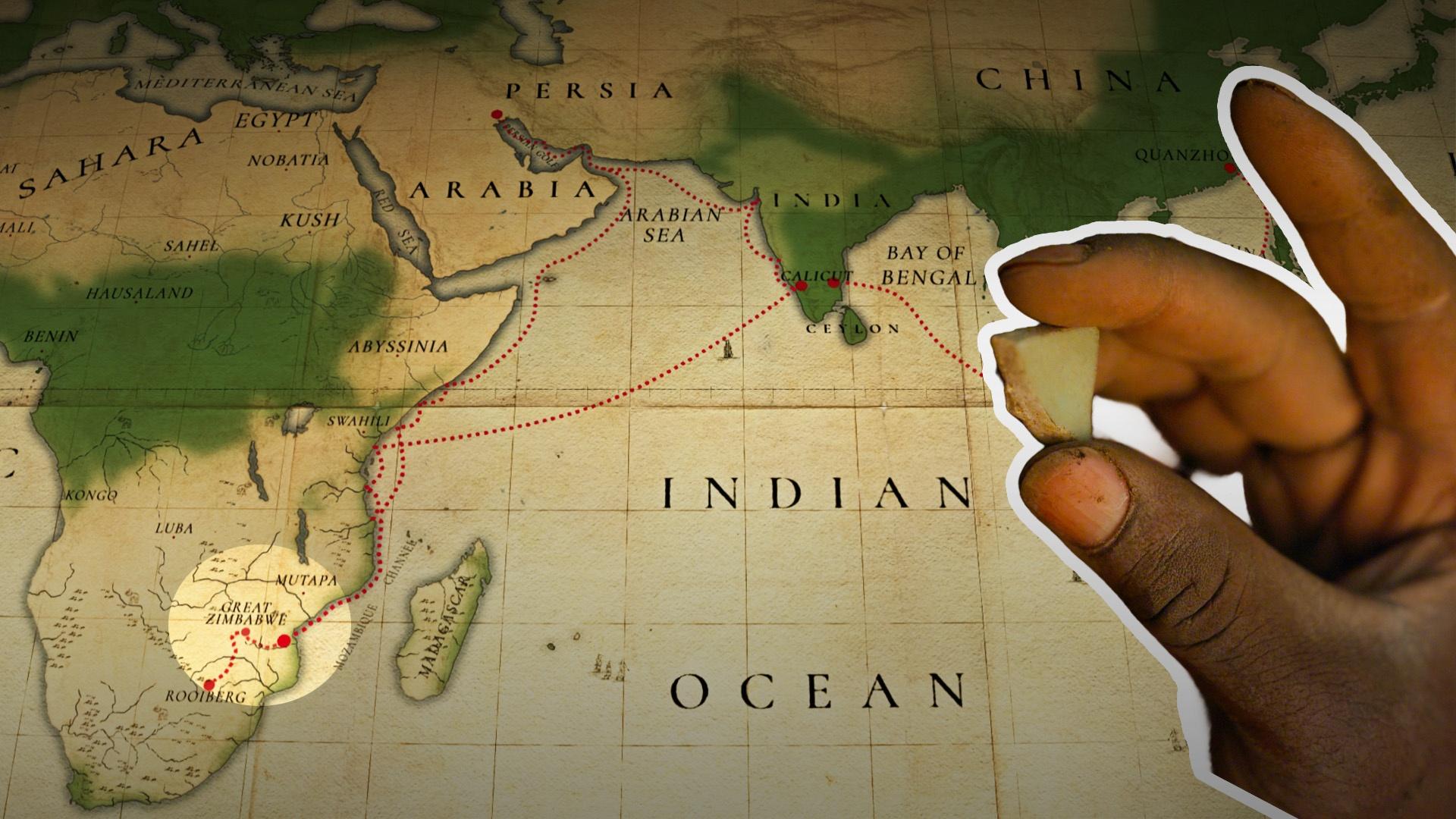
Three distances to Great Zimbabwe. India or Sri Lanka: at least 8,000 kilometers. Source of metal objects in today's Democratic Republic of Congo: around 2,000 kilometers. Source of copper and tin in modern-day South Africa: more than 500 kilometers.
| Figure | Value | Note | Claim |
|---|---|---|---|
| India or Sri Lanka to Great Zimbabwe, at least | 8,000 km | 10 | |
| Source of metal objects, around | 2,000 km | today's Democratic Republic of Congo | 6 |
| Source of copper and tin, more than | 500 km | modern-day South Africa | 15 |
What happened
- Live Science says the glossy sheen suggests an extremely high firing temperature, a feat only China had accomplished at that early date.
- Archaeologists had already found glass at Great Zimbabwe that came by boat from Southeast Asia, India and the Middle East.
- The site's people also sourced copper and tin from modern-day South Africa, more than 500 kilometers away.
Why it matters
- constraint The ware turns up across the site but in small quantities. The sherds prove it arrived and leave the volume unknown.
- contradiction Live Science's lead dates the contact to more than 1,000 years ago, yet the city flourished from the 11th to at least the 15th century. That leaves the sherds' own age unsettled.
- capability With no written record, chemical analysis of cattle bones still put a distance on exchange: it showed some animals moving across a 140-kilometer area.
Live Science's account rests on a clip from the PBS documentary "Secrets of the Dead: Africa's Golden City". In it, Shadreck Chirikure and doctoral student Muchen Zhou examine a jade-green sherd unearthed from the hillside [17]. On who used the ware, Chirikure was cautious: "Perhaps they were used by the elites." [8] Live Science does not say how many sherds were found, how they reached the site or how far they came from China.
The longest distance in the account belongs to the Indian Ocean. Chirikure told Live Science that the trip from India or Sri Lanka to Great Zimbabwe is "at least 8,000 kilometers" [10]. Merchants sailed that ocean on monsoon winds [16]. Against the metal objects from about 2,000 kilometers away in the Democratic Republic of Congo, the Indian Ocean leg is at least four times as far [19]. In our view the celadon most likely crossed the same water as the glass, but that is inference from the glass.
A sherd cannot supply a written record, and the people of Great Zimbabwe left none [11]. Live Science says the excavations are building the picture of a highly connected African kingdom [12]. That picture displaces an older claim. According to the documentary, colonists who looted the site in the late 19th century insisted Africans had not built it, credited the Phoenicians and used that claim to justify taking the artifacts to England [13].
Chirikure argues for comparing communities in places like Sri Lanka and southern Africa. He said: "it's the water that separated people, but it was also the water that connected people." [14]
What to watch
- A published excavation report giving sherd counts and the layers they came from, which would date the celadon.
- Chirikure's next project, on local resources such as soapstone that matter to the Shona people.
- Matching Longquan finds at sites between East Asia and southern Africa, which would put the celadon on the Indian Ocean route.
Clarity's read
What the record supports and how the coverage leans. The claims behind it follow.
Reality
- Evidence58
- Adoption
- Insufficient
- Hype gap+15
- Incentives
- Insufficient
- Confidence50
Claim ledger
Ranked by verification strength, evidence, and original report placement.
- [1]
Live Science reports that archaeologists digging in Great Zimbabwe have discovered pieces of jade-green Chinese pottery, which it says suggests the empire had long-distance connections with East Asia more than 1,000 years ago.
- [2]
The pottery style, called Longquan celadon, was made in eastern China starting around A.D. 950.
- [3]
University of Oxford archaeologist Shadreck Chirikure is leading the new excavations at Great Zimbabwe.
- [4]
The glossy sheen on the sherd suggests the pot was fired at an extremely high temperature, a technological achievement that had only been accomplished in China at that early date.
- [5]
Archaeologists have already discovered glass artifacts at Great Zimbabwe that came from Southeast Asia, India and the Middle East via boat.
- [6]
Chirikure said other evidence of long-distance trade at Great Zimbabwe includes metal objects from what is today the Democratic Republic of Congo, around 2,000 kilometers (1,250 miles) away.
- [7]
Chemical analysis of cattle bones has shown that some of the animals were being traded across an area of 140 kilometers (87 miles).
- [8]
Chirikure said of the Chinese ceramics: "Perhaps they were used by the elites."
- [9]
Chirikure said the Chinese pottery is found across the site of Great Zimbabwe but in small quantities, which he said means the ceramics are a rarity.
- [10]
Chirikure told Live Science that the distance from India or Sri Lanka to Great Zimbabwe is at least 8,000 kilometers (5,000 miles).
- [11]
Great Zimbabwe was the capital of an empire that arose in southeastern Africa around A.D. 1000, and its people did not leave a written history.
- [12]
Excavations are showing that Great Zimbabwe was a highly connected African kingdom that flourished from the 11th century until at least the 15th century.
- [13]
The site was first excavated in the late 19th century and looted by British colonists, who insisted Africans had not built Great Zimbabwe, claimed it arose from the Phoenicians, and used that claim to justify taking the artifacts to England.
- [14]
Chirikure said: "it's the water that separated people, but it was also the water that connected people."
- [15]
The people of Great Zimbabwe were also sourcing copper and tin from modern-day South Africa, more than 500 kilometers (300 miles) away.
- [16]
Merchants sailed the Indian Ocean using winds kicked up by monsoon cycles.
- [17]
In an exclusive clip from the PBS documentary "Secrets of the Dead: Africa's Golden City", Chirikure and Oxford doctoral student Muchen Zhou examine a jade-green piece of pottery unearthed from the hillside at Great Zimbabwe.
- [18]
For his next project, Chirikure hopes to investigate local resources, such as soapstone, that hold a lot of meaning for the local Shona people.
- [19]
The India or Sri Lanka leg of at least 8,000 km is at least four times the roughly 2,000 km to the Congo source of metal objects.
Get this ledger inside ChatGPT. Ask about any of our stories and the answer brings its figure, each claim’s verdict and the sources. Free, no account.
Sources
1 independent publisher whose own reporting we read for this story.
Topics and entities
Follow any of these and your For You feed starts watching them — no settings page required.
Topics
- African historyFollow
- Indian Ocean tradeFollow
- ArchaeologyFollow
Entities
- Great ZimbabweFollow
- Shadreck ChirikureFollow
- Longquan celadonFollow
- University of OxfordFollow
- Live ScienceFollow
- PBSFollow