ScienceIndependently confirmed2 publishers3 min readPublished
A decade from specimen to species name: what Slash's groundsnake says about New Guinea's backlog
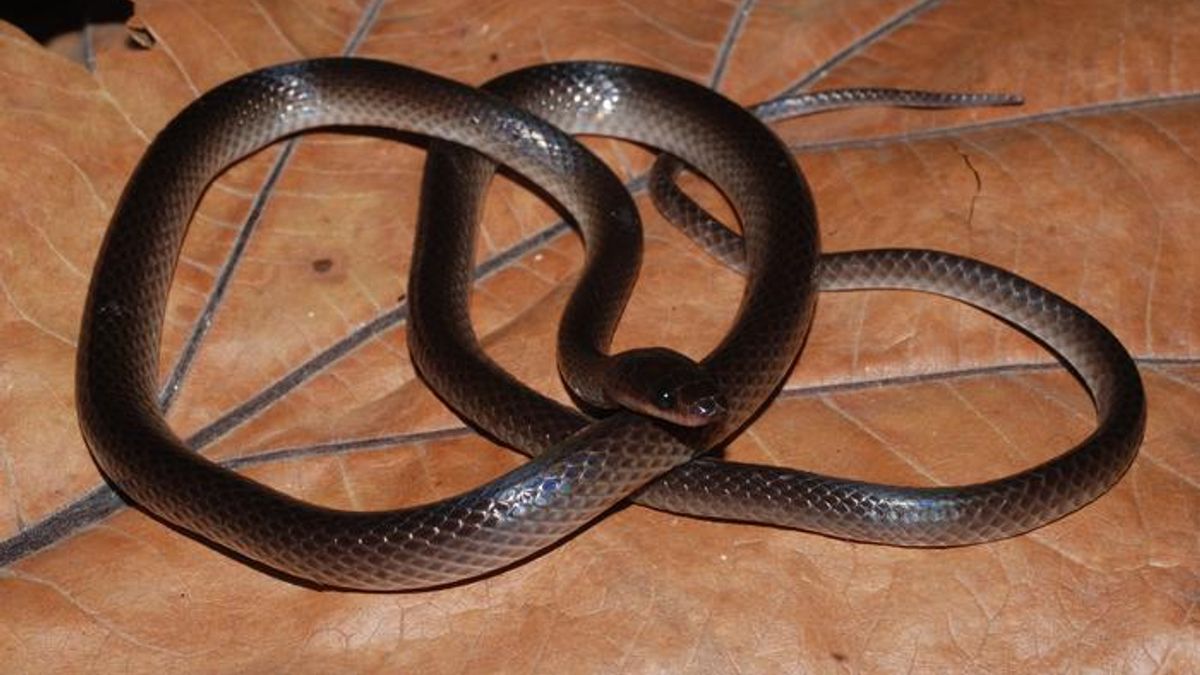
A reddish-brown snake from New Guinea now carries a Guns N' Roses guitarist's name. Proving it was a species took at least ten years of lab and field work, and that cost is the real finding.
The Scientist · Science desk
What happened
- Sara Ruane and colleagues described a new groundsnake, Lielaphis slashi, in Zootaxa, naming it for the Guns N' Roses guitarist Slash and his interest in reptiles.
- The animal is reddish-brown and about 28 inches (71 cm) long, from the forests of New Guinea.
- It is one of a group of mostly nocturnal snakes and produces no venom capable of seriously harming a person.
- Co-author Chris Austin of the LSU Museum of Natural Science first encountered an unfamiliar specimen during night fieldwork in New Guinea in 2006.
- Appearance alone did not settle its status; scale counts, multiple genetic analyses and ecological modeling of habitat were needed to separate it from relatives.
Why it matters
- cost The unit of account for this fauna is curator-years, not discoveries: one specimen absorbed at least a decade of two institutions' staff time before it had a name, and museum budgets carry that.
- decision Land-use choices in these forests are made against a species list known to be incomplete, so an absence of records cannot be read as an absence of animals worth assessing.
- exposure Anyone in these forests sorting harmless groundsnakes from deadly lookalikes by eye is relying on a signal the paper shows is unreliable even within the harmless genus.
- precedent A celebrity epithet is now the reliable route by which an obscure nocturnal snake gets read about at all, which means public attention will follow the naming, not the taxonomic need.
Every further name in this genus will cost roughly what this one cost. Genetic work needs tissue in usable condition, and niche modeling needs georeferenced records, and both come from the same place: someone crouched at the base of a large tree after sunset, in the window when these snakes are out looking for food [8]. Chris Austin, who curates herpetology at the Louisiana State University Museum of Natural Science, says the same forests at the same hour hold several highly venomous species that closely resemble the harmless groundsnakes [7][9]. Night collecting by people who can tell those apart in a headlamp beam is not an input you can scale up on demand.
The tempo shows in the dates. Austin met the animal in 2006 [7]. Ruane finished her doctorate and went to work with him at LSU in 2016, and the two have collaborated on New Guinea's poorly known snakes since [19]. At least ten years therefore separate the encounter from the paper that gave the snake a name [20]. Coffee farming and mining, which Ruane names as the pressures on this snake's habitat, do not run on that clock [16].
What the name buys is narrower than the press cycle suggests. Ruane's argument is that you have to know a species exists before you can say where it lives, what threatens it, or how to protect it [17]. The paper delivers the first item and very little of the rest. Ruane says knowledge of L. slashi remains limited because snakes are hard to observe before they leave [13]. Diet is an inference from dentition: snakes in the genus often have large teeth at the back of the mouth, which may serve to grip small slippery-scaled lizards and other reptiles' eggs, and this is not an animal that constricts [14]. Conservation planning here begins with a binomial, a scale count and a hypothesis about lizard eggs.
There is a quieter implication in the method. If appearance was not sufficient to separate this animal from its relatives [10], appearance was probably not sufficient when those relatives were separated from one another either. That is an argument for going back through museum drawers, not only back into the forest.
The celebrity epithet is the cheapest component and the only one that travels. Ruane, senior author and associate curator of herpetology at the Field Museum, says she settled on the name after rereading a Reptiles Magazine interview she first read at twelve, bought for a cover photo of Slash holding his pet reticulated python [12][18]. Slash, for his part, said he was honored and humbled and had never imagined the moment would arrive [3]. None of that changes the sequencing bill or the number of nights needed at the base of trees. It does mean one 71-centimeter snake will be findable by people who will never open Zootaxa [4], on an island whose dense tropical forests remain poorly studied [15].
What to watch
- Whether re-examining existing Lielaphis material in collections yields further undescribed species, and how many nights of new fieldwork each one requires.
Clarity's read
What the record supports and how the coverage leans. The claims behind it follow.
Reality
- Evidence72
- Adoption30
- Hype gap+18
- Incentives62
- Confidence60
Claim ledger
Ranked by verification strength, evidence, and original report placement.
- [1]
Sara Ruane and colleagues described a new species of reddish-brown groundsnake, Lielaphis slashi or Slash's groundsnake, in a paper published in Zootaxa.
- [2]
The species was named in honor of Slash (Saul Hudson), guitarist for Guns N' Roses, for his lifelong enthusiasm for reptiles, zoos, museums and natural history.
- [3]
Slash said: "As a longtime herpetophile, I am extremely honored and humbled to have Lielaphis slashi from New Guinea named after me. It is really exciting. I never would have imagined this moment would arrive."
ReportedSupportedSource: Slash, in a press release2 sources— create a free account to open themView cited source - [4]
The snake is reddish-brown and about 28 inches (71 centimeters) long, from the forests of New Guinea.
- [5]
Slash's groundsnake belongs to a group of elusive, mostly nocturnal snakes found primarily in New Guinea.
- [6]
The species is not considered dangerous to people and does not produce venom capable of causing serious harm.
- [7]
One night in 2006, Chris Austin, professor and curator of herpetology at the Louisiana State University Museum of Natural Science, encountered an unfamiliar snake during fieldwork in New Guinea; he is a co-author of the description.
- [8]
Austin says New Guinea groundsnakes are nocturnal and are typically found just after sunset at the base of large trees, where they are looking for something to eat.
- [9]
Austin says that when working at night in New Guinea one must be very careful, as several highly venomous species look very similar to the nonvenomous groundsnakes.
- [10]
Based on appearance alone it was not clear the snake was a new species; the team combined physical characters such as differences in scale counts with genetic evidence, and used ecological modeling to show that L. slashi's preferred habitat differs from that of similar snakes.
- [11]
Tianqi Huang, first author and a postdoctoral researcher at the Field Museum, says multiple genetic analyses found L. slashi genetically distinct from other similar snakes in the same genus.
- [12]
Sara Ruane is the Field Museum's associate curator of herpetology and senior author of the Zootaxa paper describing the species.
- [13]
Ruane says it is incredibly hard to observe snakes in the wild before they slither away, so knowledge about L. slashi is limited.
- [14]
Ruane says snakes in this genus often have large teeth at the back of the mouth, which New Guinea groundsnakes may use to grab and eat small slippery-scaled lizards and the eggs of other reptiles, and that this snake does not grasp and squeeze its prey like a boa constrictor.
- [15]
New Guinea is the second-largest island in the world after Greenland, divided between Indonesia and Papua New Guinea, and its dense tropical forests contain untold biodiversity but have not been well studied by scientists.
- [16]
Ruane says the habitats Slash's groundsnake comes from are under threat from industries including coffee farming and mining.
- [17]
Researchers must know a species exists before they can determine where it lives, assess the threats it faces, or develop plans to protect it; Ruane says "We can't conserve animals or other living things that we don't know about."
- [18]
Ruane says that at age 12 she received a copy of Reptiles Magazine with a cover photo of Slash holding his pet reticulated python, and that rereading his interview about museums, zoos and looking for snakes as a kid made her think he would be a good person to name a species after; she had told her teacher in fifth grade she wanted to be a herpetologist.
- [19]
In 2016, after finishing her doctorate, Ruane spent time working with Austin at Louisiana State University; the two teamed up to better study the poorly known snakes of New Guinea and have collaborated on the topic since.
- [20]
At least ten years elapsed between Austin's 2006 encounter with the snake and the published description, since Ruane only began working with him in 2016 and the description followed that collaboration.
Sources
2 independent publishers whose own reporting we read for this story.
- discovermagazine.comA Herpetologist’s Guns N’ Roses Fandom Inspired a New Snake Named After Slash
1 article · August 21, 2026
- phys.orgWelcome to the jungle: Newly discovered snake named after Slash from Guns N' Roses
1 article · August 20, 2026
Topics and entities
Follow any of these and your For You feed starts watching them — no settings page required.