Science1 publisher3 min readPublished
DNA and scale counts separate Slash's groundsnake from its New Guinea lookalikes
Chris Austin met the snake on a night survey in New Guinea in 2006 and could not place it. The Zootaxa description, about twenty years later, rests on genetic analyses, scale counts and a model of where each species lives.
The Scientist · Science desk
What happened
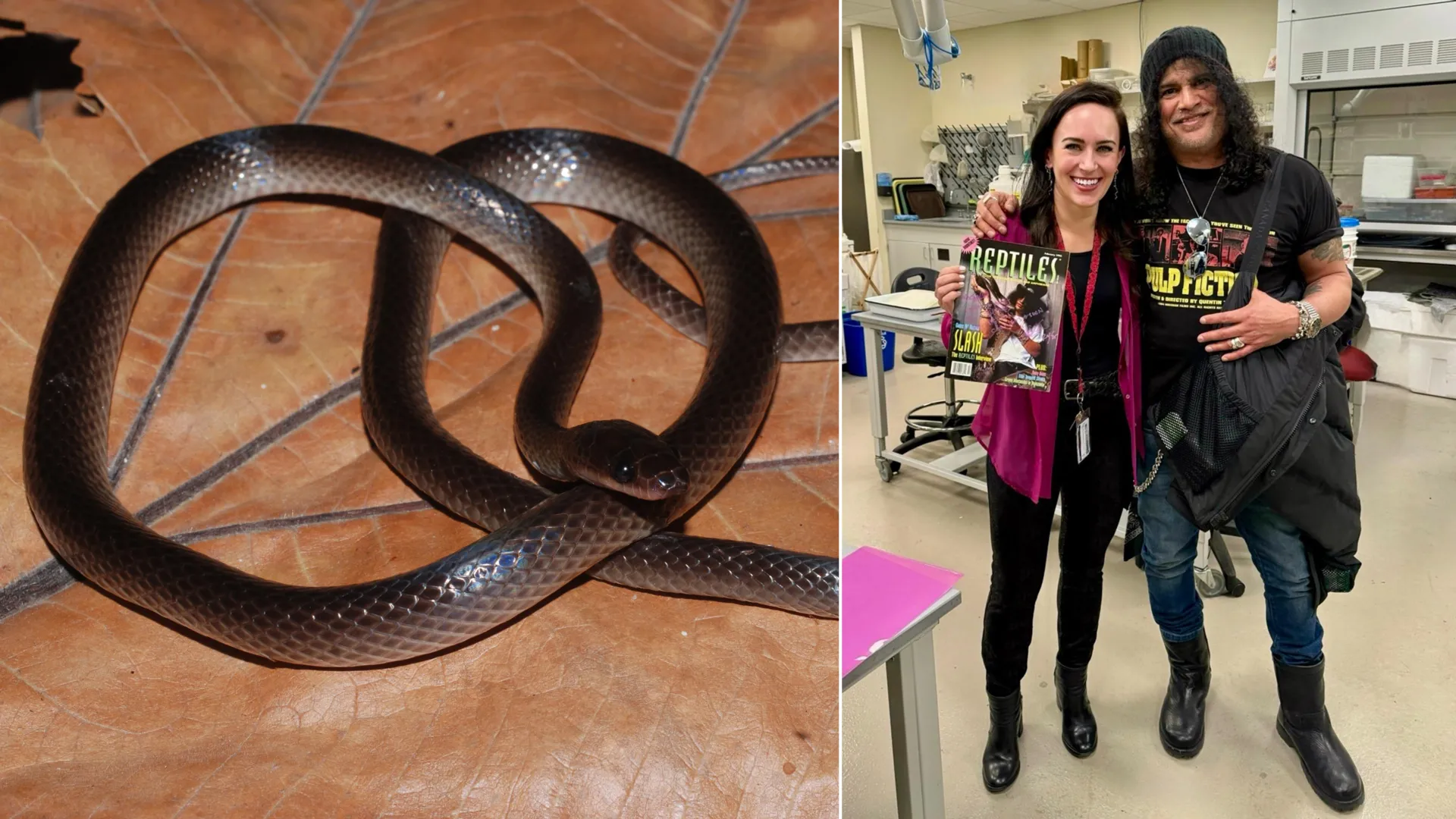
- The Field Museum said on September 18, 2026 that researchers have described a new snake species from New Guinea in Zootaxa and named it Lielaphis slashi, or Slash's groundsnake.
- Genetic analyses, differences in scale counts and ecological modelling of a different preferred habitat were combined to argue that the animal belongs to a species not previously recognized.
- The snake described is a nonvenomous reddish-brown groundsnake measuring 28 inches long, collected in New Guinea forest.
Compiled by The ScientistSomething wrong?How this is made
Why it matters
- constraint These groundsnakes cannot be sorted by eye: the specimen looked unremarkable when handled, so any tally of New Guinea's snake diversity is limited by sequencing capacity and comparative material.
- exposure If the diagnosis depends on scale counts and DNA, appearance cannot settle what a collector is holding at night in a forest that also contains highly venomous lookalikes.
- precedent Naming rights are discretionary, and Ruane used hers on a musician she read about as a child.
In hand, the snake looked ordinary. The Field Museum's account says that at first glance it did not obviously appear to represent a species new to science, and that the laboratory work turned up the differences [10]. "Using multiple cutting-edge genetic analyses, we found that L. slashi is genetically distinct from other similar snakes in the same genus," said Tianqi Huang, the study's first author and a post-doctoral researcher at the Field Museum [11].
Huang laid out the rest of the evidence: "The combination of physical characteristics, like differences in numbers of scales when compared with other species, and the genetic evidence is what led us to realize that it is an entirely new species. We also used ecological modeling to show that L. slashi's preferred habitat is different from similar snakes" [12]. Genetic distinctness from the rest of the genus rules out the simplest alternative explanation, that this is a variant of an already named Lielaphis. The habitat finding is a model fitted to where records of each species sit, so it reports an association between species and environment; it does not test what kept the lineages apart [12].
Austin, a professor and curator of herpetology at the Louisiana State University Museum of Natural Science, met the snake on a night survey in 2006 and could not identify it [7]. The description came about twenty years later [18]. In between, Sara Ruane, the Field Museum's Associate Curator of Herpetology and the paper's senior author, finished her doctorate and worked with Austin at LSU in 2016, and the two began a collaboration on New Guinea's poorly studied snakes that has continued since [2][13]. New Guinea is the world's second-largest island after Greenland, split between Indonesia and Papua New Guinea, and much of the diversity in its tropical forests is still poorly documented [14].
"When working at night in New Guinea you need to be very careful as there are several highly venomous species that look very similar to the non-venomous groundsnakes," Austin said [9].
The Field Museum's summary of the work does not report how many specimens were examined or which genetic markers were used [19]. The diet is an inference from tooth shape: the snake may use large rear teeth to catch slippery lizards and reptile eggs [6].
The name came off a magazine cover. "So when I was twelve years old and got my copy of Reptiles Magazine in the mail and it had a picture of Slash holding his pet reticulated python on the cover, I thought, 'This guy is so cool,'" Ruane said [15]. Years later, once she was in a position to assign official names, she went back to the interview and found a reader who talked about museums, zoos and hunting for snakes as a kid [16]. Slash, whose given name is Saul Hudson, said: "As a long time herpephile, I am extremely honored and humbled to have Lielaphis slashi from New Guinea named after me. It is really exciting, I never would have imagined this moment would arrive" [17][4].
What to watch
- Whether the Zootaxa paper's specimen list shows how many animals were sequenced and whether any came from older collection lots.
- Whether other Lielaphis records held in collections get reassigned once the diagnostic scale counts are applied to them.
- Whether any stomach content or feeding record ever tests the rear-teeth inference about lizards and reptile eggs.