Science1 publisher2 min readPublished
CT scan finds ordinary vertebrae inside the spider-tailed viper's fake spider
The Field Museum holotype was mistaken for a tumour when it arrived in 1968. Sent through an X-ray CT scanner rather than cut open, the bones at the tail tip turned out to be about as normal as any viper's.
The Scientist · Science desk
What happened
- Researchers put the Field Museum's holotype of the spider-tailed horned viper through an X-ray CT scanner and report in The Anatomical Record that the bones of the spidery tail tip are unremarkable.
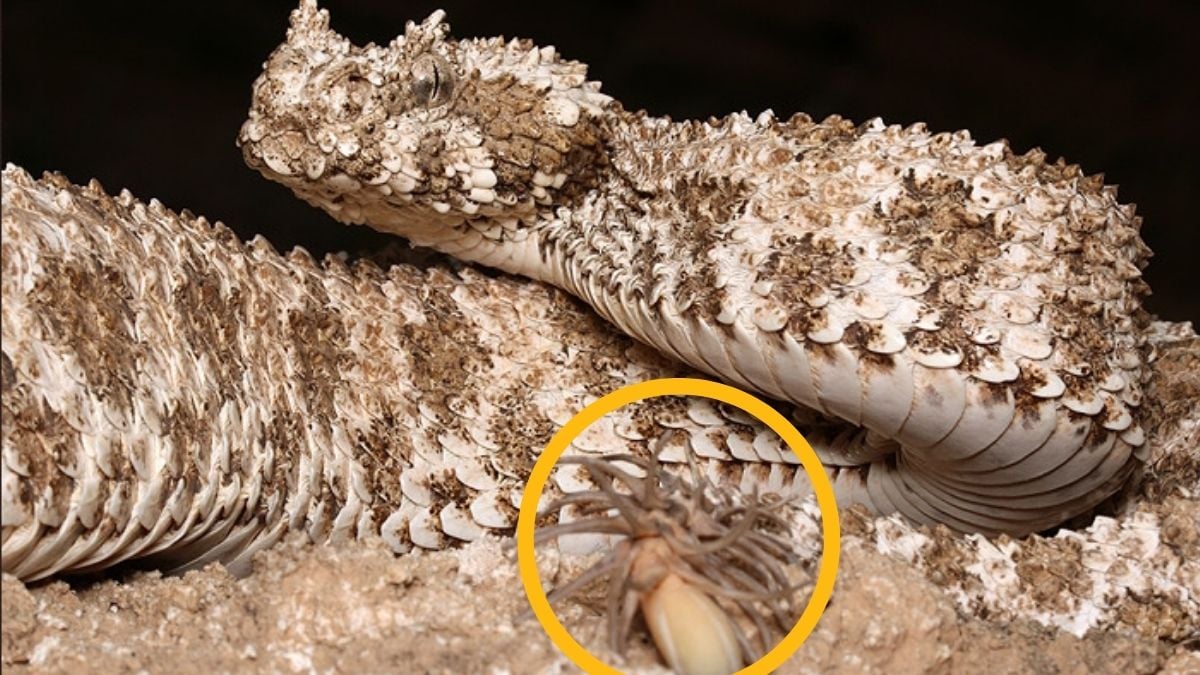
- The tail tip carries a bulbous body and long dangling legs, and a bird that swoops in to eat the fake spider is taken by the snake instead.
- XCT stacks thousands of X-ray images into a 3D rendering of an interior, which let the team look inside the tail without cutting a scientifically irreplaceable specimen open.
Compiled by The ScientistSomething wrong?How this is made
Why it matters
- constraint If the tail-tip vertebrae look like any other viper's, the most distinctive tail in the family leaves nothing for a fossil hunter to recognise, and the lure stays invisible in the bone record.
- capability Specimens that curators will never allow anyone to dissect can now yield internal anatomy, which puts a museum's untouchable type material back into comparative work.
- constraint With one animal described, there is no basis yet for saying how much the lure or its skeleton varies between individuals, sexes, or ages.
Viper vertebrae vary so much that a single bone rarely identifies a species, which is part of why a paleontologist went looking at a snake famous for its skin. Georgios Georgalis of the Polish Academy of Sciences in Krakow, the study's first author, works from living animals toward fossils, and he says the viper vertebral column gives few clues about which snake you are holding: fossils usually arrive as single bones, and vertebrae differ so much along one animal's body that matching them to a species is hard [3][4]. Viper vertebrae have not been widely studied in any case [12]. A tail ending in a spider looked like the place where bone might finally say something.
The scan did not deliver that. Phys.org's account of the work describes the tail bones as bizarrely normal [2]. Set that against the exterior, a bulbous body with long dangling legs, and the shape has to be carried by something other than the skeleton: the scales and the soft tissue beneath them [16]. The inference rests on the absence of skeletal novelty, not on a measurement of the scales. The account does not say which tissues do the work, or how the tail is held and waved while a bird is deciding.
The reason this needed a scanner rather than a scalpel is that the specimen is the holotype, the physical standard-bearer for the species [8], and no curator opens one to satisfy curiosity. Ruane, the Field Museum's associate curator of herpetology [5], says the timing was lucky: the museum was getting a new XCT lab when Georgalis raised the idea at a 2023 conference [10][13].
The specimen's own history is an argument for scanning old material. It was described as Pseudocerastes urarachnoides in 2006, 38 years after it reached Chicago [7][14], and until this study the tail was known only from the outside [18]. Before 2003, when a second snake with the same sort of tail surfaced, the first one was read as a deformity, something like a tumour [6]. Ruane says she first saw field video of the luring behaviour around 2008, as a Ph.D. student [11].
The scan does not show whether normal means normal to the eye or normal against measurements of other viper tails, and with a single animal on the stage there is no denominator for variation between individuals, sexes, or growth stages [17]. For anyone reading bones, the finding is that the most theatrical tail in the family leaves its signature where paleontologists cannot usually look [16][4].
What to watch
- Whether the paper in The Anatomical Record compares the tail vertebrae quantitatively with other Pseudocerastes species or only describes the holotype.
- Whether additional spider-tailed viper specimens get scanned, which would show how much the lure and its bones vary between individuals.
- Whether imaging that resolves soft tissue traces the lure's shape to scales, muscle, or connective tissue.