ScienceNot yet confirmed elsewhere1 publisher2 min readPublished
Venomous snakes stand out against their habitats more than nonvenomous ones across more than 450 species
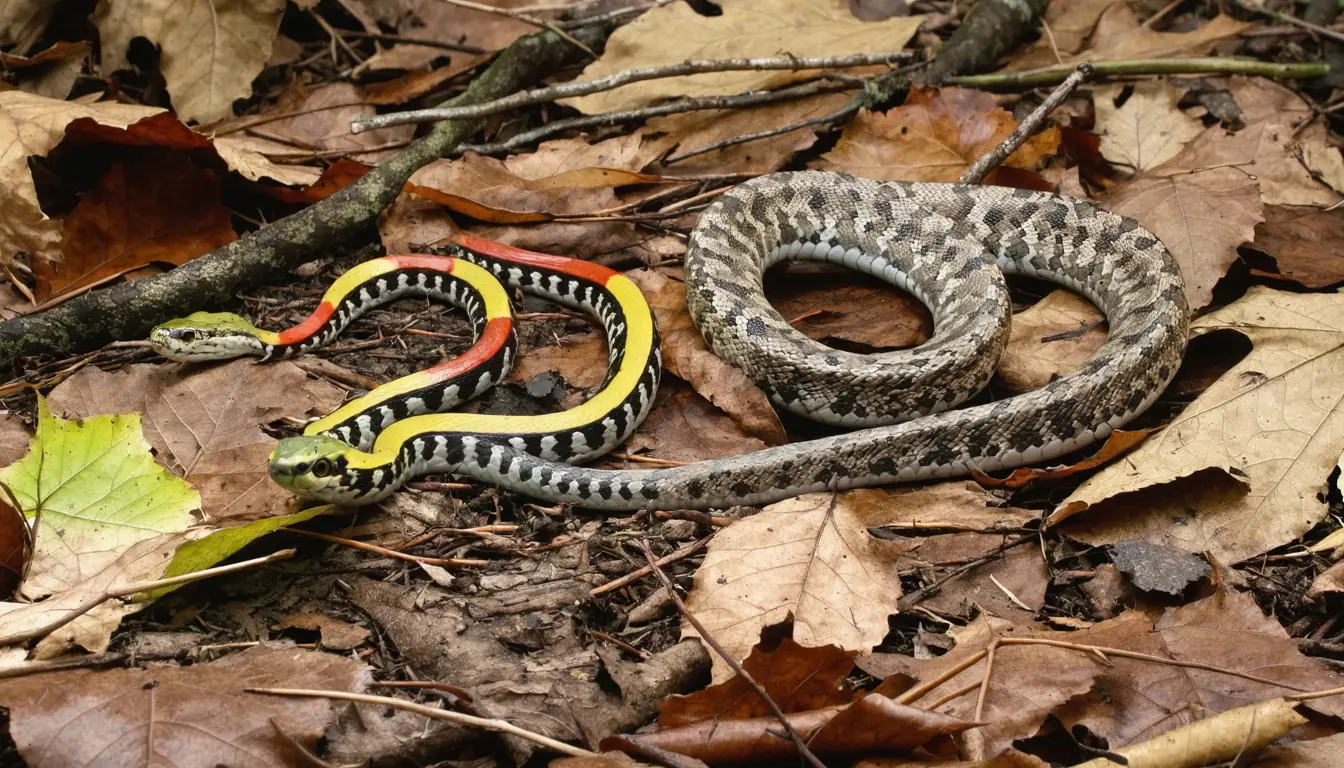
University of Galway researchers comparing more than 450 snake species found venomous ones more likely to stand out against their habitats. That supports warning colouration across snakes, beyond textbook coral snakes, as a tendency with many drab venomous exceptions.
The Scientist · Science desk
What happened
- The team judged each snake against its real surroundings, using thousands of photographs of wild snakes from the citizen-science platform iNaturalist.
- Red and yellow, the colours examined most closely, proved particularly effective at making snakes stand out against their natural backgrounds.
- Many venomous snakes are not brightly coloured, the study found, though a large number have evolved distinctive colours and patterns.
- Earlier work on warning colouration had mostly covered single species or small groups, so whether the link held across snakes generally was unclear.
Compiled by The ScientistSomething wrong?How this is made
Why it matters
- precedent Snake warning colouration now has a cross-species baseline that predator experiments and studies of single lineages can be checked against.
- constraint Because the evidence links appearance and venom without observing predators, it cannot by itself establish that conspicuous snakes are attacked less often.
- capability Field photo archives make colour-in-context comparisons possible across hundreds of species, at a scale Healy said "would otherwise be impossible for individual research teams to achieve."
"Standing out" is a relative measurement, and the Galway design treats it as one. A pattern that is loud on one background can disappear on another, so each species was compared against the natural environments it lives in [2]. Kevin Healy, head of the university's Macroecology Lab, explained why the team went to field images [13]. "Museum collections allow us to measure color accurately, but photographs taken in the wild are essential for understanding how those colors appear in the environments where they evolved," he said [9].
Coral snakes, along with wasps and poison dart frogs, are the textbook examples of warning colour [12]. A sample of more than 450 species from around the world tests whether the textbook examples are typical of snakes as a group [2].
The first number I want from a comparison like this is the effect size. According to the university, venomous species were "significantly more likely" than nonvenomous ones to stand out [1]. The release does not say how much more likely, or how the analysis handled related species that may have inherited both venom and colouring from a shared ancestor. Those details decide how far the paper's title can be pushed. It reports habitat-dependent warning colouration "found throughout snakes" [10]. Given the drab venomous species the release itself acknowledges [5], I think the title holds as a statement about the group's overall tendency. It should not be read as a rule for any one snake.
The photographs measure how a snake looks against its surroundings. Whether predators treat that look as a warning is a separate experiment, and the release's own wording is cautious: the two traits "may have evolved together in some snake species" [11]. Amy Duclaux, a lead researcher on the project, chose the verb "supporting" [13][7]. "Our findings show that venomous snakes stand out from their natural background more than nonvenomous species, supporting the idea that warning coloration has evolved to signal danger to potential predators," she said [7].
Red and yellow got special attention because they are colours commonly associated with warning signals in animals [4]. Their strong showing is a finding about contrast with snake habitats. How predators respond to those colours is the next measurement to make.
What to watch
- Whether the full paper reports an effect size and corrects for shared ancestry among related snake species.
- Predator experiments testing whether conspicuous venomous species are actually attacked less often than drab ones.
- Which venomous lineages stay drab, and whether their habitats or habits explain the exception.
Clarity's read
What the record supports and how the coverage leans. The claims behind it follow.
Reality
- Evidence45
- Adoption
- Insufficient
- Hype gap+10
- Incentives
- Insufficient
- Confidence50
Claim ledger
Ranked by verification strength, evidence, and original report placement.
- [1]
Researchers at the University of Galway found that venomous snakes are significantly more likely than nonvenomous species to have colors that stand out against their natural surroundings.
- [2]
In a study published in the Journal of Animal Ecology, the researchers examined more than 450 snake species from around the world, comparing how their coloration appears against the natural environments in which they live.
- [3]
The team compared snakes in their natural habitats by sourcing thousands of photographs through the citizen science platform iNaturalist.
- [4]
The researchers looked in particular at red and yellow coloration, two colors commonly associated with warning signals in the animal world.
- [5]
The study confirmed that while many venomous snakes are not brightly colored, a large number have evolved distinctive colors and patterns.
- [6]
Warning coloration has been studied in individual species and small groups of animals, and it had remained unclear whether conspicuous coloration is generally associated with venom across a large number of snake species.
- [7]
"Our findings show that venomous snakes stand out from their natural background more than nonvenomous species, supporting the idea that warning coloration has evolved to signal danger to potential predators."
- [8]
"We also found that red and yellow coloration is particularly effective at helping snakes stand out against their natural background, suggesting these colors play an important role in visual signaling."
- [9]
"Museum collections allow us to measure color accurately, but photographs taken in the wild are essential for understanding how those colors appear in the environments where they evolved."
- [10]
The paper is titled "Contextually conspicuous species are more likely to be venomous: Habitat-dependent aposematic colouration found throughout snakes" (Duclaux et al, Journal of Animal Ecology, 2026).
- [11]
The findings suggest that venom and warning coloration may have evolved together in some snake species, and that being highly visible may have served as a survival strategy by warning potential predators.
- [12]
Wasps, poison dart frogs and coral snakes are among the best-known examples of species whose bold colors warn potential predators that they are dangerous.
- [13]
Amy Duclaux, of the University of Galway's School of Natural Sciences, is a lead researcher on the project; Kevin Healy is head of the Macroecology Lab at the university's School of Natural Sciences.
- [14]
"Citizen science initiatives such as iNaturalist are transforming ecological research by providing images of animals in their natural habitats at a scale that would otherwise be impossible for individual research teams to achieve."
Sources
1 independent publisher whose own reporting we read for this story.
- phys.orgDressed for danger: Venomous snakes are more likely to stand out
1 article · October 5, 2026
Topics and entities
Follow any of these and your For You feed starts watching them — no settings page required.
Topics
- Citizen ScienceFollow
- Aposematism (warning coloration)Follow
- Snake evolutionFollow