Science3 publishersAlso reported elsewhere2 min readPublished
Botanists name a Colombian giant waterlily first flagged in a swimmer's online photos
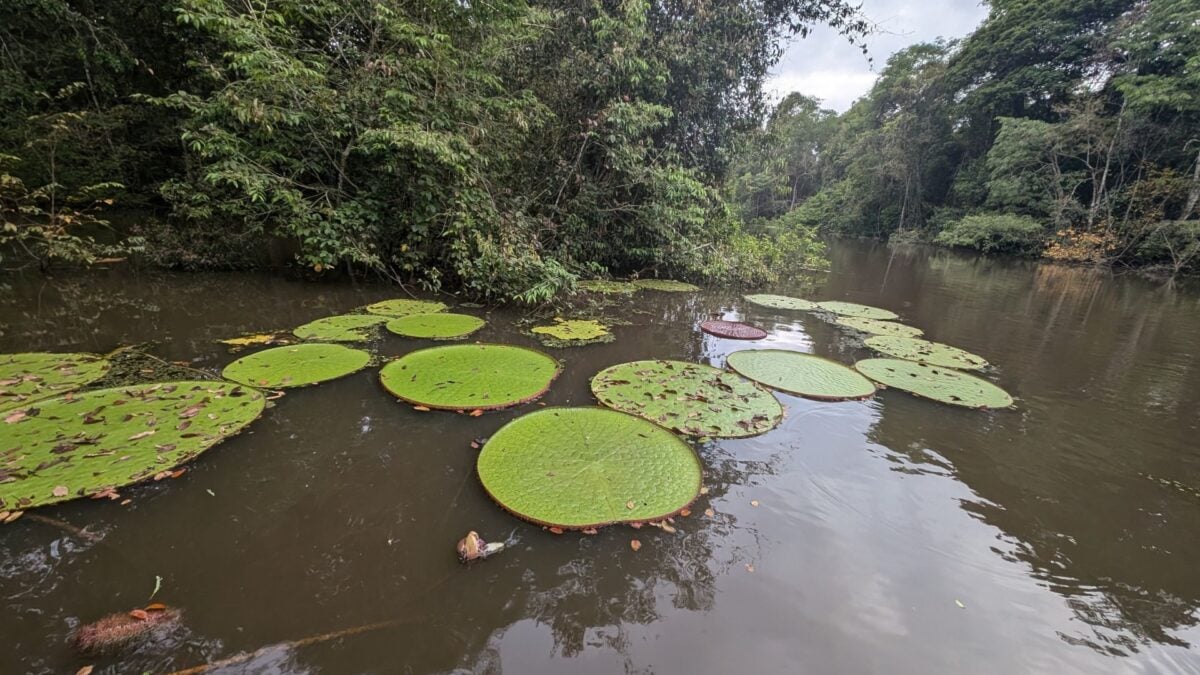
Carlos Magdalena, Maarten Christenhusz and colleagues have named Victoria colombiana, one of three new giant waterlily species found in a few years. As far as the team knows it grows in one small area, where, Christenhusz says, a single pollution spill could wipe out the whole species.
The Scientist · Science desk
What happened
- In 2021 Jeremiah Harris, who runs a carnivorous plant business in the US, posted photos from Colombia's Inirida river of plants he took to be Victoria amazonica.
- Magdalena, Christenhusz and their team found telltale green dots in satellite photos confirming giant waterlilies on the river, then organised an expedition.
- The first two plants the expedition found were not flowering, and flowers must be analysed to establish whether a waterlily is a new species.
- On the final night, Tucano guide Gustavo Melo led the team by boat to a small lake, where they found five plants, some of them flowering, just before sunrise.
- The new species differs from V. amazonica in the orientation of the spines beneath its leaves and in the shape of its flowers and fruits.
Compiled by The ScientistSomething wrong?How this is made
Why it matters
- constraint Photo and satellite searches can flag candidate populations, but each one still needs a field trip that catches the plants in flower before it can be named.
- precedent Both the Colombian and Pantanal species come from populations isolated for a long time, so other cut-off waterlily populations are the obvious next candidates for genetic comparison.
- constraint Until the Victoria mattogrossensis paper appears, other botanists cannot examine the genetic case behind the count of five.
Maarten Christenhusz of the Botanical Society of Britain and Ireland helped describe two of the new species [2]. "I think it's incredible that we find something so new, which is so large, in this world where we think everything is already known," he said [2]. Their leaves grow up to 3 metres wide [3].
I think the record supports a narrower claim: these plants were overlooked because they were misidentified. For many decades only two species were recognised, Victoria amazonica and Victoria cruziana [4]. Jeremiah Harris took the Colombian plants for the first [7]. Plants in the Pantanal, hundreds of kilometres to the south-east, look very similar to the second, and it took genetic studies to show they are a distinct species [17].
Each of the three new species came to light by a different route [1][22]. V. boliviana began in cultivation. In 2016 Carlos Magdalena at the Royal Botanic Gardens, Kew noticed that plants grown from Bolivian seed were a bit different, with even larger leaves [5]. The paper naming it appeared in 2022, six years later [6][19]. For the Pantanal species, the starting point was Magdalena's realisation that the population must have been isolated for a very long time, and genetic studies then bore that out [17]. Only V. colombiana began with social media and satellite photos [22], and one case cannot show how often that route works.
In that case the images did two jobs. Scientists had thought no giant waterlilies grew in the Inirida region at all [8], so Harris's posted photos gave the team a reason to look. Satellite pictures then confirmed the plants were there before anyone travelled [10]. Neither could supply a flower. A guide's tip at 11pm on the last night, about ten hours before the plane was due to leave, produced the flowering plants [12][21].
"This river is geographically completely separated from the Amazon, and has been for millions of years, and that is why this is such an interesting find," Christenhusz said [9]. He also said the spines beneath the leaves are a defence against manatees and plant-eating fish, and that they vary between species depending on which herbivores are most common [15].
What to watch
- Publication of the Victoria mattogrossensis paper, and whether its genetic data support the split from V. cruziana.
- Whether the team manages to collect V. colombiana seed, and whether surveys find the species outside its one known small area.
Clarity's read
What the record supports and how the coverage leans. The claims behind it follow.
Reality
- Evidence55
- Adoption
- Insufficient
- Hype gap+10
- Incentives
- Insufficient
- Confidence60
Claim ledger
Ranked by verification strength, evidence, and original report placement.
- [1]
In the past few years no fewer than three new species of giant waterlily have been discovered, taking the total to five.
- [2]
"I think it's incredible that we find something so new, which is so large, in this world where we think everything is already known," said Maarten Christenhusz of the Botanical Society of Britain and Ireland, who has helped describe two of the new species.
- [4]
For many decades just two giant waterlily species were known: Victoria amazonica and Victoria cruziana.
- [5]
In 2016 Carlos Magdalena at the Royal Botanic Gardens in Kew noticed that giant waterlilies grown from Bolivian seeds were a bit different, with even larger leaves.
- [6]
In 2022 Magdalena and colleagues published a paper showing the Bolivian plants were a new species, Victoria boliviana.
- [7]
In 2021 Jeremiah Harris, who runs a carnivorous plant business in the US, posted pictures online that he took while swimming near the Inirida river in Colombia next to what he assumed was V. amazonica.
- [8]
Scientists had thought there were no giant waterlilies in the Inirida region.
- [9]
"This river is geographically completely separated from the Amazon, and has been for millions of years, and that is why this is such an interesting find," said Christenhusz.
- [10]
Magdalena, Christenhusz and their team examined satellite photos and found telltale green dots confirming giant waterlilies were growing on the Inirida, then organised an expedition.
- [11]
The expedition found two plants, neither flowering; analysing the flowers is a crucial step in establishing whether a waterlily is a new species.
- [12]
At 11pm on the last night of the expedition, with the plane due to leave at 9am, guide Gustavo Melo from the Indigenous Tucano community said he knew where more giant waterlilies were growing.
- [13]
The team set off by boat in the dark and found five plants in a small lake just before sunrise, including some that were flowering.
- [14]
The team published a paper naming the species Victoria colombiana; it differs from V. amazonica in the orientation of the spines beneath the leaves and in the shape of its flowers and fruits.
- [15]
According to Christenhusz, the spines are a defence against manatees and plant-eating fish, so they vary between species depending on which herbivores are most prevalent.
- [16]
As far as the team is aware, V. colombiana is found in only one small area, and Christenhusz says a single event such as a pollution spill could wipe out the entire species.
- [17]
Magdalena realised giant waterlilies in the Pantanal, hundreds of kilometres to the south-east of Colombia, must have been isolated for a very long time; genetic studies revealed they are a distinct species despite looking very similar to V. cruziana.
- [18]
Magdalena, Christenhusz and colleagues will publish a paper soon describing the fifth species, to be named Victoria mattogrossensis.
- [19]
Six years passed between Magdalena noticing the Bolivian plants and the paper naming V. boliviana.
- [20]
Four of the five giant waterlily species have published descriptions; the fifth, V. mattogrossensis, awaits its paper.
- [21]
Melo's tip came about ten hours before the plane was due to leave.
- [22]
The three new species reached science by different routes: cultivated seed (V. boliviana), online photos plus satellite images (V. colombiana), and an isolation inference tested genetically (V. mattogrossensis); only one of three began with social media and satellites.
Sources
3 independent publishers whose own reporting we read for this story.
- gizmodo.comSomeone Posted an Instagram Selfie. Scientists Spotted a Giant New Species in the Background
1 article · October 8, 2026
- newscientist.comNumber of known species of giant waterlilies almost doubles
1 article · October 8, 2026
- phys.orgChance Instagram sighting leads to discovery of rare giant water lily in Colombia
1 article · October 8, 2026
Topics and entities
Follow any of these and your For You feed starts watching them — no settings page required.
Topics
- Biodiversity and species conservationFollow
- Species discovery and descriptionFollow
- Plant taxonomyFollow