ScienceNot yet confirmed elsewhere1 publisher3 min readPublished
Sightings-based model projects suitable gemsbok habitat reaching Montana by 2100
University of Illinois researchers project suitable habitat for New Mexico's introduced gemsbok could reach southern Washington and Montana by 2100. The model maps where the antelope could live, so the risk to cattle forage depends on whether herds can get there.
The Scientist · Science desk
What happened
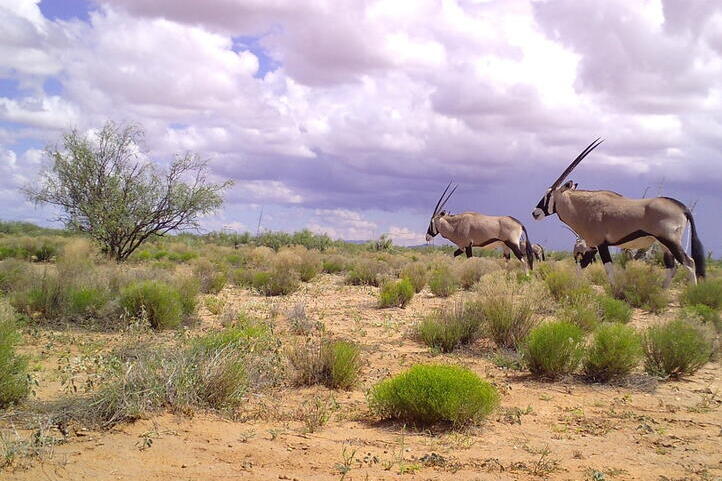
- Gemsbok were released in New Mexico as a hunting species in the 1960s and 1970s and have since spread more than 100 kilometers from where they were introduced.
- For each sighting, the model weighed temperature seasonality, precipitation, vegetation cover, terrain ruggedness and human population density, then searched for matching conditions elsewhere and in future climates.
- Under future climate scenarios, many patches of suitable habitat that are isolated today are projected to merge into larger, more contiguous areas.
- Co-author Bob Schooley said the coyotes and mountain lions of the Southwest kill far fewer gemsbok than the lions and hyenas the species left behind in Africa.
Compiled by The ScientistSomething wrong?How this is made
Why it matters
- exposure Andreoni named western Texas, western New Mexico, Arizona and parts of California such as Death Valley as the places where merging patches would most open routes for gemsbok, so those areas face the nearest exposure.
- cost Any herd growth would draw on the same forage as cattle, pronghorn and bison, so ranchers and managers of native grazers would share the cost, with drought years the hardest by Alexander's account.
- decision If containment is the goal, the projection points managers to the gaps between today's habitat patches, where dispersal barriers may still hold before warming joins the patches.
The map starts from photographs taken by the public. "We turned toward participant science to do this work. When people contribute photos to apps like iNaturalist, the occurrence records get scraped into something called the Global Biodiversity Information Facility," said Nathan Alexander, the study's lead author [4], who began the work as a doctoral student at Illinois and is now a postdoctoral scholar at Southern Illinois University [16]. "From that, we were able to use a statistical method called Maxent to find habitat associations for gemsbok." [4]
Public sightings have one weakness I would want addressed before trusting the far edge of the map, in Washington and Montana [2]. Every record pairs a gemsbok with a person who saw it, and human population density was one of the variables the model weighed [5]. I'd expect part of what the model learned to describe where people look, alongside where gemsbok live. The phys.org account does not say how the team handled that bias, or which climate scenarios produced the 2100 projection.
The nearer result deserves more weight. Pockets of suitable habitat that now sit apart are projected to merge into larger blocks [6], and that changes what stands between the animals and new ground. "When there are these isolated patches, there might be dispersal barriers that they can't cross to get to the next patch. But when these patches coalesce and connect, there might be increased opportunities for gemsbok to invade and expand into these novel habitats," said Kieran Andreoni [7], who began the research as a master's student and is now conservation director at the Southern Plains Land Trust in Colorado [15].
The animal's physiology makes the projection plausible. Gemsbok are native to the Kalahari Desert [14]. "Gemsbok are famous for being really well adapted to heat and drought. In addition to other heat adaptations, they can get all of their water from plants, so they don't really need to drink," said co-author Bob Schooley [8], professor and head of the Department of Natural Resources and Environmental Sciences at Illinois [17]. Schooley said that is unusual for an animal that can weigh 450 pounds [9].
Diet overlap is the researchers' main worry [11]. "Along with that diet overlap, gemsbok are able to forage on lower-quality plant materials than some of our native species," Alexander said. In drought years, he added, "we could imagine our native species might be a little bit more stressed and nutrient-deficient" [12].
The thing this doesn't tell you is how many gemsbok will arrive, or when. The team mapped where the animals could survive given the habitat they use today [3]. Suitable habitat is a condition for spread, and the account frames the damage the same way: should gemsbok "disperse and proliferate in all of these areas," the impacts on cattle, native wildlife and plant communities "could be significant" [13].
I think the evidence supports watching gemsbok closely on the ground next to their current range, where the physiology and the projected connections point the same way. Calling them an established threat across the West would take herd counts and spread rates measured over years.
What to watch
- New gemsbok sightings logged in western Texas, Arizona or Death Valley, the areas the model expects to connect first.
- The paper's handling of sampling bias in app-based records and its choice of climate scenarios, either of which could move the 2100 edge of the map.
- Herd counts or spread-rate estimates from New Mexico that would put a size and a pace on the risk the map describes.
Clarity's read
What the record supports and how the coverage leans. The claims behind it follow.
Reality
- Evidence55
- Adoption
- Insufficient
- Hype gap+20
- Incentives
- Insufficient
- Confidence50
Claim ledger
Ranked by verification strength, evidence, and original report placement.
- [1]
Gemsbok were brought to New Mexico as a game species for hunting in the 1960s and 1970s and have expanded more than 100 kilometers (62 miles) from their introduction point.
- [2]
In a study published in the Journal of Mammalogy, University of Illinois Urbana-Champaign researchers project that by 2100 suitable gemsbok habitat will spill beyond New Mexico into Texas, Arizona, Utah, California and as far north as southern Washington and Montana.
- [3]
The team mapped where gemsbok could survive under future climate scenarios based on their current habitat preferences.
- [4]
"We turned toward participant science to do this work. When people contribute photos to apps like iNaturalist, the occurrence records get scraped into something called the Global Biodiversity Information Facility. From that, we were able to use a statistical method called Maxent to find habitat associations for gemsbok."
- [5]
For every gemsbok occurrence, the researchers looked at temperature seasonality and precipitation, vegetation cover, terrain ruggedness and human population density, then looked for similar habitat patterns across space and time to predict where gemsbok might go.
- [6]
Many suitable habitats that now exist as isolated pockets will likely coalesce into larger, more contiguous habitats under future climate scenarios.
- [7]
"When there are these isolated patches, there might be dispersal barriers that they can't cross to get to the next patch. But when these patches coalesce and connect, there might be increased opportunities for gemsbok to invade and expand into these novel habitats. We see this particularly in western Texas, but also into western New Mexico and up into Arizona, and even some regions of California, like Death Valley."
- [8]
"Gemsbok are famous for being really well adapted to heat and drought. In addition to other heat adaptations, they can get all of their water from plants, so they don't really need to drink."
- [9]
Getting all their water from plants is unusual for animals as big as gemsbok, which can weigh 450 pounds (204 kilograms).
- [10]
Gemsbok left their natural predators, lions and hyenas, in Africa, and southwestern predators such as coyotes and mountain lions do not kill nearly as many gemsbok.
- [11]
The primary concern is diet overlap: larger gemsbok herds eating the same forage as cattle and native species like pronghorn and bison could diminish food reserves for those species.
- [12]
"Along with that diet overlap, gemsbok are able to forage on lower-quality plant materials than some of our native species. So in drought years, we could imagine our native species might be a little bit more stressed and nutrient-deficient"
- [13]
Should gemsbok disperse and proliferate in all of these areas, the impacts on cattle, native wildlife and plant communities could be significant.
- [15]
Kieran Andreoni began the research as a master's student in the Department of Natural Resources and Environmental Sciences and is now conservation director at the Southern Plains Land Trust in Colorado.
- [16]
Nathan Alexander, the lead author, began the research as a doctoral student at the University of Illinois and is now a postdoctoral scholar at Southern Illinois University.
- [17]
Bob Schooley is professor and head of the Department of Natural Resources and Environmental Sciences at the University of Illinois.
Sources
1 independent publisher whose own reporting we read for this story.
- phys.orgAfrican antelopes spreading in New Mexico: How far could they go under climate change?
1 article · October 9, 2026
Topics and entities
Follow any of these and your For You feed starts watching them — no settings page required.