ScienceNot yet confirmed elsewhere1 publisher2 min readPublished
Model of calm wave windows predicts mangrove presence at over 75% of 400 sites
An international team matched 20 years of wave data from about 400 coasts to mangrove presence, calling it correctly at over 75% of sites. Its authors say the result could sharpen where and when restoration crews plant.
The Scientist · Science desk
Three figures. The model called more than about 300 of about 400 sites correctly. A random or constant guess would be right about 50% of the time, as half the sites have mangroves. The team analyzed 20 years' worth of wave data.
| Figure | Value | Note | Claim |
|---|---|---|---|
| Sites the model called correctly, more than about | 300 sites | 16 | |
| Random guess, right about | 50 % of the time | 15 | |
| Wave data analyzed | 20 years | 1 |
What happened
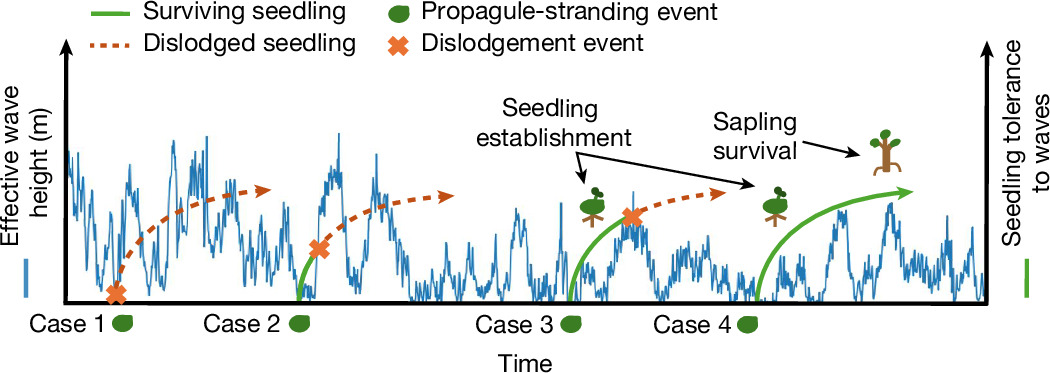
- The model joins a wave-exposure model built from the global data with the 'windows of opportunity' concept Thorsten Balke developed through experiments.
- Earlier research had shown that young mangroves tolerate stronger waves and sediment transport as they age, with the steepest gain in the first three months.
- Will Glamore of UNSW's Water Research Laboratory explained that restoration projects often fail because their accompanying studies generally take only average values into account.
- The paper appears in Nature, with Sarah Wells, a UNSW doctoral candidate, as lead author.
Why it matters
- decision Site studies that report only mean wave conditions would miss the quantity that, in this analysis, separated coasts with mangroves from coasts without.
- constraint Protection and establishment pull against each other: the places where mangroves would shield the coast best may be among the hardest places for seedlings to take root.
- exposure Wave direction could change in many subtropical and tropical regions, so a site judged suitable today could lose its establishment window at the same wave height, and an unsuitable one could gain it.
Half the sites held mangroves [2], so a model that simply guessed would be right about half the time on this sample [15]. Over 75% correct [3] on about 400 sites [1] means more than 300 right calls and fewer than 100 wrong ones [16][17]. The account does not say which sites the model missed, or whether any were held out from the fitting.
Glamore's diagnosis concerns restoration, and the test concerns something adjacent. The model sorts coasts that carry mangroves from coasts that do not [3], and sites with mangroves show longer low-energy periods more often [4], a correlation drawn across existing forests. The seedling-level evidence comes from Balke's earlier experiments, which defined the window the model borrows [9]. The study did not test whether a restoration project sited and timed by the model survives better than one planned on average conditions.
Glamore said the findings show "how short periods of ideal conditions can play a decisive role in enabling mangroves to establish themselves and develop" [19]. The seedlings explain why short periods matter. Wells said a 1-day-old seedling can barely tolerate any waves, while a 1-week-old can already withstand certain waves [8]. Balke, describing the earlier work, said: "At the time, we defined a 'favorable window of opportunity,'" [5]. Outside that window, the next high tide can bring waves, currents and resuspended sediment that uproot the young plant [6].
We'd expect two sites with the same mean wave energy to differ in how long their calm runs last, and a seedling experiences only the runs.
We think the calm-window screen is a reasonable first filter for where and when to plant. It screens for waves only. The researchers stress that waves are one factor, and that sea level rise, tides, salinity, temperature and sedimentation also play a role [14].
What to watch
- A field comparison of restored sites planted using calm-window screening against sites planned on average conditions.
- The paper's own breakdown of which sites the model got wrong, and whether any were held out from fitting.
- Wave-direction projections applied to specific restoration sites, since angle of incidence can change a window at constant wave height.
Clarity's read
What the record supports and how the coverage leans. The claims behind it follow.
Reality
- Evidence60
- Adoption
- Insufficient
- Hype gap+15
- Incentives
- Insufficient
- Confidence58
Claim ledger
Ranked by verification strength, evidence, and original report placement.
- [1]
The international team analyzed 20 years' worth of wave data from around 400 locations worldwide.
- [2]
Half of the roughly 400 locations had mangroves and half did not.
- [3]
The team correctly predicted the presence or absence of mangroves at over 75% of the sites studied.
- [4]
Sites with mangroves experience longer periods of low wave energy more frequently than coasts without mangroves.
- [5]
Thorsten Balke, a vegetation ecologist at the University of Oldenburg, said of his earlier studies: "At the time, we defined a 'favorable window of opportunity,'"
ReportedSupportedSource: Thorsten Balke, University of Oldenburg, as quoted by phys.orgView cited source - [6]
Only during a specific period can a seedling take root and become firmly anchored; otherwise, during the next high tide, waves, currents and sediment resuspension could uproot the young plant.
- [7]
Previous research had shown that young mangroves become more tolerant of stronger waves and sediment transport as they age, with the steepest increase in the first three months.
- [8]
Sarah Wells, a UNSW doctoral candidate and lead author, said a 1-day-old seedling can barely tolerate any waves, while a 1-week-old seedling can already withstand certain waves.
- [9]
The team combined a model of wave exposure, developed from the global data analysis, with the 'windows of opportunity' concept Balke developed through experiments.
- [10]
The findings are published in the journal Nature; Sarah Wells, a doctoral candidate at UNSW, is lead author.
- [11]
Because mangroves are often planted to protect the coast from strong waves, the places where they could offer the greatest protection may also be among the places where it is most difficult for young mangroves to take root.
- [12]
Climate change does not make waves stronger everywhere, but their direction could change in many subtropical and tropical regions; even slightly altered wave conditions, in particular the angle of incidence, determine whether a suitable establishment window exists at a site.
- [13]
Some current mangrove sites could become unsuitable for new seedlings in the future, while sites that are currently unsuitable may become more favorable.
- [14]
The researchers stress that waves are only one factor influencing how mangroves will spread; sea level rise, tides, salinity, temperature and sedimentation also play a role.
- [15]
On a sample where half the sites have mangroves, a random or constant guess of presence would be right about 50% of the time.
- [16]
Over 75% correct on about 400 sites is more than about 300 sites called correctly.
- [17]
Fewer than about 100 of the roughly 400 sites were called wrongly.
- [18]
Dr. Will Glamore of the Water Research Laboratory at UNSW explains that mangrove restoration projects often fail because accompanying studies on optimal environmental conditions generally take only average values into account.
ReportedContestedSource: Will Glamore, UNSW Water Research Laboratory, as reported by phys.orgView cited source - [19]
Glamore said the study's findings show "how short periods of ideal conditions can play a decisive role in enabling mangroves to establish themselves and develop."
- [20]
The findings could help improve the planning of reforestation projects, for example by identifying favorable times and suitable locations.
Sources
1 independent publisher whose own reporting we read for this story.
- phys.orgMangroves shield coasts from waves, but seedlings need calm waters to take root
1 article · October 12, 2026
Topics and entities
Follow any of these and your For You feed starts watching them — no settings page required.