Molten bismuth strips manganese from a precursor and leaves nanoporous beta-SiC at 800 degrees C
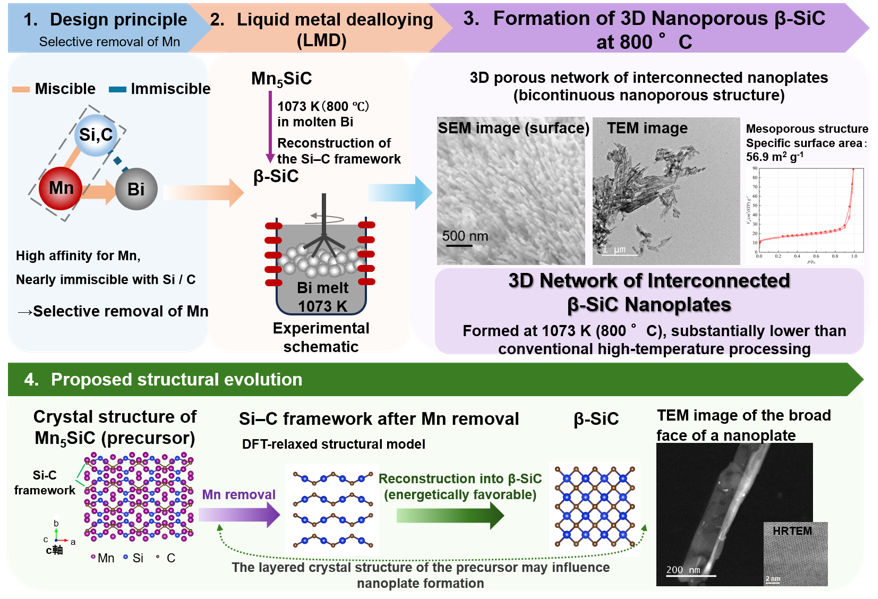
Tohoku University researchers formed crystalline beta-SiC at 800 degrees Celsius by soaking Mn5SiC in molten bismuth. The step also left an interconnected network of nanoscale plates, in a ceramic that usually needs much hotter processing.
The Scientist · Science desk
What happened
- Liquid metal dealloying works by immersing a multi-element solid in a molten metal that selectively removes one element.
- According to Tohoku's Hidemi Kato, the method had been applied mainly to metals, intermetallic compounds and semimetals before this work.
- The study, by Xiao Bian and colleagues, is published in Scripta Materialia.
Why it matters
- capability Crystalline phase and three-dimensional nanoscale porosity came out of a single step, in a material where forming and controlling nanometer-scale pores at the same time is a known difficulty.
- constraint The plate architecture is observed but not yet steerable: the authors say how precursor structure relates to plate growth and orientation is still unresolved.
- precedent One precursor in one molten metal is the evidence so far, so extending liquid metal dealloying to other covalent ceramics remains a claim to test.
The temperature is the headline number. The report calls 800 degrees Celsius (1,472 degrees Fahrenheit) substantially lower than the temperatures typically used to produce nanostructured SiC [3], but it gives no figure for those temperatures. The size of the saving cannot be worked out from this account.
The calculations indicated that the silicon-carbon framework's rearrangement into beta-SiC is energetically favorable [9]. That finding covers the end state only. How fast the framework gets there at 800 degrees, and why it forms plates, are separate questions. For the plates, the authors suggest only that the precursor's layered crystal structure may have influenced their formation, and they say further studies are needed to clarify how precursor structure relates to nanoplate growth and crystallographic orientation [10]. In our view that is the right amount of confidence.
Hidemi Kato, a professor at Tohoku's Institute for Materials Research, framed the result as a design option. "We think this approach could provide an exciting new strategy for designing nanoporous ceramics," he said [11].
A lower processing temperature alone does not establish cheaper processing. SiC is attractive for electronics, catalysts and energy-related materials [1], and a milder route matters to all three only if the whole chain is cheaper. The phys.org account does not include the cost of that chain, the yield, pore dimensions, any measured property of the material or how the Mn5SiC precursor is made. A saving at the furnace has to be netted against the precursor and the bismuth bath.
What to watch
- Follow-up work on how the layered Mn5SiC structure sets nanoplate growth and orientation, which the authors say is still needed.
- Measured properties, yield and processing cost for the nanoporous beta-SiC, which would test the cheaper-processing case.
- Attempts to apply liquid metal dealloying to other strongly covalent ceramics with different precursors or molten metals.
Clarity's read
What the record supports and how the coverage leans. The claims behind it follow.
Reality
- Evidence58
- Adoption
- Insufficient
- Hype gap−5
- Incentives
- Insufficient
- Confidence60
Claim ledger
Ranked by verification strength, evidence, and original report placement.
- [1]
Silicon carbide (SiC) is a ceramic known for excellent heat resistance and chemical stability, which makes it attractive for applications such as electronics, catalysts and energy-related materials.
- [2]
SiC generally requires high-temperature processing, and simultaneously forming and controlling porous structures at the nanometer scale remains challenging.
- [3]
A team led by the Institute for Materials Research at Tohoku University formed crystalline beta-SiC at 800 degrees C (1,472 degrees F), substantially lower than the temperatures typically used to produce nanostructured SiC.
- [4]
The study, by Xiao Bian et al., is published in the journal Scripta Materialia.
- [5]
The process simultaneously created a porous architecture made of nanoscale plates interconnected in three dimensions.
- [6]
Liquid metal dealloying (LMD) works by immersing a solid precursor containing multiple elements in a molten metal, which selectively removes a specific element.
- [7]
The researchers used Mn5SiC, a compound with a layered crystal structure, as the precursor and immersed it in molten bismuth; manganese was selectively dissolved into the molten metal while the remaining silicon-carbon framework reorganized to form crystalline beta-SiC.
- [8]
According to Hidemi Kato, LMD had previously been applied mainly to metals, intermetallic compounds and semimetals, and this research expands the scope to strongly covalently bonded ceramics.
- [9]
First-principles calculations indicated that the structural rearrangement of the remaining silicon-carbon framework into beta-SiC is energetically favorable.
- [10]
The researchers suggest that the layered crystal structure of the precursor may have influenced the formation of the nanoplate architecture; further studies will be needed to clarify how the precursor structure is related to the growth and crystallographic orientation of the nanoplates.
- [11]
"We think this approach could provide an exciting new strategy for designing nanoporous ceramics."
Sources
1 independent publisher whose own reporting we read for this story.
- phys.orgLiquid metal dealloying creates nanoporous silicon carbide at just 800°C
1 article · October 13, 2026
Topics and entities
Follow any of these and your For You feed starts watching them — no settings page required.
Topics
- Materials ScienceFollow
- Liquid metal dealloyingFollow
- Nanoporous ceramicsFollow