Science1 publisher2 min readPublished
Simulated early Mars rain drops about 10 times the average formaldehyde on Tharsis and Elysium
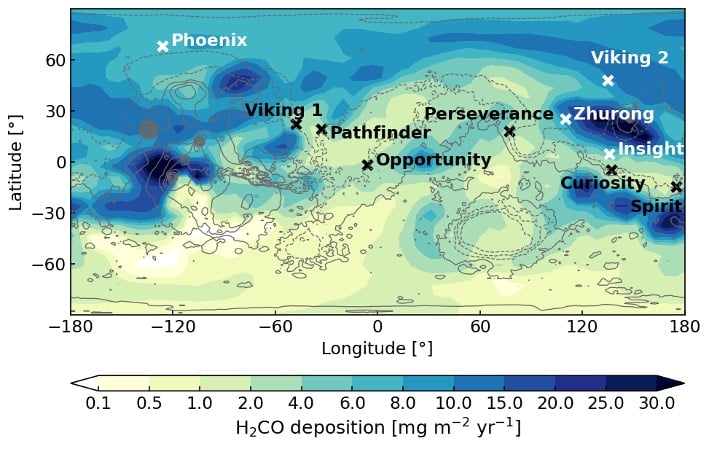
Tohoku University researchers and colleagues modelled early Mars's formaldehyde rain, putting about 10 times the global average on Tharsis and Elysium. The prediction links where a raw material for sugars and amino acids landed to the planet's ancient water cycle.
The Scientist · Science desk
Drafted by a language model from the sources cited here and checked against its claim ledger before publication. How we use AISend a correction
What happened
- The team simulated warm conditions 3.8 to 3.6 billion years ago, varying temperature, water vapor, pressure and UV light, and found water vapor mattered most for formaldehyde production.
- In the model, UV light split water molecules to free the hydrogen formaldehyde needs, and rain carried the molecule to the surface, so water-rich regions received more.
- The figures estimate how much formaldehyde reached the surface billions of years ago, not how much remains there today.
- The researchers plotted the predicted hot spots against the landing sites of Mars missions.
Compiled by The ScientistSomething wrong?How this is made
Why it matters
- capability Results from rover sites already explored can now be compared with a predicted formaldehyde supply, which puts the formaldehyde route to sugars and amino acids up against real field data.
- constraint A rover test at a predicted hot spot measures delivery and billions of years of survival together, so a weak result at one site would not cleanly refute the map.
- decision Landing-site planners get a new criterion to weigh, but Koyama makes its use conditional on observations first confirming that more formaldehyde went with more favorable chemistry.
The tenfold figure for Tharsis and Elysium is measured against the model's own planet-wide average [10]. A ratio inside one simulated climate ranks terrains against each other. It measures relative supply. The amount any patch of ground actually received would have to come from the paper's absolute deposition rates.
The climate is an input too. The modelled window, 3.8 to 3.6 billion years ago, is about 200 million years long [1]. The warm climate assumed for it rests on geological and mineral evidence. That evidence suggests Mars had periods warm and wet enough for surface water, possibly with rivers, lakes and an ocean in the northern hemisphere [1].
The thing this doesn't tell you is what happened after the formaldehyde landed. Earlier work showed the molecule could form in the atmosphere of a warm early Mars [2]. Once it reaches water, it can feed reactions that build sugars, amino acids and other complex organic molecules [3]. The new model stops at the ground. Anything formaldehyde seeded at Tharsis or Elysium would have had to last at least 3.6 billion years for a rover to find it [2].
The paper, by Shungo Koyama and colleagues, appears in The Planetary Science Journal [5]. Scientists from Tohoku University, the Earth-Life Science Institute and the Institute of Science Tokyo led the team [4]. I think the map is more useful today as a prediction than as a list of targets, and Koyama describes it the same way. "By comparing our map with findings from rovers, we can begin to test whether places that received more H2CO were also more favorable for early life-related chemistry," Koyama said [12]. "If future observations confirm this relationship, our map could help identify promising targets for future Mars missions," he said [13].
What to watch
- Comparisons of the map with organic and mineral findings at existing rover landing sites, the test Koyama proposes.
- Whether early Mars climate models with a different water cycle put the formaldehyde hot spots in the same places.
- Whether landing-site proposals for future Mars missions cite predicted formaldehyde delivery as a selection criterion.