ScienceNot yet confirmed elsewhere1 publisher2 min readPublished
NTU method replaces sol-gel chemistry with ice templates and polymer vapor to make aerogels
NTU researchers report aerogels as light as 0.004 g/cm3, made by sublimating ice templates and depositing polymer from vapor. The same route embedded living stem cells and stored gases in the material, so the open questions are viability, capacity and scale.
The Scientist · Science desk
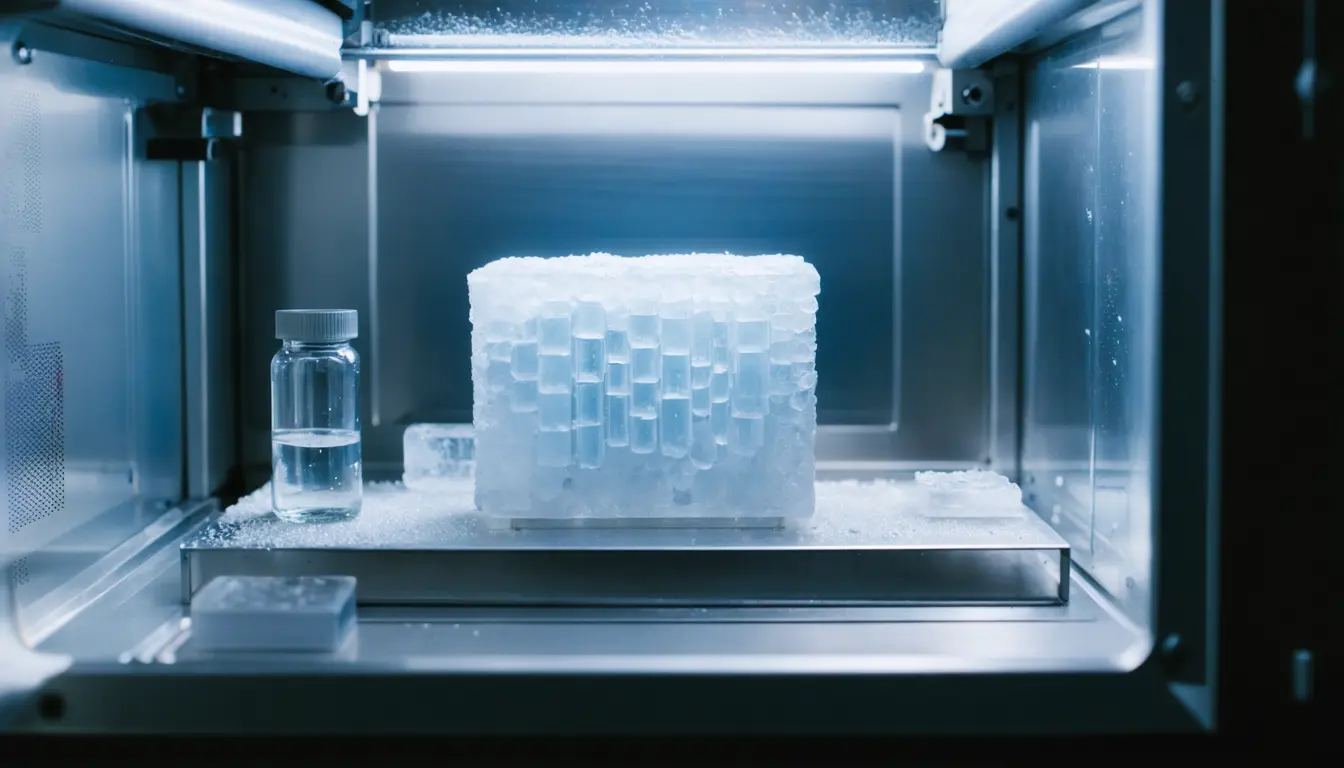
Three figures from the phys.org summary of the NTU study: density as low as 0.004 g/cm3; porosity of 90% up to 99%; surface area exceeding 1,300 m2/g, with strong mechanical stability.
| Figure | Value | Note | Claim |
|---|---|---|---|
| Aerogel density, as low as | 0.004 g/cm3 | 6 | |
| Porosity, at least | 90% | up to 99% | 6 |
| Surface area, exceeding | 1,300 m2/g | 6 |
What happened
- Conventional aerogel manufacturing depends on liquid-based sol-gel chemistry and complex drying, according to the summary of the NTU study.
- The reported porosity runs from 90% to 99%, and surface area exceeds 1,300 m2/g, with the authors citing strong mechanical stability.
- The same fabrication strategy produced metal-organic framework, multicomponent, cell-laden and gas-laden aerogels.
- Living stem cells and other cell types survived fabrication, and the materials supported spheroid formation, neural differentiation, angiogenesis and osteogenesis.
Why it matters
- constraint The process runs under low pressure on a frozen template, so we'd expect chamber size and cycle time to cap piece size and throughput if it is run in batches.
- decision Tissue engineering and gas delivery are framed as potential uses, so a team considering either would be running the first test of yield, cost and cell performance.
- contradiction The authors call the manufacturing scalable, but the demonstrations summarized are material properties, cell assays and gas release, not production runs.
The design is easy to state. A frozen solid seeded with microscopic gas bubbles goes into a low-pressure chamber [4]. The ice sublimates straight to vapor while polymer molecules deposit from the gas and assemble into a connected porous network [5]. The ice is the template and it leaves as a gas. The group, working across National Taiwan University's engineering and medical colleges and its hospital, calls this the world's first purely gaseous-born aerogel platform, a priority claim that comes from the authors themselves [1].
The headline figures are a density as low as 0.004 g/cm3 and a surface area above 1,300 m2/g [6]. The summary does not say they come from one sample. If they did, a cubic centimeter of the lightest material would carry more than 5 m2 of internal surface [13]. The authors place the materials among the lightest and most versatile aerogels reported to date [6], but that comparison is theirs, and the summary lists no reference aerogels measured under the same conditions.
The cell result needs a denominator before it means much. Stem cells and other cell types survived fabrication and stayed biologically active [8]. The gas results are the same kind of demonstration: argon and carbon dioxide were stored and released in a controlled manner [9]. The thing this summary doesn't tell you is the rest of the experiment: what fraction of cells survived, against what control, how much gas a given piece holds, or how large a batch the chamber produces.
"Solvent-free" is also the group's description, along with environmentally friendly and free of harmful byproducts [11]. The starting material is a solution that has been frozen [3]. We'd read the label as covering the steps after freezing, and a full waste comparison with sol-gel production would depend on what the frozen solution contains.
The paper is Chin-Yun Lee and colleagues, "Pure gaseous-born aerogels from solid solutions via vapor sublimation and deposition polymerization," in Nature Communications (2026), DOI 10.1038/s41467-026-76084-4 [10].
What to watch
- Full-text data in the Nature Communications paper: cell viability fractions with controls, and gas capacities per gram.
- Any report of piece size or batch throughput from the low-pressure chamber.
- Independent replication of the 0.004 g/cm3 density and 1,300 m2/g surface area, ideally against a sol-gel aerogel measured the same way.
Clarity's read
What the record supports and how the coverage leans. The claims behind it follow.
Reality
- Evidence50
- Adoption
- Insufficient
- Hype gap+30
- Incentives
- Insufficient
- Confidence55
Claim ledger
Ranked by verification strength, evidence, and original report placement.
- [1]
Researchers at National Taiwan University, working across the College of Engineering, College of Medicine and National Taiwan University Hospital, describe their method as the world's first purely gaseous-born aerogel fabrication platform.
- [2]
Conventional aerogel manufacturing depends on liquid-based sol-gel chemistry and complex drying processes.
- [3]
The new technique uses vapor sublimation and deposition polymerization to create ultralight, highly porous materials directly from solid solutions.
- [4]
The process transforms frozen solid templates containing microscopic gas bubbles into three-dimensional aerogels under low-pressure conditions.
- [5]
During fabrication, ice sublimates directly into vapor while polymer molecules deposit and assemble into an interconnected porous network.
- [6]
The aerogels reach densities as low as 0.004 g/cm3, porosities of 90%-99% and surface areas exceeding 1,300 m2/g while maintaining strong mechanical stability, which the source says places them among the lightest and most versatile aerogels reported to date.
- [7]
The researchers fabricated metal-organic framework aerogels, multicomponent aerogels, cell-laden aerogels and gas-laden aerogels using the same fabrication strategy.
- [8]
Living stem cells and other cell types survived the fabrication process and remained biologically active within the aerogels, which supported stem cell spheroid formation, neural differentiation, angiogenesis and osteogenesis.
- [9]
The team demonstrated aerogels that store and release gases such as argon and carbon dioxide in a controlled manner.
- [10]
The study is Chin-Yun Lee et al., 'Pure gaseous-born aerogels from solid solutions via vapor sublimation and deposition polymerization', Nature Communications (2026), DOI 10.1038/s41467-026-76084-4.
- [11]
The source describes the solvent-free approach as environmentally friendly and generating no harmful byproducts.
- [12]
The source says the study establishes a new generation of customizable aerogels that combine ultralight weight, multifunctionality, biological compatibility and scalable manufacturing.
- [13]
If the surface-area and density figures came from one sample, a cubic centimeter of the lightest material would carry more than about 5.2 m2 of internal surface.
Sources
1 independent publisher whose own reporting we read for this story.
- phys.orgVapor-based method creates ultralight aerogels without conventional liquid-based chemistry
1 article · October 12, 2026
Topics and entities
Follow any of these and your For You feed starts watching them — no settings page required.
Topics
- Materials ScienceFollow
- AerogelsFollow
- Tissue engineeringFollow
Entities
- National Taiwan UniversityFollow
- Nature CommunicationsFollow
- Phys.orgFollow