Science1 publisher3 min readPublished
Tohoku imaging shows mouse neurons losing ATP in REM sleep as blood volume climbs
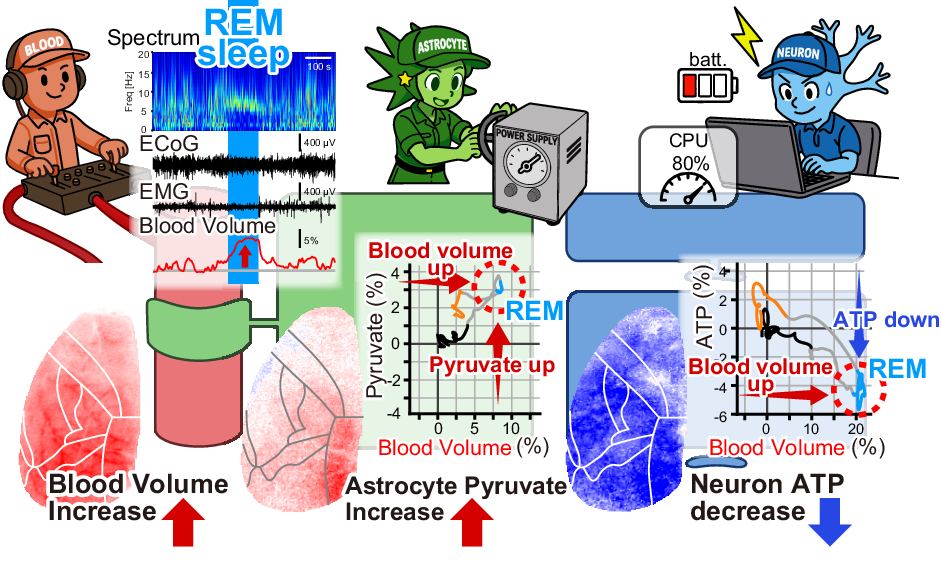
Tohoku University researchers imaging mice saw brain blood volume start rising about 50 seconds before REM sleep, yet neuronal ATP fell once REM began. The team takes this to mean dreaming uses energy faster than it arrives, though slower ATP production would look the same.
The Scientist · Science desk
What happened
- Tohoku University researchers imaged mice through resin-cleared skulls, tracking brain blood volume, neuronal ATP and astrocytic pyruvate through natural sleep.
- Blood volume began rising about 50 seconds before the classically defined start of REM, beginning in the posterior cortex and moving forward.
- Once REM began, pyruvate in astrocytes rose while the ATP level inside neurons fell.
Compiled by The ScientistSomething wrong?How this is made
Why it matters
- constraint A falling ATP level fits both higher neuronal use and slower delivery from astrocytes or mitochondria, so the heavy-demand reading stays unconfirmed until someone measures production or consumption rates.
- decision Researchers who treat blood supply as a proxy for neuronal energy during sleep would score REM as well supplied in these mice, so ATP now has to be measured directly in this stage.
- capability A transparent-skull preparation lets the timing of fuel supply be set against sleep-stage changes in unanesthetised, naturally sleeping animals.
- constraint Matsui's question about why dreaming feels tiring is about people, and mouse cortex data cannot answer it, because the animals cannot report dreams or fatigue.
The ATP measurement is a level. It falls whenever neurons spend ATP faster than they make it. So the drop the Tohoku group recorded once REM began [8] could come from more spending, less production, or both. The release lists candidates on each side. Neurons may be spending heavily on memory-related synaptic reorganisation, on communication between the hippocampus and cortex, or on broad transitions across brain circuits [9]. Alternatively, the transfer of metabolic resources from astrocytes to neurons may change during REM, or mitochondrial ATP production may shift [10].
The astrocyte signal does not decide between them. Pyruvate in astrocytes rose at REM onset, a change the authors say fits either more fuel arriving or faster glycolysis in those cells [7]. A pyruvate rise in astrocytes alongside falling neuronal ATP is consistent with neurons burning through their supply. It is equally consistent with a slower handoff from astrocyte to neuron, one of the possibilities the release itself raises [10].
The timing is the firmest part of the result. In non-REM sleep, blood volume followed theta-band activity by several seconds, the familiar pattern of vessels answering neuronal and metabolic demand [4]. The pre-REM rise led the change of state by about 50 seconds [5], a far longer lead than that. The authors interpret it as a large-scale process that may prepare the brain metabolically for REM [6].
So the brain appears to raise supply ahead of REM and still fall behind once REM is under way. I think the paradox holds as described. It supports the release's conclusion that the dreaming brain may be operating under unusually high energy demands while its fuel supply increases [11], provided "demand" is read broadly enough to include a delivery bottleneck inside the tissue. Separating those two needs a rate of ATP production or consumption. The release, summarising a paper in Communications Biology [3], does not report one, nor the number of mice imaged or the size of the ATP drop.
The work was framed around a human experience. "Sleep may appear peaceful, but the brain is highly active -- especially when dreaming," said Ko Matsui, a professor at Tohoku University [12]. "We were intrigued by this paradox, and wanted to look into the scientific basis behind why dreaming is somehow tiring," he said [13]. The recordings come from mice [1], animals that cannot report a dream or say they woke up tired.
The release places the findings in a wider argument about the brain's energy economy: animal brains, unlike conventional computers, must run within strict metabolic limits, and the nervous system may redirect resources instead of supplying them evenly [14]. The narrower consequence is for anyone using blood supply as a stand-in for neuronal energy during sleep. In these mice, that stand-in rose into REM [5] at the point where neuronal ATP was falling [8].
What to watch
- Whether the Communications Biology paper reports how many mice were imaged, how large the neuronal ATP drop was, and whether it appeared in every REM episode.
- A rate measurement, of mitochondrial ATP output or astrocyte-to-neuron fuel transfer, that separates higher consumption from reduced supply during REM.
- Whether an anticipatory blood volume rise ahead of REM shows up in human imaging, where REM can be tied to reported dreams.