Science1 publisher2 min readPublished
A question from Maori put nephrite jade in front of a Taiwanese synchrotron
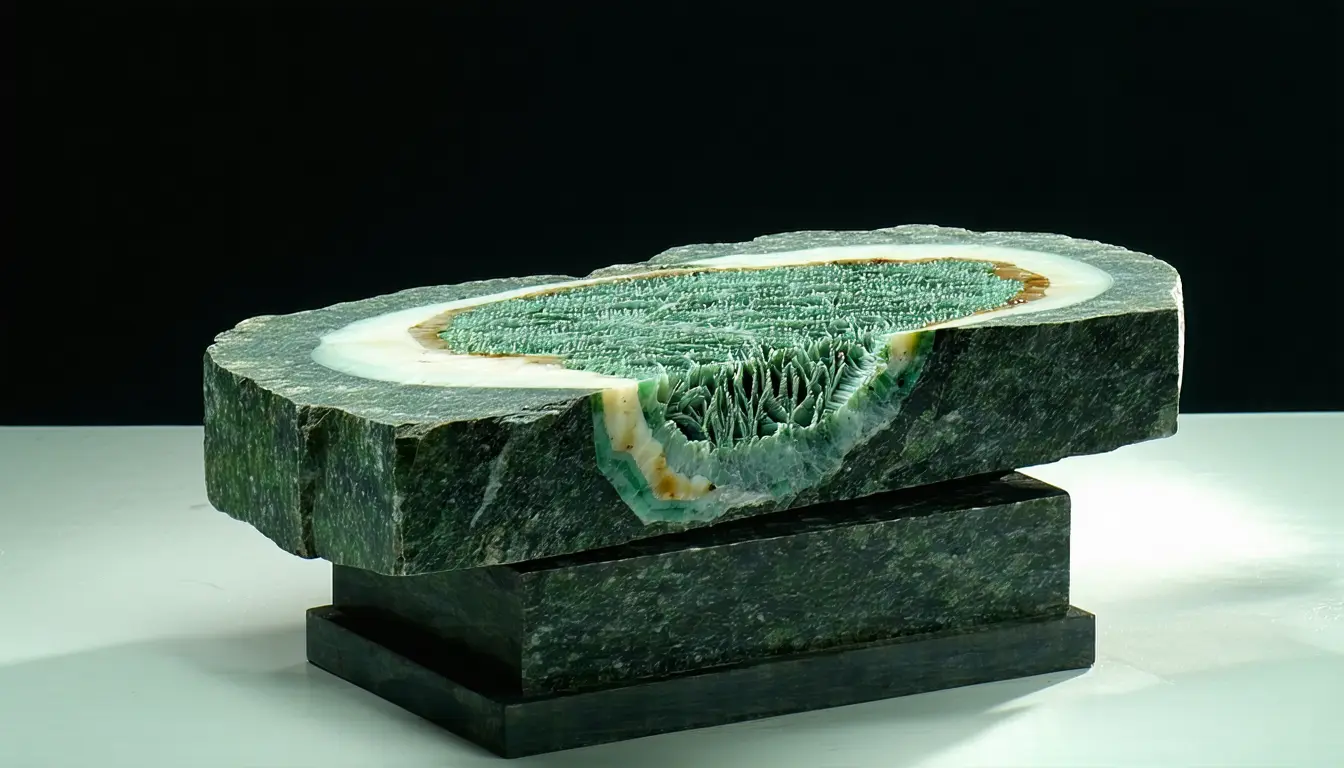
Natalia Seliutina's new paper in the New Zealand Journal of Geology and Geophysics describes the microstructure of pounamu at grain sizes thinner than a hair, and she says the cause of its toughness is still an open question.
The Scientist · Science desk
What happened
- Geology PhD candidate Natalia Seliutina has published a paper in the New Zealand Journal of Geology and Geophysics on nephrite jade, the stone known in Aotearoa as pounamu or greenstone.
- In 2024 she took the work to the National Synchrotron Radiation Research Center in Taiwan, using a particle accelerator to probe the crystal and molecular structure of the stone.
- Seliutina describes the grains as needles several times thinner than a human hair. An ordinary laboratory instrument would not resolve how they are arranged.
Compiled by The ScientistSomething wrong?How this is made
Why it matters
- contradiction phys.org presents the research under a space-exploration headline, while Seliutina's own account of the project stops at describing structure and looking for patterns. The headline promises an application the evidence has not reached.
- constraint If the toughness comes from a combination of parameters, nobody can copy it into a synthetic material until the combination is named and weighted. That keeps the work at characterisation, short of a specification a fabricator could work from.
- precedent A doctoral project and international beamtime went to answering a question first posed by iwi. That is a working model for how a culturally significant material gets studied, with the community setting the agenda.
The instrument choice follows from the grain size. "Nephrite jade has very small grain sizes, like needles several times thinner than your hair," Seliutina said [7]. A beamline is one of the few ways to see how those needles sit together. "A particle accelerator allows you to look at materials with precision and explore the molecular and crystal structure," she said [8].
The interview does not report a fracture-toughness value for pounamu, or the test that produced one [14]. The ranking she gives is qualitative: "It's extremely, exceptionally tough. It's one of the toughest natural materials to ever exist," Seliutina said [3].
On the cause, she is explicit that the work is at the describing stage. "It's not clear what is responsible for this unique toughness, so I'm describing the structure and trying to identify if there are any patterns or reasons that I can notice," she said [4]. "It's a very complicated material, so I think it's going to be a combination of parameters" [5]. That sentence sets the limit on what anyone can do with the result. To grow or sinter a synthetic analogue, an engineer needs to know which parameter dominates and by how much, and this account gives neither number [14].
The phys.org write-up is headlined "Researcher studies mystical gemstones with a future in space exploration," and its introduction says understanding the properties of pounamu might one day help us explore space [13]. The minus 30 degrees that appears in the same introduction describes Siberia, one of the places Seliutina has followed gemstones, along with carving studios in Otepoti and particle accelerators in Taiwan [15], not a temperature at which pounamu was tested [14]. Seliutina's own statement of purpose in the piece is narrower: she is studying microstructure and mechanical properties in the hope the work may help develop new materials [2].
The provenance of the question is the part of this that is unusual, and it is on the record. Seliutina said her supervisor, Dr. Simon Cox, has a personal interest in pounamu and has spent a lot of time with different iwi across the South Island, where the same question kept coming up: why is pounamu so tough? The initial question, she said, was asked by Maori, not scientists [12]. She described the 2024 session in Taiwan, the first synchrotron-based microstructure study on nephrite jade, as carrying an obligation in both directions: "You obviously want to make everything right and process the data very carefully and precisely, because it is a very big deal culturally and scientifically," she said [11] [9]. She also called it "insanely scary and cool" [10].
What to watch
- Whether a follow-up paper reports a measured fracture-toughness value for pounamu with a named test method and a comparison material.
- Whether the synchrotron data can single out which structural parameter dominates, the number a synthetic analogue would have to hit.
- Whether any materials or aerospace group takes up the structure, and on what terms agreed with the iwi who asked the original question.