ProductNot yet confirmed elsewhere1 publisher3 min readPublished
Navy asks for fiber that carries 10kW over 10km, and a laser weapon that comes apart
ONR's $10.25 million draft solicitation treats the laser source and the beam director as separate products joined by fiber. That moves value into connectors, transport, and interface specs.
The Product Desk
What happened
- In a draft request for solutions published on August 12 through the National Security Technology Accelerator (NSTXL), the Office of Naval Research detailed plans to explore 'distributed' laser weapons in which the laser source and the beam director are not bolted together in the same apparatus but connected through a specialized optical fiber spooled across a ship, base, or battlefield.
- The project, dubbed 'Universal Optical Transport for Distributed Laser Weapons' and valued at $10.25 million, seeks prototype connectors and fiber capable of transmitting 10 kilowatts over 10 kilometers with minimal power loss and high beam quality.
- The draft document says 'The shift to distributed laser weapons allows for significantly expanded geographic coverage and multi-sector force protection' in support of expeditionary airbase defense and counter-drone missions ashore.
- The focus on expeditionary airbase defense and counter-drone missions ashore is a departure from the Navy's past focus on shipboard directed energy systems operating on the high seas.
- Distributed systems could keep a power-hungry, heat-generating laser source in a fortified position while deploying a comparatively lightweight and agile beam director around the perimeter of a base or formation, and with the right fiber connection a single source could plausibly feed multiple directors that simultaneously engage incoming targets.
Why it matters
The Office of Naval Research published a draft request for solutions on August 12 through the National Security Technology Accelerator asking industry to stop bolting high-energy laser weapons together: keep the laser source in one place, put the beam director somewhere else, and connect the two with a specialized optical fiber spooled across a ship, base, or battlefield [1]. The program, called Universal Optical Transport for Distributed Laser Weapons and valued at $10.25 million, is looking for prototype connectors and fiber that carry 10 kilowatts over 10 kilometers with minimal power loss and high beam quality [2].
For anyone selling into directed energy, that is a bill-of-materials change more than a mission change. A distributed architecture lets the power-hungry, heat-generating source sit in a fortified position while a lighter beam director moves around a perimeter, and with the right fiber a single source could feed several directors engaging targets at once [5]. ONR frames the payoff as "significantly expanded geographic coverage and multi-sector force protection" for expeditionary airbase defense and counter-drone work ashore [3], a departure from the service's earlier concentration on shipboard systems at sea [4]. The named use case is Marines taking forward airfields under Expeditionary Advanced Base Operations while exposed to drones and rocket, artillery, and mortar fire [6].
The interesting part is what the program is actually buying. Distribution is described as primarily a physics and technical standards problem, and solving it would let the Navy mix sources and beam directors from different vendors through an open photonic interface [12]. That is the opposite of the integrated-weapon business model. It makes the connector, the fiber, the loss budget, and the interface document the products, and it makes any vendor whose value sits in owning the whole chassis a worse fit.
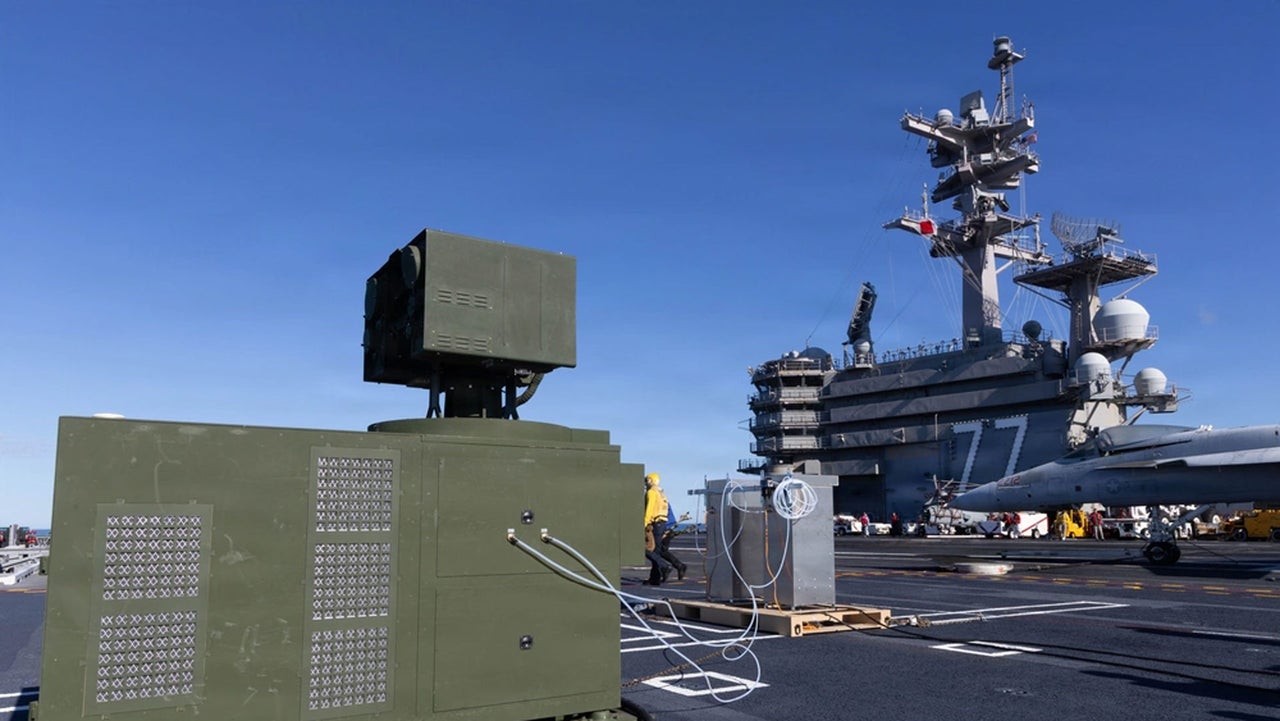
It also cuts against where the Navy's money and doctrine currently are. The service's present approach bundles critical laser components into a single container that rolls on and off a warship [7], the logic behind the Chief of Naval Operations' Containerized Capability Campaign, which Adm. Daryl Caudle pitches as fielding capability "at the speed of relevance" rather than at the pace of platform-centric acquisition [8]. That is what put the Army's Palletized High Energy Laser on the flight deck of the USS George H.W. Bush for live-fire testing in October 2025 [9], and Congress is now adding $5 million for a containerized version of HELIOS, the Navy's lone 60 kilowatt shipboard laser [10]. Both efforts answer the same complaint: mounting exquisite lasers on platforms never designed for them, from a Stryker to an Arleigh Burke destroyer, keeps producing power, cooling, and integration problems [11].
Scale matters here. The distributed transport program is worth roughly twice the containerized HELIOS plus-up [15], and its 10 kilowatt target is about one sixth of HELIOS's 60 kilowatt output [16], which means the fiber being specified would not, on its own, feed a current weapon-class source. Containerization is as much an acquisition strategy as an engineering one [13]; the two are compatible in principle, with a containerized source feeding fiber to multiple swappable directors [14], but they are unlikely to converge soon, and the performance targets read as an early-stage bet on enabling technology [17].
Watch whether the final solicitation holds the 10 kilowatt and 10 kilometer numbers or relaxes them, and whether ONR publishes an actual photonic interface specification. Absent that document, the mix-and-match promise stays a slide.
Clarity's read
What the record supports and how the coverage leans. The claims behind it follow.
Reality
- Evidence48
- Adoption12
- Hype gap+6
- Incentives58
- Confidence44
Claim ledger
Ranked by verification strength, evidence, and original report placement.
- [1]
In a draft request for solutions published on August 12 through the National Security Technology Accelerator (NSTXL), the Office of Naval Research detailed plans to explore 'distributed' laser weapons in which the laser source and the beam director are not bolted together in the same apparatus but connected through a specialized optical fiber spooled across a ship, base, or battlefield.
- [2]
The project, dubbed 'Universal Optical Transport for Distributed Laser Weapons' and valued at $10.25 million, seeks prototype connectors and fiber capable of transmitting 10 kilowatts over 10 kilometers with minimal power loss and high beam quality.
- [3]
The draft document says 'The shift to distributed laser weapons allows for significantly expanded geographic coverage and multi-sector force protection' in support of expeditionary airbase defense and counter-drone missions ashore.
ReportedSupportedSource: ONR draft request for solutions, quoted by Laser Wars via Fast CompanyView cited source - [4]
The focus on expeditionary airbase defense and counter-drone missions ashore is a departure from the Navy's past focus on shipboard directed energy systems operating on the high seas.
- [5]
Distributed systems could keep a power-hungry, heat-generating laser source in a fortified position while deploying a comparatively lightweight and agile beam director around the perimeter of a base or formation, and with the right fiber connection a single source could plausibly feed multiple directors that simultaneously engage incoming targets.
- [6]
The ONR document describes U.S. Marines exposed to drone attacks and rocket, artillery, and mortar fire while seizing forward airfields under the Expeditionary Advanced Base Operations concept as a potential real-world application.
- [7]
The Navy's current approach to laser weapons essentially involves bundling critical laser components into a single container that can be rolled on and off a warship with relative ease.
- [8]
Chief of Naval Operations Adm. Daryl Caudle has pushed the service toward a Containerized Capability Campaign (C3), a doctrine built around cramming novel capabilities into standardized containers that can be swapped across platforms and fielded 'at the speed of relevance, not the speed of platform-centric acquisition.'
- [9]
The same containerization logic led the Navy to conduct live-fire testing of the U.S. Army's Palletized High Energy Laser (P-HEL) system off the flight deck of the USS George H.W. Bush in October 2025.
- [10]
Congress is trying to extend containerization to the Navy's lone 60 kilowatt High Energy Laser with Integrated Optical Dazzler and Surveillance (HELIOS) with a $5 million funding addition for a containerized version of the shipboard laser system.
- [11]
Bolting exquisite laser weapons onto platforms never designed to carry them, whether a Stryker infantry carrier vehicle or an Arleigh Burke-class guided missile destroyer, has consistently yielded significant power, cooling, and integration challenges.
- [12]
Distribution is primarily a physics and technical standards challenge that, if solved, could allow the Navy to mix and match laser sources and beam directors from different vendors through an open photonic interface.
- [13]
Containerization is as much an acquisition strategy as an engineering one, enabling the service to circumvent bespoke integrations for every new capability it needs to rapidly field on a warship.
- [14]
The two approaches are not mutually exclusive: a containerized laser source could potentially feed fiber out to multiple modular beam directors that are themselves swappable across various sites, ship or shore.
- [15]
The $10.25 million distributed optical transport program is about 2.05 times the size of the $5 million congressional addition for a containerized HELIOS.
- [16]
The 10 kilowatt transport target is about one sixth of HELIOS's 60 kilowatt output.
- [17]
The two approaches are unlikely to converge anytime soon, and ONR's current performance targets for distributed laser prototypes suggest the initiative is still an early-stage engineering bet on enabling technology.
Sources
1 independent publisher whose own reporting we read for this story.
- fastcompany.comThe Navy is rethinking what a laser weapon looks like
1 article · August 21, 2026
Topics and entities
Follow any of these and your For You feed starts watching them — no settings page required.
Topics
- High-Power Optical Fiber TransportFollow
- Counter-Drone and Base DefenseFollow
- Directed-Energy WeaponsFollow
- Modular and Open Systems ArchitectureFollow
- Defense Acquisition StrategyFollow
Entities
- Office of Naval ResearchFollow
- National Security Technology AcceleratorFollow
- U.S. NavyFollow
- Universal Optical Transport for Distributed Laser WeaponsFollow
- HELIOSFollow
- Palletized High Energy LaserFollow
- Containerized Capability CampaignFollow
- Daryl CaudleFollow
- Lockheed MartinFollow
- Expeditionary Advanced Base OperationsFollow
- Laser WarsFollow