Build2 distinct publishers2 min readPublished
The hull carried the launcher and the link while the Navy's Adjunct Remote Engagement System held fire control. That division of labour is what six months of integration actually bought, on terms Lockheed Martin has only partly disclosed.
The Engineer · Build desk

Compiled by The EngineerSomething wrong?How this is made
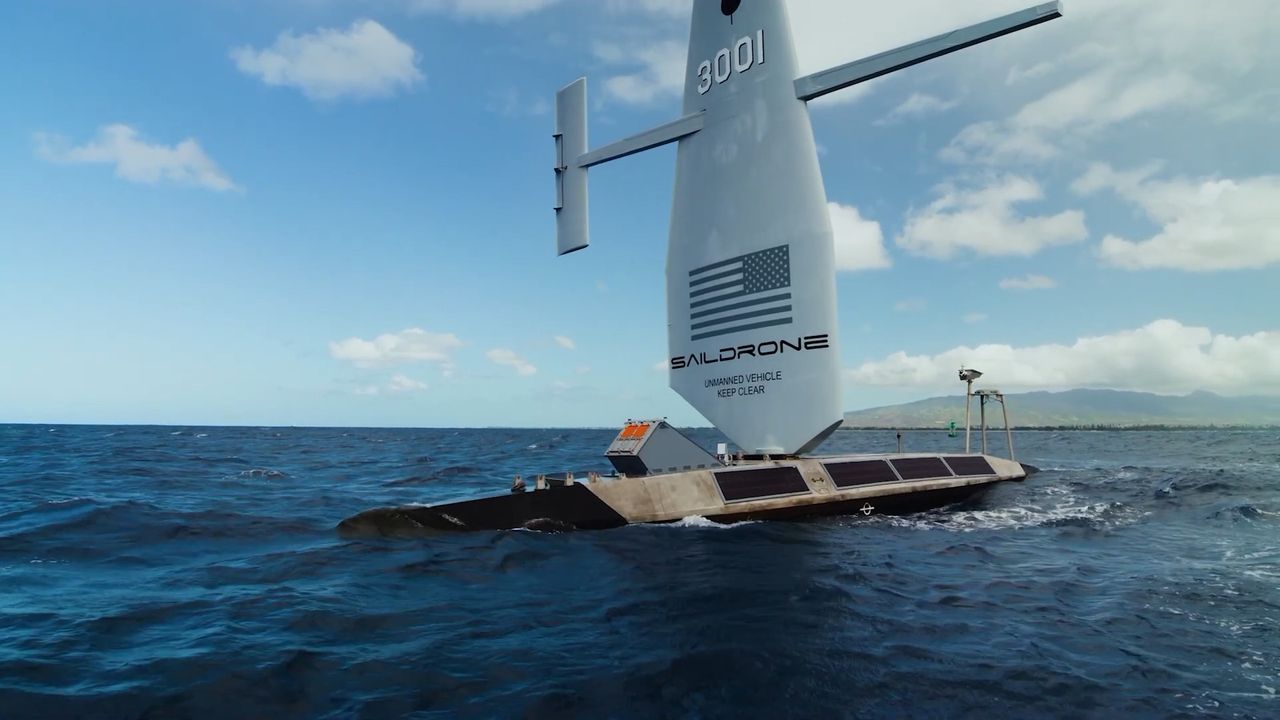
Start with what ARES is. The Navy's Adjunct Remote Engagement System is a remotely operated combat system, and during this demonstration it supplied the fire control and the command and control [3]. The Surveyor did not work out on its own that a surrogate high-speed surface craft was a target; Lockheed Martin says the vessel acted on targeting data delivered to it through ARES [4]. The hull's role in the engagement sequence is therefore narrow: it carries Lockheed Martin's JAGM Dual Launcher and holds a link long enough to execute a release [2]. Anything that needs judgement stays on something crewed.
That narrowness is why the schedule is credible. The partners say the project went from concept to demonstration in six months [10], and neither end of it was new work: the arrangement reused systems that had already accumulated operational histories instead of designing a vessel and a weapon together from the keel up [11]. The two announcement dates bracketing the effort are 295 days apart, about 9.7 months [19], so six months is the engineering window inside a longer calendar rather than the calendar itself.
For that six-month figure to transfer to another program, three things have to be true at once: the hull is already fielded, the effector is already fielded, and a remote fire-control system already exists to sit between them and own the decision. Drop the third and the job changes entirely: without it, the effort becomes building an autonomous shooter, a different task and a much longer one.
The effector suits the water it was fired over. JAGM carries two independent guidance modes, semi-active laser and millimeter-wave radar, intended to keep working in poor visibility and changing weather [5], which describes most maritime targeting. The wing that makes the hull cheap to keep out there, meanwhile, descends from a land yacht that set a 126.2 mph wind-powered record in 2009 [17], an unusual entry in a fire-control lineage. The original brief was endurance without crews or fuel-hungry propulsion [16], and a missile rail bolted onto that brief inherits it.
What the released data supports is interoperation. Launcher, communications and fire control worked together in sequence. It does not establish how the complete system behaves against a maneuvering target under contested communications or electronic attack [7], and with only a round count published [6], nobody outside the program can check. Until a shot is disclosed with the link itself under attack, what this demonstrates is wiring; lethality is still an open question.
Ranked by verification strength, evidence, and original report placement.
A Surveyor-class autonomous surface vessel launched two Joint-Air-to-Ground Missiles near Hawaii during RIMPAC 2026, according to an August 20th announcement from Lockheed Martin.
The vessel used the Navy's Adjunct Remote Engagement System (ARES) and Lockheed Martin's JAGM Dual Launcher while coordinating with the USS Theodore Roosevelt carrier strike group.
ARES is a remotely operated combat system that provided fire-control and command-and-control capabilities during the demonstration.
Lockheed Martin said the Surveyor acted on targeting data for a surrogate high-speed surface craft through ARES.
JAGM uses semi-active laser and millimeter-wave radar guidance; those independent guidance modes are designed to support operations in poor visibility and changing weather.
Lockheed Martin reported that two rounds were launched, without publishing accuracy, firing range or target-effects results.
Distinct publishers with included, body-backed reporting in this cluster.
runtimewire.com
1 article · August 29, 2026
tomshardware.com
1 article · August 29, 2026
Follow any of these and your For You feed starts watching them — no settings page required.
product
Six months from concept to a missile off a robot boat: arming USVs is an integration job now1 distinct publisher
product
Boeing locks in seven years of SM-3 parts before anyone commits to a missile count1 distinct publisher
product
Navy asks for fiber that carries 10kW over 10km, and a laser weapon that comes apart1 distinct publisher
invest
L3Harris shows what forfeiture can reach, and what it cannot1 distinct publisher
Evidence-backed comparisons of source perspectives and observed adoption signals. Read the methodology
Which Builder, Operator, and Investor concerns the observed source mix emphasized—not a truth score.
Evidence, demonstrated adoption, hype gap, incentives, and confidence are assessed independently, each on its own current evidence. How these are measured.
One release, two retellings
Every load-carrying fact — two rounds away, ARES holding fire control, a surrogate high-speed craft as the target — rests on Lockheed Martin's August 20th announcement. Tom's Hardware relays it; Runtime Wire relays it and is candid that accuracy, firing range and target effects were not published. No Navy statement, no third-party observer, and not one figure that could be checked against something outside the announcing company.
One hull, one exercise window
This is further along than a range test: the Surveyor sat inside a working carrier strike group engagement chain and separately did a passive electronic-warfare task with an MH-60S. It is also exactly one vessel, once, with no second hull, no quantity and no programme line anywhere in the reporting. The endurance numbers Saildrone offers — 2.5 million nautical miles, 65,000 days at sea — belong to the unarmed science fleet, as Runtime Wire is careful to say.
The speed story outruns the calendar
The overstatement here is arithmetic rather than adjectival. Lockheed Martin's own dates — a stake announced October 29th, 2025, a demonstration announced August 20th, 2026 — are 295 days apart, while the partners describe six months from concept to demonstration and both publishers repeat it. Tom's Hardware calls the launch successful, though nothing released makes 'successful' mean more than that the rounds left the rails. And the Spectre payloads presented as de-risked, the Mk 70 and SURTASS, have not been integrated at all.
Investor, supplier and narrator are one firm
Lockheed Martin built the missile, sold the launcher, provides the fire-control pitch, holds a $50 million position in the vessel's maker, and issued the only account of how the test went. Saildrone is mid-pivot from ocean mapping to weapons work and needs precisely this milestone in front of US and European buyers. Nobody in the disclosure chain had a reason to publish what did not work.
Firm on dates, blind on performance
Runtime Wire names Tom's Hardware as its primary source, which tells you how short the chain behind our coverage is. The named systems and the dates are solid enough to reason from, and the timeline arithmetic requires trusting neither publisher. Performance is the part no amount of careful reading recovers, so any judgement about what this vessel can actually do in a fight stays provisional until the next trials produce numbers.