ScienceIndependently confirmed2 publishers3 min readPublished
Hammering nails exposed the gripper limit that Beijing's 8.64-second sprint hid
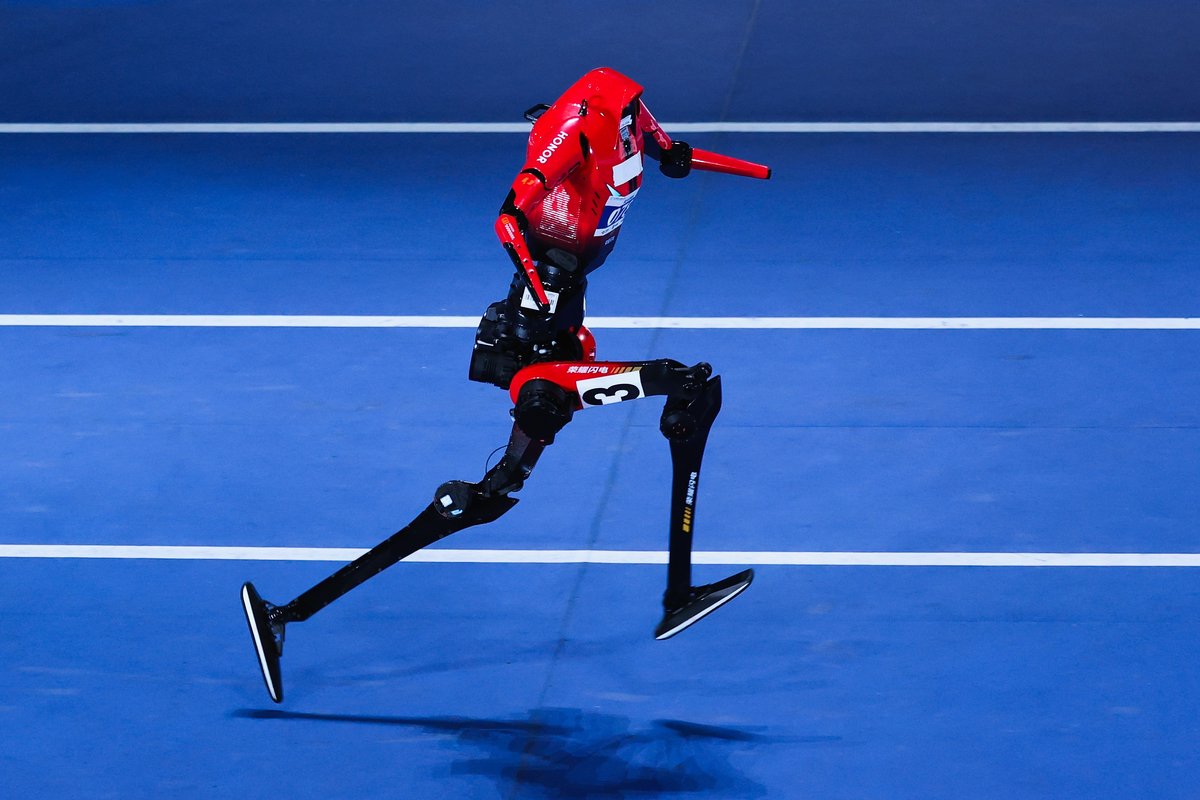
The second World Humanoid Robot Games cut the machines' 100-metre time from 21.5 seconds to 8.64 in a year, while the dexterity events failed even with human operators in control gloves. That puts the bottleneck in the hands.
The Scientist · Science desk
What happened
- The second World Humanoid Robot Games ran in Beijing from 22 to 26 August, with more than 600 teams entered, mostly from Chinese universities, research institutions and robotics companies.
- A robot from Beijing company X-Humanoid took the 100-metre gold in 8.64 seconds, almost a second inside Usain Bolt's 2009 record race, having won the same event last year in 21.5 seconds.
- A second X-Humanoid machine cleared 3.4 metres in a standing vertical jump, beating a human record set in 1993, according to the state-run Global Times.
- In the dexterity events, robots could not hammer nails into a corkboard efficiently even while team members wearing control gloves were driving their movements.
Why it matters
- constraint The work anyone would pay a humanoid to do is contact-rich, so a gripper that cannot load a tool caps the commercial ceiling regardless of how fast the locomotion numbers fall.
- decision For a buyer, the medal table prices trajectory execution; the autonomy premium inside the scenario events is the only column that corresponds to a task currently done by a person on payroll.
- contradiction Nature's progress framing and Scientific American's inventory of crashes cover the same five days, so which account you trust depends on whether your metric ends at the finish line or after it.
- capability Racket sport against a live human is the one Beijing result that cannot be pre-scripted, which makes it the narrow place to look for real-time adaptation rather than replayed motion.
Karen Liu's comparison is the one to keep. A sprint or a backflip is a trajectory: the machine knows every millisecond what torque to generate, and it does not have to think [12]. Track and field asks humanoids to do the thing their hardware already does well, turning stored energy into acceleration [12]. The Stanford computer scientist's point is that daily-life tasks are the hard ones, and that most people's intuition about laundry versus backflips runs backwards [11].
The nail-hammering event is where the diagnosis gets specific. Robots struggled to drive nails into a corkboard efficiently even when team members wearing control gloves were supplying the motion [14]. In that configuration a human provides the perception, the planning and the timing, and the task still fails. What is left is the hand. Liu's account of the mechanism fits: grippers cannot get enough contact with a tool to put strong force through it [13].
The athletics numbers, meanwhile, move fast. Same event, same company: 21.5 seconds last year, 8.64 this year [5][4], an improvement of 12.86 seconds, or 59.8 percent [21]. Average speed over the distance went from roughly 4.65 metres per second to roughly 11.57 [22]. That is a genuine rate of change and deserves the attention it is getting.
What the 8.64 does not tell you is what happens after the line. Scientific American reports that most of the 100-metre field crashed into the padded wall at the end, that one robot caught fire, and that a weightlifting entrant went into the judges' table [17]. The clock stops at 100 metres, so deceleration and graceful failure sit outside the measurement. Nature headlined the same five days as rapid progress with hurdles remaining [8]; Scientific American called them as ridiculous as they are impressive [9]. Both readings are available because the metric ends where the difficulty starts. Rodney Brooks, the MIT emeritus professor, gave the general version of this after a humanoid beat the human half-marathon record in April: watching a robot perform one thing fools us into crediting it with human-style general competence [18].
The organisers did build the part that would settle this. Scenario-based events, including shelving books and making beds, scored autonomous completion above teleoperation [10], which both concedes that the glove is on the field and gives you a way to price it. Booster Robotics, which brought nearly 300 machines, calls the games a real-world testing ground for embodied intelligence [15]. Boston Dynamics, which did not enter, states the same bar as humanoids ceasing to be toys [16].
One result cuts the other way. According to Scientific American, a humanoid played tennis against a human and anticipated unpredictable moves [19], and Nature describes a table-tennis showcase against a human Olympian [20]. A racket sport against a live opponent cannot be pre-scripted the way a jump can, which makes it the thinnest but most interesting evidence in Beijing. If next year's games publish per-task autonomy splits, that is the figure to read against an actual job description.
What to watch
- Whether next year's games publish per-task splits of autonomous versus glove-driven scores in the scenario events.
- Whether any team shows force-loaded tool use, such as hammering or drilling, with no human in the loop.
- Whether the non-Chinese entries among this year's 16 countries turn up in manipulation events rather than athletics.
Clarity's read
What the record supports and how the coverage leans. The claims behind it follow.
Reality
- Evidence72
- Adoption30
- Hype gap+42
- Incentives66
- Confidence74
Claim ledger
Ranked by verification strength, evidence, and original report placement.
- [1]
The second annual World Humanoid Robot Games were held in Beijing and ran from 22 to 26 August.
- [2]
The games drew more than 600 competing teams, mainly from Chinese universities, research institutions and robotics companies.
- [3]
The games feature 51 events, including kickboxing, table tennis and soccer, with machines representing 16 countries taking part, including Germany, Japan and the United States.
- [4]
A robot from Beijing company X-Humanoid won gold in the 100-metre sprint with a time of 8.64 seconds, almost one second faster than Usain Bolt's record-breaking race in 2009.
- [5]
The same X-Humanoid robot won the 100-metre sprint at last year's games in 21.5 seconds.
- [6]
Another X-Humanoid robot jumped 3.4 metres vertically from a standing position at this year's games, breaking a human record set in 1993, according to the state-run Chinese outlet the Global Times.
ReportedSupportedSource: Global Times, via Nature2 sources— create a free account to open themView cited source - [7]
On the first day of the games, two humanoid robots beat Usain Bolt's 100-metre world record before crashing into a padded wall, according to Scientific American.
ReportedSupportedSource: Scientific American2 sources— create a free account to open themView cited source - [8]
Nature's account of the event is headlined 'Robot Olympics' reveal humanoids' rapid progress but hurdles remain.
- [9]
Scientific American's account of the event is headlined 'The humanoid robot Olympics is as ridiculous as it is impressive'.
- [10]
This year's games expanded from sprints and jumps to include real-world challenges such as shelving books and making beds; in these 'scenario-based events', robots that completed tasks on their own were scored more highly than those remotely operated by humans.
- [11]
Karen Liu, a computer scientist at Stanford University, says most people would call folding laundry easier than doing a backflip, but for humanoids a task from daily life is far harder than a backflip.
- [12]
Liu says humanoids thrive in track-and-field events because they translate energy into acceleration extremely efficiently, and that backflips and sprints follow a prescribed trajectory: every millisecond the robot knows what to do and how much torque to generate, and it does not need to think.
- [13]
Liu says humanoids struggle with high-dexterity tasks, that grippers mimicking the strength and coordination of the human hand are difficult to build, and that tool use is particularly hard because grippers struggle to create enough contact with a tool to apply strong force.
- [14]
Robots at the games struggled to hammer nails into a corkboard efficiently, even when operated by team members wearing gloves that control the robots' movements.
- [15]
Cheng Hao, chief executive of Booster Robotics in Beijing, which had nearly 300 robots at the games, said the games are not simply a competition but an important real-world testing ground for embodied intelligence.
- [16]
Aya Durbin, who directs development of the Atlas humanoid at Boston Dynamics, which did not send robots to the games, said humanoids will not become part of everyday life if they are always 'toys' and need to solve actual problems.
- [17]
Scientific American reports that most of the robots that ran the 100-metre dash crashed into the padded wall at the end, that one caught fire, and that a humanoid in the weightlifting event crashed into the judges' table.
- [18]
Rodney Brooks, an emeritus professor at MIT, told Scientific American after a humanoid beat the human half-marathon record in April that these robots are not actually interacting with the real world, and that seeing an AI system or robot perform one thing fools people into thinking it has the same general competence as a human.
- [19]
One humanoid robot successfully played tennis against a human, anticipating unpredictable moves and showing an ability to adapt in a real-world setting, according to Scientific American.
- [20]
At the games a robot faced off against a human Olympian during a table-tennis showcase match.
- [21]
The winning 100-metre time fell by 12.86 seconds year on year, a reduction of 59.8 percent.
- [22]
Average speed over the 100 metres rose from about 4.65 metres per second to about 11.57 metres per second.
Sources
2 independent publishers whose own reporting we read for this story.
- nature.com‘Robot Olympics’ reveal humanoids' rapid progress — but hurdles remain
2 articles · August 26, 2026
- scientificamerican.comThe humanoid robot ‘Olympics’ is as ridiculous as it is impressive
1 article · August 25, 2026
Topics and entities
Follow any of these and your For You feed starts watching them — no settings page required.
Topics
- China Robotics IndustryFollow
- Robot Manipulation and DexterityFollow
- Humanoid RoboticsFollow
- Embodied AIFollow
- Benchmark and Demo ValidityFollow
Entities
- Aya DurbinFollow
- World Humanoid Robot GamesFollow
- MITFollow
- Usain BoltFollow
- X-HumanoidFollow
- Booster RoboticsFollow
- Karen LiuFollow
- AtlasFollow
- Boston DynamicsFollow
- Associated PressFollow
- CCTV+Follow
- Cheng HaoFollow
- Global TimesFollow
- NatureFollow
- Stanford UniversityFollow
- Scientific AmericanFollow
- Rodney BrooksFollow