Product3 publishers3 min readPublished Updated
Boston Dynamics drops the pinky from Atlas to save three actuators per hand
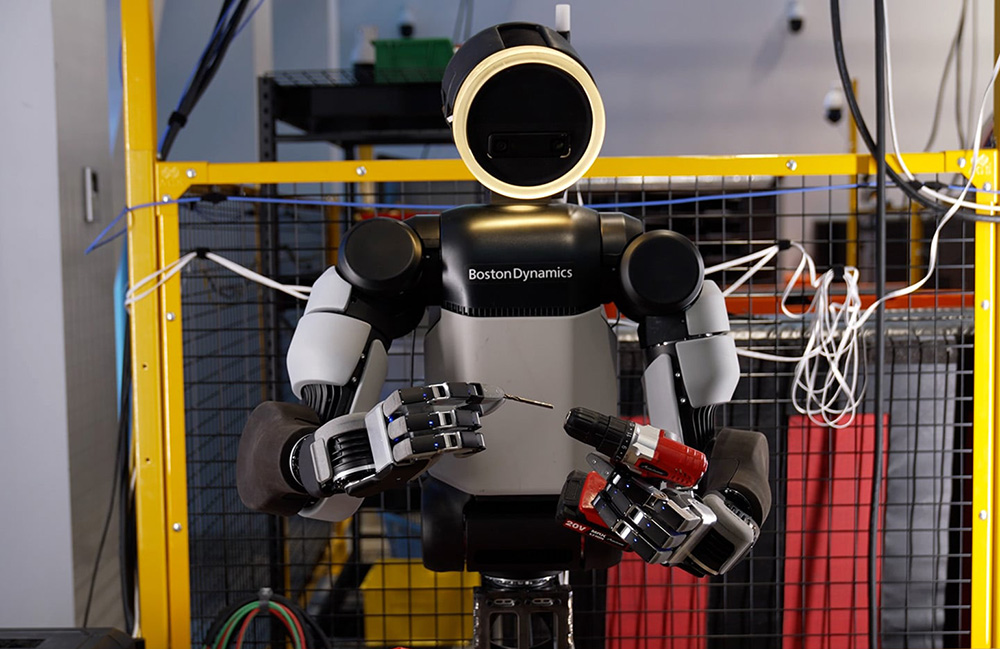
Boston Dynamics gave Atlas a four-finger hand with 13 degrees of freedom, judging a pinky not worth three more actuators. Manufacturability and simulation training shaped it as much as dexterity, and buyers can test that choice against their own task lists.
The Product Desk · Product desk
What happened
- The previous Atlas hand had seven degrees of freedom; the new one puts three in each finger and four in a more capable opposable thumb.
- All joints are directly driven by a single actuator type, and the actuators are encapsulated so no cables cross the joints.
- Boston Dynamics says four fingers already reorient objects in the hand, recover slipping grasps and work tools while pressing their triggers.
- The mechanics were optimized for high-fidelity simulation so control policies trained by reinforcement learning can transfer to the physical robot.
Compiled by The Product DeskSomething wrong?How this is made
Why it matters
- cost One actuator type across every joint, plus three fewer actuators per hand with no pinky, should shorten the spare-parts list a plant maintenance crew has to stock.
- constraint Lift plans built from the fridge demo would overrun the sustained rating on every repeated carry, so work cells have to be sized to the lower figure.
- capability Policies can meet varied motor behavior, surface friction and object geometry in simulation first, so a new task's early failures happen away from the physical robot.
A nail gun has a grip and a trigger, and the person using one holds the grip while one finger works the trigger. Boston Dynamics lists nail guns with drills, grinders, torque drivers and welding torches among the tools its new Atlas hand is designed to handle [16]. The hand is roughly the size of a large human hand because Atlas is meant to use human-scale tools and equipment [6].
Humanoids are increasingly designed to work in places built for people [18]. The easy next step is to copy the person down to the fifth finger. Boston Dynamics tested the copy against the job. Adding a pinky would have been relatively straightforward, the company said, so the team checked whether its tasks needed one [9]. A fifth finger would have meant three more actuators, adding cost, size and potential failure points [11].
The report gives enough to estimate the parts count. The joints are directly actuated [5], each finger other than the thumb has three degrees of freedom [4], and a fifth finger would add three actuators [11]. If each degree of freedom has its own actuator, as those figures suggest, the hand has 13 and a five-finger version would have 16, about 23 percent more [1].
The second design target is training. The transmissions are backdrivable, so outside forces can move the joints and Atlas can sense its own joint positions and motion [13]. Boston Dynamics said that, with controls that compensate for friction and motor cogging, this lets the hand be modeled with high dynamic fidelity [15]. Pressure-sensitive tactile sensors across the fingertips and palm add contact information [14].
The strength figure needs adjusting before it goes into a work-cell plan. The company said the hand can carry a loaded mini-fridge weighing more than 100 pounds [7]. The production Atlas is rated for an instantaneous payload of 110 pounds and a sustained payload of 66 [8]. The fridge sits within 10 pounds of the peak rating and at least 34 pounds above the sustained one [2].
Every figure here comes from Boston Dynamics through one report by Interesting Engineering, and it covers one company's hand [1]. On that evidence, Boston Dynamics put parts count and simulation fidelity ahead of anatomy. Whether other humanoid makers are doing the same is outside what the report covers. It does not include a price, an actuator count or failure data from deployed robots.
The test Boston Dynamics ran on the pinky works on any humanoid shortlist. Take the tasks planned for the robot's first month and sort them on two questions: do the parts arrive in a controlled orientation, and does the job need a tool trigger or in-hand reorientation. Controlled parts with neither need are work a conventional gripper already does well [17]. Varied parts with a trigger are the case Boston Dynamics built this hand for [16]. In my view, every joint a vendor adds beyond that should come with the name of the task that fails without it.
What to watch
- A published price or actuator count for the hand would let buyers check the manufacturability claim against numbers.
- Repair and failure records from Atlas deployments would show whether fewer actuators translate into less downtime.
- Hand designs from other humanoid makers would show whether four fingers stays a Boston Dynamics choice or spreads.