Science2 publishersIndependently confirmed2 min readPublished
Strain dating suggests gut microbes rare in industrialized people traveled with early humans
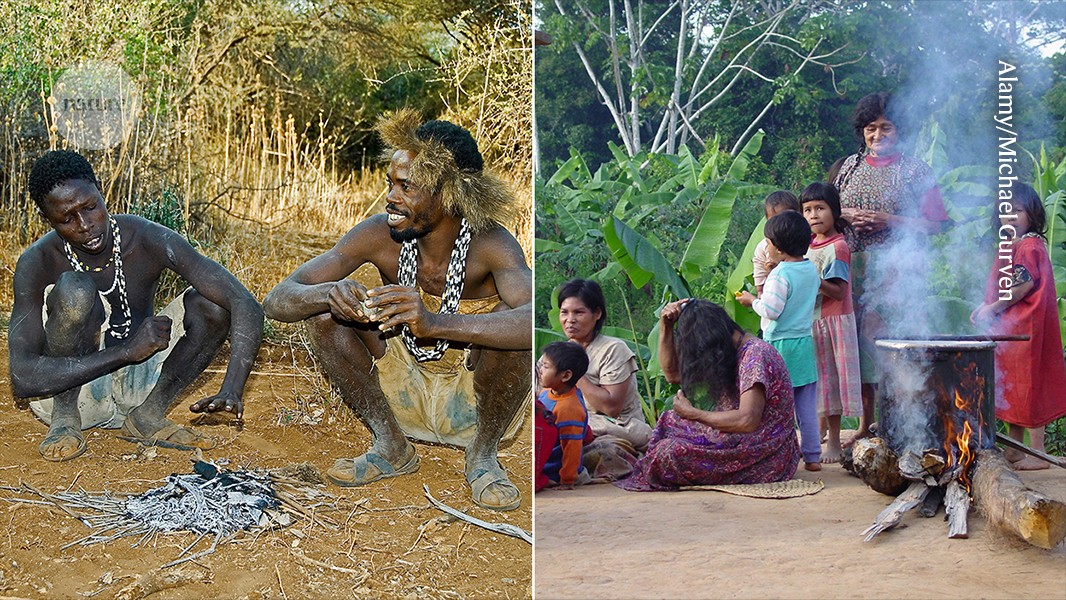
Stanford-led researchers find the Hadza and Tsimane share over 1,200 gut bacterial species, about 60% of them rare or absent in industrial guts. For many species, strain split dates match migrations out of Africa and into the Americas, so the missing microbes look like companions handed down over millennia.
The Scientist · Science desk
Drafted by a language model from the sources cited here and checked against its claim ledger before publication. How we use AISend a correction
What happened
- The ancestral populations of the Hadza, hunter-gatherers in Tanzania, and the Tsimane of the Bolivian Amazon separated geographically tens of thousands of years ago.
- The work is the first deep sequencing of Tsimane stool samples, which a 2020 Nature Communications study had read only at low resolution.
- A 2023 Cell study by the same Stanford group found the average Hadza person carries about 750 gut species, against 250 for the average Californian.
- The paper is due in Nature on Oct. 7 and asks whether Homo sapiens has carried a characteristic, diverse microbiome going back millennia.
Compiled by The ScientistSomething wrong?How this is made
Why it matters
- capability A dated list of long-resident gut species gives researchers specific candidates for testing how losing them changes human biology.
- constraint Health claims built on this result outrun it, because whether microbiome loss contributes to autoimmune disease, type 2 diabetes or obesity is still unresolved.
- constraint Comparisons that treat industrialized microbiomes as the human baseline are measuring against communities that lack most of the species these two distant groups share.
The design depends on distance. The Hadza are hunter-gatherers in Tanzania, and the Tsimane are forager-horticulturalists in the Bolivian Amazon whose lives have had comparatively limited exposure to industrialization [2]. A shared species list alone would not show that the microbes traveled with people. The stronger evidence is timing. The team used several complementary population-genetics methods to estimate when strains of each species diverged [6]. Strains picked up recently and separately would have no reason to split on the schedule of prehistoric human migrations.
Taken at face value, about 60% of more than 1,200 shared species comes to roughly 720 species that are rare or missing in industrialized guts [18]. Justin Sonnenburg, a professor of microbiology and immunology and the study's senior author [8], put it in stronger terms. "Our study establishes that the hundreds of bacterial species that are rare or missing in industrialized microbiomes were ancient companions of ours as we migrated around the globe, likely passed from generation to generation for millennia," he said [7].
Deep metagenomic sequencing reads all the DNA in a stool sample as millions of short fragments, joins overlapping fragments into longer sequences and matches those against databases of microbial genomes [9]. The Tsimane samples were given voluntarily and collected by the Tsimane Health and Life History Project, whose members are collaborators on the study [16]. Sequencing them deeply let the Stanford team build a census that includes hard-to-capture species [12]. The Hadza samples had been sequenced in the group's earlier work [17].
The dates measure how long the microbes have lived with humans and say nothing about why industrialized people lack them. Sonnenburg calls the removal recent. "This long-term association has implications for how such recent biodiversity loss in our microbiome may impact our biology and thus our health," he said [11]. What the study shows was handed down is the microbes themselves. The earlier evidence that lifestyle shapes microbiome composition [13] is untouched by the dating.
I think the timing result is the strongest part of the work, provided "many species" turns out to mean a large share of the 1,200 [4][6]. The Stanford account does not give that share, or the number of people sampled.
What to watch
- The full Nature paper's sample sizes and the share of the 1,200-plus species whose strain split dates actually match the migration timeline.
- Strain-level dating in other nonindustrialized populations, to test whether the co-migration pattern holds beyond two groups.
- Experiments testing whether adding or removing specific long-resident species changes immune or metabolic measures in people.