Product5 publishersWidely confirmed3 min readPublished Updated
A humanoid beat Bolt's 100m mark on a course that removed everything hard about the job
China's locomotion stack closed a human gap in about a year. It closed it in events that take out perception, grasping and anything unrehearsed, which is most of a deployment.
The Product Desk
What happened
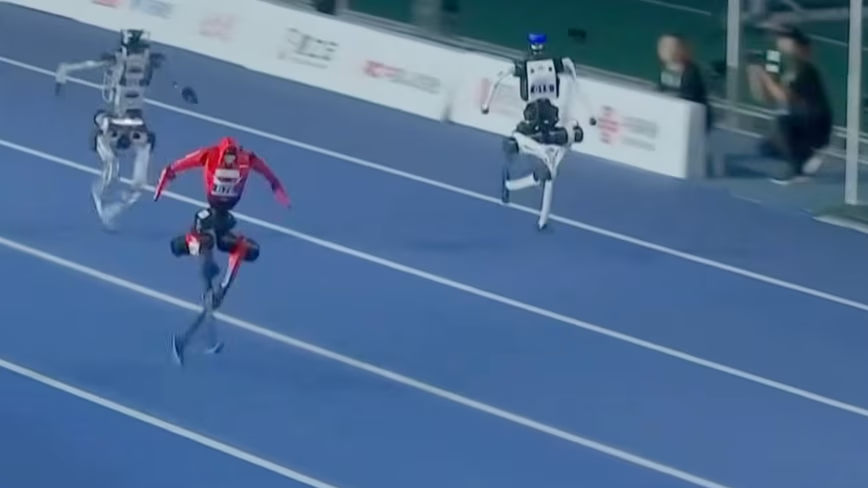
- A robot from Beijing's X-Humanoid ran the 100 metres in 9.39 seconds at the second World Humanoid Robot Games, inside Usain Bolt's 9.58.
- The same company's machine cleared 2.88 metres in the high jump, against Javier Sotomayor's human record of 2.45.
- The event runs more than 2,000 robots from 16 countries across 51 events at Beijing's Olympic speed skating oval.
- At the first games in 2025, much of what the robots did was remote controlled, in a field being reshaped by China's smartphone supply chain.
Compiled by The Product DeskSomething wrong?How this is made
Why it matters
- constraint A time on a measured lane bounds nothing in a stockroom, because the test contains no object to grasp, no unfamiliar room and no bystander to avoid.
- cost Leg geometry tuned to a track is capital spent on one measurement, and a buyer of a point-optimised chassis pays for tuning it cannot use.
- decision Shortlisting any of these vendors now means demanding an autonomy fraction on an unrehearsed task, since the medal table will not supply one.
- precedent Money is moving to training environments and contract manufacturing rather than stadiums, which sets the next claim to be tested: work on ground the robot has not seen.
A sprint lane is the most forgiving place a legged machine will ever be tested: fixed length, flat ground, nothing to pick up, nothing to identify, nobody in the way. That is what makes the twelve-month delta worth reading and also what caps what it tells a buyer. The winning 400 metres time at the first games was 2.05 times the human record; the winning 100 metres at the second was 0.98 times it [10]. Different distances, so not a clean comparison, but the control and actuator work behind that movement is real.
Honor's entry shows the method. The company added 10 centimetres of leg before the games, taking leg length to 1.05 metres [5], roughly a 10.5 percent increase on what it had [14], and a change aimed at one measurement. Its robot was timed at 9.32 seconds in trials [2], 0.07 seconds quicker than the run that took the record [9]. Note where the margins sit: the sprint record fell by about 2 percent [17], the high jump by 17.6 percent [16]. The bigger win came in the event with the shorter specification.
The figure the scoreboard does not carry is autonomy. At the April half marathon, 38 percent of entries ran autonomously [6], meaning 62 percent were flown by a remote pilot [13], and even the autonomous ones were following a route handed to them in advance [6]. Rodney Brooks, the MIT emeritus professor behind iRobot, called an earlier Beijing robot race a "publicity stunt" with "nothing useful that you could use in any application because it shows no safety at all" [11]. Yanran Ding of the University of Michigan names the audience error: people hold "a cognitive bias to think that running a half marathon faster than a human is more difficult than folding laundry, which is not true" [7]. Alan Fern of Oregon State puts the gains down to engineering and investment rather than a breakthrough, and sets the bar at a robot handling a place it has never seen [8].
So the discount is not on the locomotion. A firm that can post these times has shown it can grind an actuator and control problem down with money and a supply chain [10]. It has not shown transfer, and transfer is the entire content of the pitch when the machine reaches a stockroom. The companies working the other end of that problem are spending on unglamorous infrastructure instead: NEURA Robotics is building gyms to train robots in messy physical environments, and London's Humanoid has raised $152mn with Bosch lined up to manufacture at scale [12]. Neither produces a stadium photograph. Both produce the thing a stadium photograph is standing in for.
What to watch
- Whether the next games publish an autonomy split per event, so a sprint time can be read against how much of the run was piloted.
- Whether X-Humanoid or Honor show the same hardware doing unscripted manipulation rather than fixed-course locomotion.
- Whether Humanoid's $152mn and the Bosch manufacturing arrangement produce a deployed unit doing paid work in an environment it was not trained on.
Clarity's read
What the record supports and how the coverage leans. The claims behind it follow.
Reality
- Evidence60
- Adoption
- Insufficient
- Hype gap+40
- Incentives65
- Confidence60
Perspective Coverage
5 publishers- Builder
- Builder 47%
- Operator
- Operator 29%
- Investor
- Investor 24%
Claim ledger
Ranked by verification strength, evidence, and original report placement.
- [1]
A robot built by Beijing company X-Humanoid ran 100 metres in 9.39 seconds at the second World Humanoid Robot Games, against Usain Bolt's 9.58-second record from 2009.
- [2]
A machine from phone maker Honor was timed at 9.32 seconds in trials.
- [3]
More than 2,000 robots from 16 countries are competing across 51 events at Beijing's Olympic speed skating oval.
- [4]
At the first games in 2025, Unitree's H1 won the 400 metres in 88 seconds against a human record of 43 seconds, and much of what the robots did was remote controlled, in a field now being reshaped by China's smartphone supply chain.
- [5]
Honor lengthened its robot's legs by 10 centimetres to 1.05 metres before the games, a design change aimed at one number.
- [6]
In the April half marathon, only 38% of entries ran autonomously, the rest were piloted remotely, and even the autonomous ones followed a route they had already been given.
- [7]
Yanran Ding of the University of Michigan said people have "a cognitive bias to think that running a half marathon faster than a human is more difficult than folding laundry, which is not true."
ReportedSupportedSource: Yanran Ding, University of Michigan, quoted by thenextweb.com2 sources— create a free account to open themView cited source - [8]
Oregon State's Alan Fern attributes the gains to engineering and investment rather than a breakthrough, and says real progress means a robot handling a place it has never seen.
ReportedSupportedSource: Alan Fern, Oregon State University, via thenextweb.com2 sources— create a free account to open themView cited source - [9]
Honor's trial time was 0.07 seconds quicker than the run credited with beating Bolt's record.
- [10]
The 2025 winning 400 metres time was 2.05 times the human record, while the 2026 winning 100 metres time was 0.98 times the human record.
- [11]
Rodney Brooks, the MIT emeritus professor behind iRobot, called an earlier Beijing robot race a "publicity stunt" with "nothing useful that you could use in any application because it shows no safety at all."
ReportedSupportedSource: Rodney Brooks, MIT emeritus professor, quoted by thenextweb.comView cited source - [12]
NEURA Robotics is building gyms to train robots in messy physical environments, while London's Humanoid raised $152mn with Bosch lined up to manufacture at scale.
- [13]
62% of half marathon entries were remotely piloted rather than autonomous.
- [14]
Honor's added 10 centimetres represents about a 10.5% increase on the robot's previous leg length of 95 centimetres.
- [15]
The same firm's robot cleared 2.88 metres in the high jump, beyond Javier Sotomayor's human record of 2.45 metres.
- [16]
The high jump mark was 17.6% above the human record.
- [17]
The 100 metres record was beaten by about 2.0%, an order of magnitude smaller margin than the high jump result.
Sources
5 independent publishers whose own reporting we read for this story.
- dexerto.comRobot breaks Usain Bolt’s 100m world record before massive crash into wall
1 article · August 24, 2026
- gizmodo.comThe Robots Beat Usain Bolt, Then Met Their Match: Beans
1 article · August 24, 2026
- interestingengineering.comLightning humanoid robot runs 100 meters in 9.32 seconds to beat Usain Bolt’s record
1 article · August 24, 2026
- thenextweb.comA humanoid robot just beat Usain Bolt’s 100m record, and roboticists are unimpressed for good reason
1 article · August 23, 2026
- theverge.comHumanoid robots smash Usain Bolt’s 100-meter record
1 article · August 24, 2026
Topics and entities
Follow any of these and your For You feed starts watching them — no settings page required.
Topics
- China Robotics IndustryFollow
- Humanoid RobotsFollow
- Robot locomotionFollow
- Robotics benchmarks and competitionsFollow