Build4 publishersIndependently confirmed2 min readPublished
Boston Dynamics hands Atlas's move into factories to former Amazon AI chief Rohit Prasad
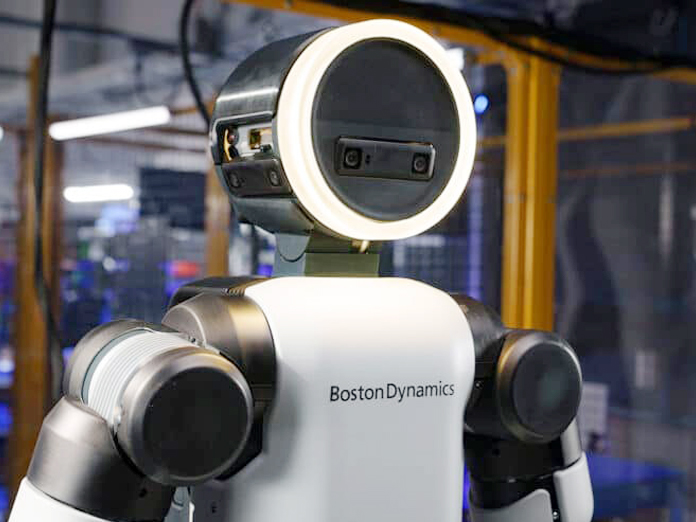
Boston Dynamics made former Amazon AI chief Rohit Prasad CEO from October 7, with Atlas deployments at Hyundai and Google DeepMind scheduled for 2026. His record is in shipping AI software to households, while the job he takes on is getting a humanoid to work reliably through factory shifts.
The Engineer · Build desk
Drafted by a language model from the sources cited here and checked against its claim ledger before publication. How we use AISend a correction
What happened
- Prasad spent nearly 14 years leading machine-learning research at Raytheon BBN Technologies, then 12 years at Amazon working on Alexa and artificial intelligence.
- Robert Playter stepped down as CEO in February, and chief financial officer Amanda McMaster ran the company as interim CEO while the board searched for a successor.
- Hyundai controls the company, having completed the purchase of an 80% stake in 2021 in a deal that valued Boston Dynamics at $1.1 billion.
- Boston Dynamics already has two robots in commercial use, Spot for inspection and Stretch for handling boxes in warehouses.
Compiled by The EngineerSomething wrong?How this is made
Why it matters
- constraint Atlas gets roughly two years between its first customer deployments and Hyundai's own plant to build the shift-by-shift reliability record a buyer would price against.
- cost Hyundai bears the cost of building humanoid capacity ahead of proven demand, and that capacity pays only if buyers outside Hyundai's own plants commit.
- constraint Alexa's household reach measures software distribution, so it predicts little about running a humanoid fleet that needs safety sign-off, field service and line integration.
RuntimeWire describes the job as turning technical performance into reliable, repeatable work that customers will pay to scale [13]. The outlet links the timing of the hire to Atlas's move toward production [11]. That move changes what counts as success. A controlled demonstration has to work once. A deployment, by RuntimeWire's account, has to run safely and reliably across shifts, fit into the plant's workflow and compete with the automation already installed [14].
The most recent Atlas step the outlet covered was the robot carrying a mini fridge, a test of whole-body manipulation with an awkward object [18]. It was a sensible choice of task, because it put the emphasis on manipulation over acrobatics [18]. But the reporting does not include a reliability figure, a unit price or a customer beyond Hyundai and Google DeepMind [10].
Prasad has said the talking computer on Star Trek helped steer him toward speech processing and conversational AI [19]. His actual record is scale in software. Boston Dynamics says Alexa reached hundreds of millions of households [8], and Prasad later led Nova, Amazon's foundation-model family [2]. Those are company-reported measures of distribution. For them to predict how Atlas will do, the hard part of Atlas would have to be its software. RuntimeWire's counterpoint is that robotics adds hardware, safety, service and integration demands that a voice assistant does not face [15].
I think the board is betting that the software is the hard part. Boston Dynamics calls its effort Physical AI, meaning systems that perceive and act in real environments [9], and a foundation-model executive fits that description of the problem. The company's roots are in hardware. Founder Marc Raibert started it after research into dynamic, legged robots [12], and its work has long been judged by what its machines can do in motion [17].
Hyundai has said it plans to deploy Atlas at its Georgia plant beginning in 2028 and to build capacity to produce as many as 30,000 humanoid robots a year, Bloomberg reported [4]. Counted from the 2026 deployments, that is about two years [20]. The 30,000 is a capacity target. It does not describe current production or sales [4]. RuntimeWire calls Hyundai a potential first customer and test site, and names demand beyond Hyundai and economical production at scale as the tests still ahead [16].
What to watch
- Results from the 2026 Hyundai and Google DeepMind deployments, especially any published uptime or task-success figures across full shifts.
- A named Atlas customer outside Hyundai, or a list price for the robot.
- Prasad's first senior hires in hardware, safety and field service.