Science1 publisherNot yet confirmed elsewhere3 min readPublished
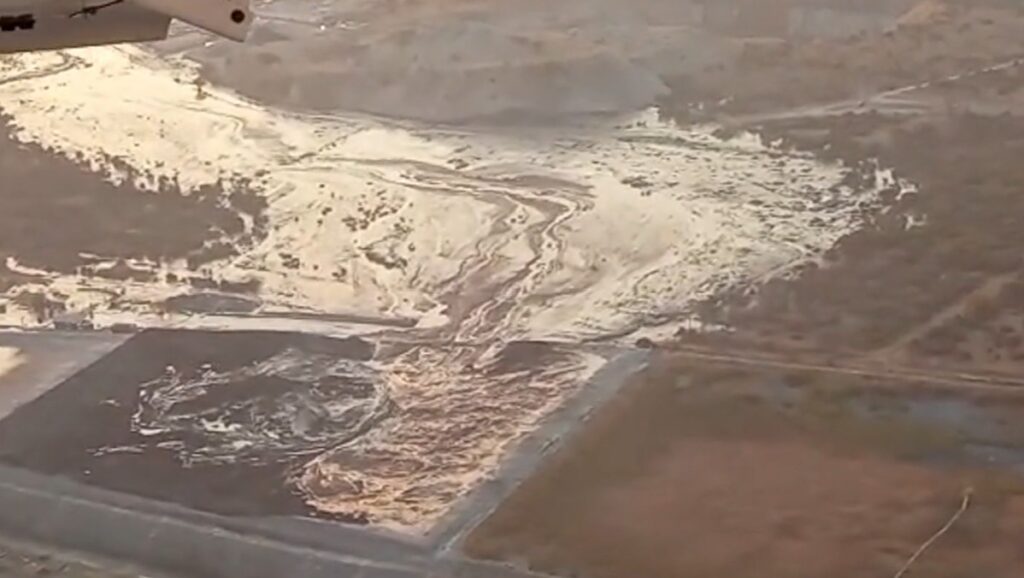
A chrome tailings dam near Brits failed while it appeared to be idle
Satellite imagery from 15 July put the Dikwena impoundment in an apparently inactive state 29 days before the 13 August breach. Dormant structures are the part of the portfolio nobody staffs.
The Scientist · Science desk
Drafted by a language model from the sources cited here and checked against its claim ledger before publication. How we use AISend a correction
What happened
- A major tailings accident occurred at a chrome mine at Dikwena near Brits, South Africa.
- On 13 August 2026 a major failure occurred in a large tailings storage facility at the Dikwena facility, owned by Samancor Chrome, in the Brits area of South Africa.
- The failure appears to have originated in a failure of the dam wall of one of the tailings storage facilities at the site.
- The location of the failure appears to have been 25.65236 degrees South, 27.85177 degrees East.
- The blog post includes a Google Earth image of the site, with the location of the breach marked, collected on 15 July 2026.
Compiled by The ScientistSomething wrong?How this is made
Why it matters
A tailings storage facility at Samancor Chrome's Dikwena operation near Brits, South Africa, failed on 13 August 2026 [6], and the breach appears to have originated in the wall of one of the dams on the site [1]. The detail that should interest anyone holding a mine waste portfolio is not the collapse itself but its apparent state beforehand: a Google Earth scene of the site collected on 15 July 2026, with the eventual breach point marked at 25.65236 S, 27.85177 E, led the Landslide Blog at eos.org to observe that this facility "does not appear to have been active in July" [2][7][8].
That is 29 days between the image and the failure [12]. It is also an observation from one image, not a deposition record, and the blog offers it as exactly that [8]. But if it holds, the failure mode on the table is not an operating crew pushing a rate too hard. It is a structure that had stopped producing the routine operational signals - deposition planning, beach management, daily walkovers by people who are on site because there is a job to do there - that most tailings monitoring quietly depends on.
The history described by tailings expert Alastair Bovim, interviewed by the Daily Maverick, makes the dormancy question sharper rather than softer. According to Bovim, the original facility was re-mined between 2019 and 2022, a new facility was designed in 2022, and that new facility started operation in 2024 [3]. He said historical satellite imagery from 2022 to 2024 shows new dams and walls being constructed [4]. On those dates the structure moved through re-mining, redesign, construction and operation inside roughly seven years [14], with the current facility in operation for about two years before it failed [13]. Sites with that much recent reconfiguration are exactly where a "which impoundment is this, who owns its instrumentation, and is it live" question gets answered badly.
Two things about the evidence base are worth noting for operators reading this as a governance case rather than a news item. First, the public record so far is being assembled from a video of the aftermath collected by Iaan Myburgh and published by the Daily Maverick, from a Sentinel-2 image posted to LinkedIn by Adam Thomas, and from images and videos posted by Peter McGough, alongside reporting from IOL [9][10]. Second, the blog carries no casualty count and no spill volume [15]. When third-party imagery and social posts are the fastest source of quantified aftermath, internal monitoring was not the first thing to speak.
What to watch: whether Samancor confirms or contradicts the July inactivity read with actual deposition records; whether the 2019 to 2022 re-mining and 2024 restart sequence described by Bovim is confirmed by the operator [3]; and whether casualty figures and released volumes are published at all [15]. The blog's own closing note is the right expectation to hold - "This event asks many questions. I wonder how many answers we'll get" [11].