ProductIndependently confirmed2 publishers2 min readPublished
Tangshan desalination plant piping brine to a soda ash maker claims 60% lower energy use
Tangshan Sanyou Group's Hebei desalination plant has entered trial production, claiming 60% lower power use and brine turned into soda ash feedstock. The 60% is the company's own figure with no clear baseline, so operators should treat it as a design claim to test.
The Product Desk
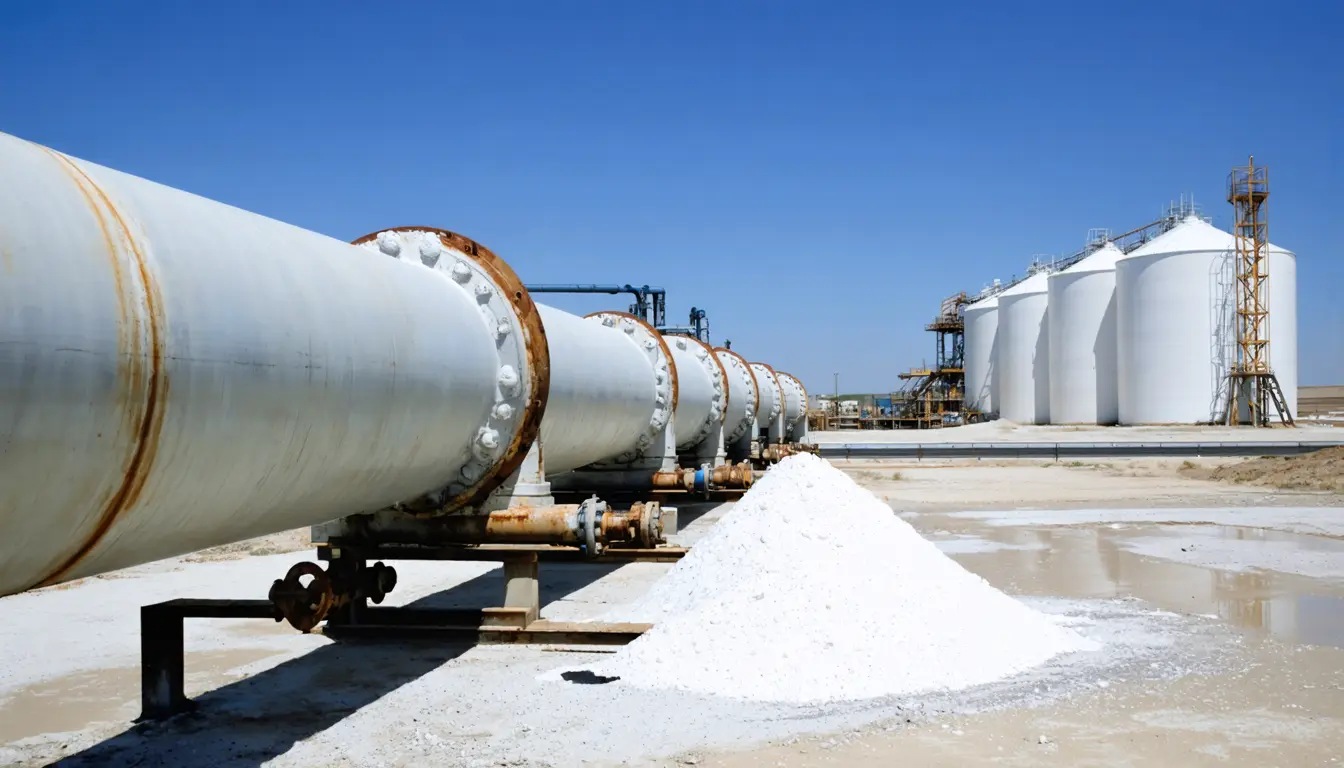
Nearly 100 million tonnes of concentrated seawater a year once the project reaches its third phase; about 33.3 percent of input brine leaves as concentrate, 66.7 percent as fresh water; concentrate salinity 120 grams per liter, per SCMP; a 50-kilometer pipeline to a nearby soda ash plant.
| Figure | Value | Note | Claim |
|---|---|---|---|
| Seawater processed yearly at third phase, nearly | 100 million tonnes | 11 | |
| Input brine volume leaving as concentrate, about | 33.3% | 66.7 percent leaves as fresh water | 6 |
| Concentrate salinity | 120 g/L (SCMP) | 2 | |
| Pipeline to soda ash plant | 50 km | 4 |
What happened
- Under the three-to-one conversion the South China Morning Post reported, every 3 tonnes of raw waste brine yields 2 tonnes of fresh water and 1 tonne of concentrate at 120 grams per liter.
- Tangshan Sanyou's four-stage process uses specialized membrane components to filter out calcium and magnesium while keeping the sodium chloride.
- The concentrate moves through a 50-kilometer pipeline to a nearby chemical plant, where it is raw material for soda ash.
Why it matters
- constraint The brine-to-salt result depends on a chemical plant within pipeline reach. A site without one would still have a third of its input volume to place.
- exposure A business case that cites the 60 percent is relying on the developer's own R&D head, relayed through a secondary write-up.
- contradiction The write-up calls the plant uniquely advanced and a possible permanent relief for Bohai Bay, while describing it as reportedly cutting power and only in trial production.
Anyone who forwards this plant's headline to a finance lead will be asked for the baseline first, and the source gives the 60 percent in two forms. The opening says the facility reportedly cuts power demands by 60 percent [7]. Speaking to Science and Technology Daily, Zhao Lin, head of R&D at Tangshan Sanyou Group, said the plant uses 60 percent less electricity than standard desalination methods, in a sentence that ties the saving to generating 10,000 yuan in economic value [8]. Zhao also said the project is the "largest" and most energy-efficient of its kind worldwide [10].
A saving measured per 10,000 yuan of output moves with the price of what the plant sells, but a saving per tonne of water does not. Interesting Engineering did not report a kilowatt-hour figure, a named comparison plant or any measurement from outside the company.
The plant, as described, depends on a pipeline as much as on its membranes. Under the three-to-one split, about two thirds of the input volume leaves as fresh water and the remaining third leaves as concentrate [6]. The membranes make that concentrate usable, and the chemical plant at the end of the pipe decides whether it counts as a product [4].
Scale is stated two ways. The opening cites millions of tonnes of waste brine [7]. The third phase is put at nearly 100 million tonnes of concentrated seawater a year [11], and the plant today is in trial production [1]. If the 100 million tonnes is input brine at the three-to-one split, about 33 million tonnes a year of concentrate would move down the pipeline [13].
We would keep the 60 percent out of any business case until it arrives as a per-cubic-metre figure against a named baseline, and we would run the site test now. If the number holds up, waiting means a slower start, and the site test takes one call to the nearest chemical producer.
The site question and the energy question sort an operator's case into four cells. The site question: is there a soda ash or comparable chemical plant within pipeline reach that would take a concentrate near 120 grams per liter [2]? The energy question: can the claim be restated per cubic metre against your current plant? Yes to both is worth a vendor conversation. A buyer in reach with no restated energy figure is a waste-handling project, to be judged on disposal cost. An energy figure with no buyer is an energy project that leaves the concentrate with you.
What to watch
- Whether Tangshan Sanyou or Science and Technology Daily publishes electricity use per cubic metre of water against a named baseline plant.
- Trial-production data confirming the three-to-one split and the 120 grams per liter concentrate.
- Whether the plant reaches its third phase of nearly 100 million tonnes a year and how much concentrate the soda ash plant takes.
Clarity's read
What the record supports and how the coverage leans. The claims behind it follow.
Reality
- Evidence35
- Adoption8
- Hype gap+55
- Incentives65
- Confidence45
Claim ledger
Ranked by verification strength, evidence, and original report placement.
- [1]
A large-scale desalination facility in the Caofeidian industrial zone of Tangshan, Hebei province, China, has entered trial production.
- [2]
The South China Morning Post reported a three-to-one conversion ratio: for every three tonnes of raw waste brine processed, the plant yields two tonnes of fresh water and one tonne of hyper-concentrated brine with a salinity of 120 grams per liter.
ReportedSupportedSource: South China Morning Post, as relayed by Interesting Engineering2 sources— create a free account to open themView cited source - [3]
The plant was designed through a collaboration between Tangshan Sanyou Group and academic experts.
- [4]
The hyper-concentrated brine travels through a 50-kilometer pipeline to a nearby chemical plant, where it is raw material for soda ash used in glass, metallurgy, paper, textiles and food manufacturing.
- [5]
Researchers at Tangshan Sanyou Group designed a four-stage process using specialized membrane components that selectively filter out calcium and magnesium while preserving pure sodium chloride.
- [6]
About two thirds (66.7 percent) of input brine volume leaves as fresh water and one third (33.3 percent) leaves as concentrate.
- [7]
The facility reportedly cuts power demands by 60 percent and turns millions of tonnes of waste brine from desalination runoff into chemical salt.
- [8]
Speaking to Science and Technology Daily, Zhao said the plant uses 60 percent less electricity than standard desalination methods, in a sentence that ties the saving to generating 10,000 yuan in economic value.
ReportedInsufficientSource: Zhao Lin to Science and Technology Daily, as reported by Interesting Engineering2 sources— create a free account to open themView cited source - [9]
The article says the single facility could permanently relieve Bohai Bay of one of its heaviest industrial burdens, and calls the innovation a long-term cure for marine pollution there.
ReportedInsufficientSource: Interesting Engineering2 sources— create a free account to open themView cited source - [10]
Zhao Lin, head of R&D at Tangshan Sanyou Group, said the project is the "largest" and most energy-efficient of its kind worldwide.
ReportedInsufficientSource: Zhao Lin, head of R&D at Tangshan Sanyou Group, as reported by Interesting EngineeringView cited source - [11]
Once the project reaches its third phase, the plant will process nearly 100 million tonnes of concentrated seawater annually.
- [12]
The article says global initiatives currently operate mostly at pilot or research levels, making the Tangshan facility uniquely advanced due to its scale, direct connection to soda ash manufacturing, and power cuts.
- [13]
If the 100 million tonnes a year is input brine at the three-to-one split, about 33 million tonnes a year of concentrate would move down the pipeline.
Sources
2 independent publishers whose own reporting we read for this story.
- interestingengineering.comChina’s new desalination plant cuts energy use by 60%, turns waste into useful salt
1 article · October 12, 2026
- scmp.comChinese desalination plant cuts 60% energy use by turning waste brine to industrial salt
1 article · October 11, 2026
Topics and entities
Follow any of these and your For You feed starts watching them — no settings page required.
Topics
- Industrial water reuseFollow
- DesalinationFollow
- Brine managementFollow
Entities
- South China Morning PostFollow
- Zhao LinFollow
- Tangshan Sanyou GroupFollow
- Science and Technology DailyFollow