ProductNot yet confirmed elsewhere1 publisher3 min readPublished
CAS cobalt-manganese catalyst converts 83% of carbon monoxide from wood syngas in testing
Chinese Academy of Sciences researchers report a cobalt-manganese catalyst that converted nearly 83% of carbon monoxide from wood-based syngas in testing. So far the case for cheaper fuel rests on one producer's profit projection, and no price has been published for the airlines that would buy the fuel.
The Product Desk
What happened
- Formed into pellets for pilot testing, it made over 5.15 grams of product per gram of cobalt per hour, with 79% of the liquid in the jet-fuel range.
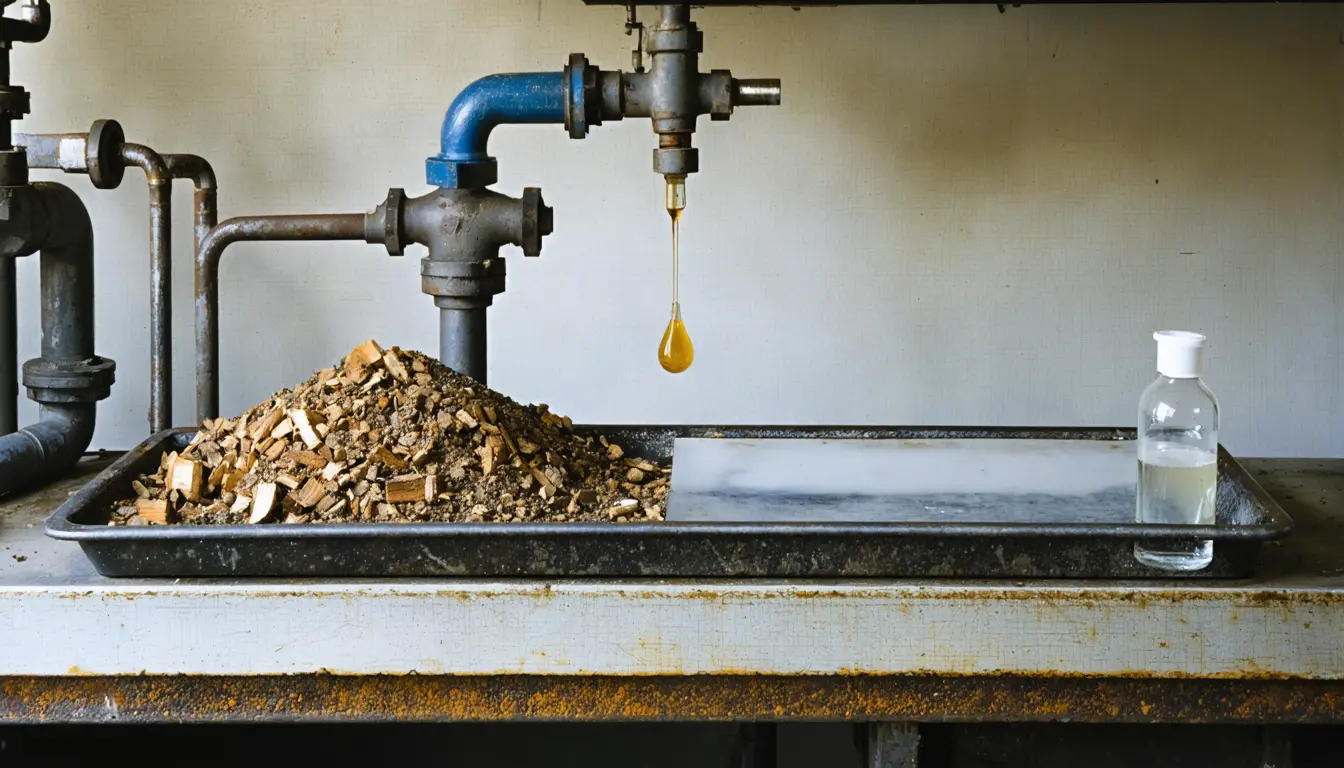
- A 1,000-tonne pilot test ran the catalyst on syngas made from woody biomass.
- A planned 100,000-tonne Sichuan plant is expected to earn $302 million a year by 2028 against $114 million in operating costs, the South China Morning Post reported.
Why it matters
- contradiction The reported revenue and cost imply a 62% margin against the 55% quoted, leaving about $22 million a year of cost unexplained in the public figures.
- decision Fuel buyers weighing supply from the Sichuan plant still need a per-tonne price, because the 55% figure only tells them the producer expects to profit.
- capability If the reported CO2 tolerance holds at scale, a project can plan around unrefined biomass syngas instead of designing for a clean feed.
A plant engineer reading this study would go straight to the pellets. That is the form the researchers used for pilot testing [7]. In that run the catalyst made more than 5.15 grams of product per gram of cobalt per hour, and 79% of the liquid fell in the jet-fuel range [7]. The more widely quoted selectivity figure, over 67%, has a different denominator: all the hydrocarbons produced [3].
The design goes after an old Fischer-Tropsch compromise. Run the reaction faster and more of the output turns into unwanted gases instead of jet-range hydrocarbons [4]. The team at CAS Shanghai Advanced Research put cobalt and manganese on etched Beta zeolites to improve speed and selectivity together [1][5]. "It also exhibits remarkable stability and strong tolerance to CO2-rich feeds, thus enabling it to process real-world syngas feedstocks," the researchers wrote in the study paper [6].
The pitch built on these results is cheaper sustainable aviation fuel. The work behind it so far is a catalyst test and a 1,000-tonne pilot on woody biomass syngas [8]. "Excellent performance in industrial test and techno-economic analysis further demonstrates the strong potential of this catalyst for scalable production of SAF," the researchers wrote [9]. The cost figures in circulation come from the South China Morning Post. It reports a planned 100,000-tonne plant in Sichuan expected to bring in $302 million a year by 2028, with $114 million in operating costs and an estimated gross margin near 55% [18][14].
Those numbers do not agree. Revenue less operating cost is $188 million, about 62% of revenue [15][16]. A 55% margin would need roughly $136 million in costs, around $22 million more than the stated operating figure [17]. The article does not explain the difference or give the plant's capital cost.
If 100,000 tonnes is the plant's annual saleable output, the projection works out to about $3,020 of revenue and $1,140 of operating cost per tonne [12][13]. Those are producer-side numbers. A wide margin is easy to read as room to cut prices. It is just as consistent with a plant that charges a high price and keeps the difference. I'd expect an airline fuel buyer to ask first for a delivered price per tonne, set against the fossil jet fuel it buys now. Sustainable fuels make up under 1% of jet fuel consumed worldwide, and the article puts that mainly down to high production costs [10][11].
Sort each figure in the story along two lines: measured or projected, and producer-side or buyer-side. Measured and producer-side: the 83% conversion, the 67% and 79% selectivity figures and the 5.15-gram rate [2][3][7]. Projected and producer-side: the $302 million, the $114 million and the 55% [18][14]. Both buyer-side boxes are empty, and the claim that wood-based jet fuel is getting cheaper belongs in one of them.
I'd treat the catalyst as a credible yield result and hold the cost claim until the Sichuan plant quotes a price. The tradeoff is that a buyer who waits may be late to a plant that does hit its numbers, and that plant is due to be finished before 2028 [19].
What to watch
- Whether the Sichuan plant publishes a selling price per tonne for its jet fuel that buyers can set against fossil jet.
- A reconciliation of the $302 million revenue and $114 million cost figures with the 55% margin, or a published capital cost for the plant.
- Whether the pellet-form conversion and selectivity figures hold once the 100,000-tonne plant is running, due before 2028.
Clarity's read
What the record supports and how the coverage leans. The claims behind it follow.
Reality
- Evidence35
- Adoption10
- Hype gap+45
- Incentives
- Insufficient
- Confidence40
Claim ledger
Ranked by verification strength, evidence, and original report placement.
- [1]
The Chinese Academy of Sciences (CAS) Shanghai Advanced Research has developed a cobalt-manganese catalyst that converts syngas derived from woody biomass and other feedstocks into sustainable aviation fuel.
- [2]
In testing, the catalyst converted nearly 83 percent of carbon monoxide.
- [3]
The catalyst directed over 67 percent of the resulting hydrocarbons into the carbon range needed for jet fuel.
- [4]
Fischer-Tropsch industrial chemistry typically suffers from a compromise where increasing reaction speeds results in unwanted gases instead of jet-fuel hydrocarbons.
- [5]
The researchers designed the cobalt-manganese catalyst supported on etched Beta zeolites to optimize processing speed and product selectivity simultaneously.
- [6]
"It also exhibits remarkable stability and strong tolerance to CO2-rich feeds, thus enabling it to process real-world syngas feedstocks," the study paper said.
- [7]
During pilot testing the catalyst was formed into solid pellets and produced over 5.15 grams of product per gram of cobalt per hour, with 79 percent of the resulting liquid consisting of jet-fuel hydrocarbons.
- [8]
A 1,000-tonne pilot test combined woody biomass syngas with the new cobalt-manganese catalyst for jet fuel production.
- [9]
"Excellent performance in industrial test and techno-economic analysis further demonstrates the strong potential of this catalyst for scalable production of SAF," the researchers noted in the study paper.
- [10]
Sustainable alternative fuels make up under 1 percent of jet fuel consumed worldwide.
- [11]
The main issue for sustainable aviation fuel is high production costs combined with early-stage technologies and expensive feedstocks.
- [12]
If the plant sells 100,000 tonnes a year, projected revenue is about $3,020 per tonne.
- [13]
If the plant produces 100,000 tonnes a year, projected operating cost is about $1,140 per tonne.
- [14]
The Sichuan plant figures leave an estimated gross profit margin near 55 percent.
- [15]
Projected revenue less operating cost at the Sichuan plant is $188 million a year.
- [16]
The reported revenue and operating cost imply a gross margin of about 62%, against the 55% quoted.
- [17]
A 55% gross margin on $302 million of revenue implies about $136 million in costs, roughly $22 million more than the $114 million operating figure.
- [18]
A planned 100,000-tonne facility in Sichuan province is expected to generate $302 million in annual revenue by 2028, with operating costs of $114 million, according to the South China Morning Post.
ReportedInsufficientSource: South China Morning Post, as cited by Interesting EngineeringView cited source - [19]
Plans are underway to complete the commercial-scale Sichuan plant before 2028.
Sources
1 independent publisher whose own reporting we read for this story.
- interestingengineering.comNew catalyst converts wood into jet fuel with 83% carbon monoxide conversion
1 article · October 9, 2026
Topics and entities
Follow any of these and your For You feed starts watching them — no settings page required.
Topics
- Biomass gasificationFollow
- Fischer-Tropsch synthesisFollow
- Sustainable Aviation FuelFollow
Entities
- Shanghai Advanced Research Institute, Chinese Academy of SciencesFollow
- Chinese Academy of SciencesFollow
- South China Morning PostFollow