Product1 publisher2 min readPublished
Dalian researchers boil seawater with electrolyzer waste heat in a 250 kW hydrogen plant
Chinese Academy of Sciences researchers report a 250 kW seawater hydrogen plant with 14.4% better electricity use than alkaline electrolysis. Stack heat distills the plant's own feed water and leaves a brine that could yield uranium, though no recovery rate has been reported.
The Product Desk · Product desk
Drafted by a language model from the sources cited here and checked against its claim ledger before publication. How we use AISend a correction
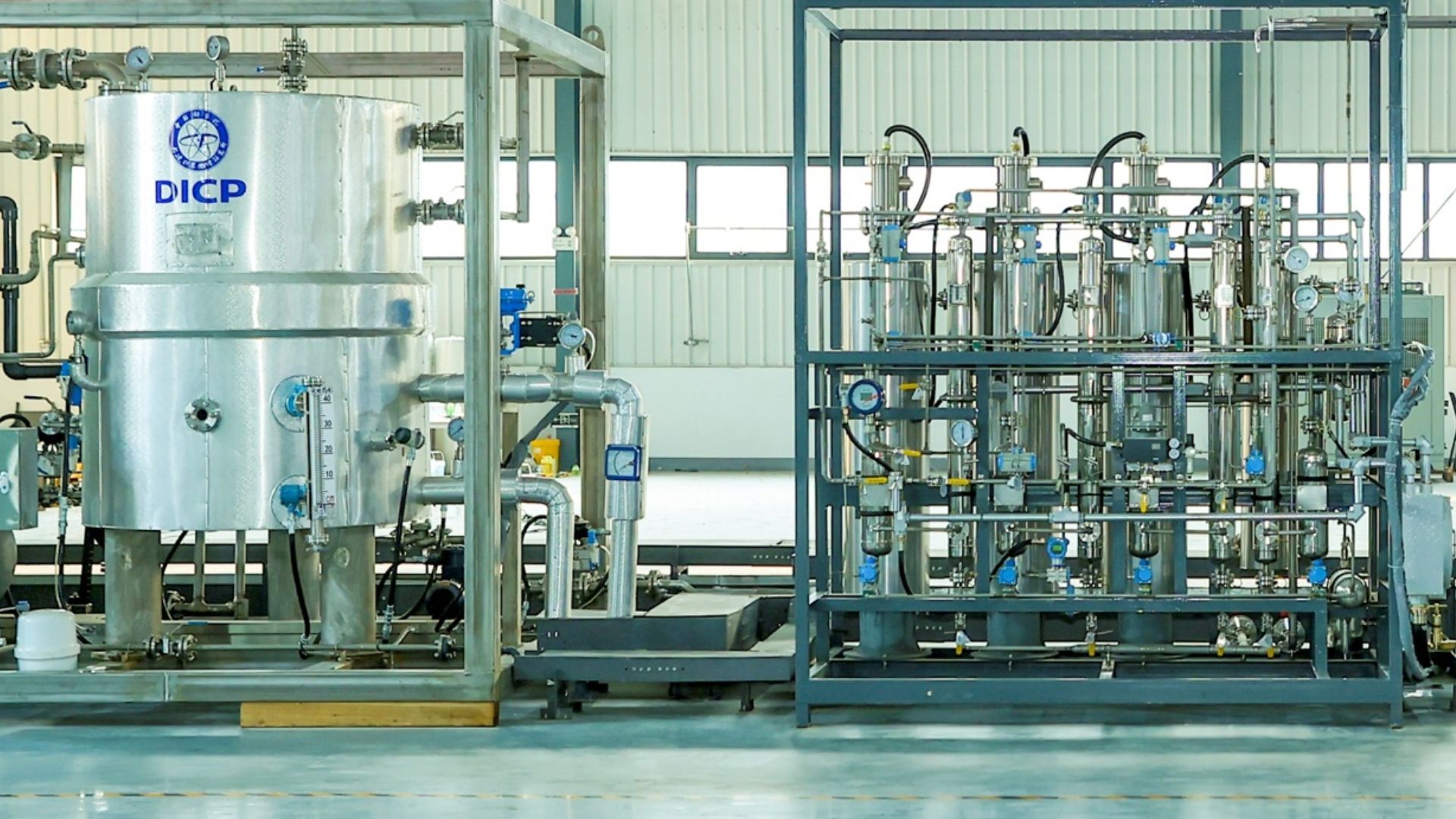
What happened
- The plant makes 380,000 standard cubic meters of hydrogen a year at 99.99% purity, along with 256 metric tons of fresh water, according to the study.
- In testing it ran for 40 days under daily start-stop conditions without an obvious decline in performance.
- It scales up a 25 kW unit from 2023 built on the same desalination technology. The China Petroleum and Chemical Industry Federation gave that earlier unit an internationally leading rating.
- The study puts hydrogen at $2.10 a kilogram on onshore wind power at $0.033/kWh and $2.90 on solar at $0.049/kWh, against a selling price near $3.90.
Compiled by The Product DeskSomething wrong?How this is made
Why it matters
- cost Moving from the wind case to the solar case cuts the estimated margin under the $3.90 selling price from $1.80 to $1.00 a kilogram. The site's power price decides how much room the design leaves.
- exposure Wind- and solar-fed projects can count daily cycling as tested for this design only over weeks. Long-term stack and tower wear stays a risk the operator carries.
- decision The study says the integrated design could be more competitive than desalinating first and electrolyzing after. Teams already committed to the two-step layout now have a published case to check their cost model against.
An engineer specifying an electrolyzer for a coastal site has two ways to get water into it. Both cost something. If the stack runs on raw seawater, chloride ions corrode the anode and calcium and magnesium deposits build up on the cathode [5]. If the site desalinates first, by reverse osmosis or distillation, it takes on extra equipment and a larger electricity draw [6].
The group led by Deng Dehui and Liu Yanting at the Dalian Institute of Chemical Physics started from the desalinate-first route and looked for energy it was losing [4][18]. Commercial stacks run at 80 to 90 degrees Celsius, and about 30% of their electricity can leave as low-grade heat, according to the study [7]. If the 250 kW rating is electrical input, that comes to roughly 75 kW of heat [19]. The plant pipes that heat into a vacuum distillation tower. There seawater boils at 40 to 50 degrees Celsius and the vapor condenses into fresh water [8].
Interesting Engineering's headline on the study has the plant pulling uranium from seawater [23]. The article's text is narrower: the concentrated brine can be processed to recover salt, uranium, bromine and other marine resources [22]. The fresh water output exists but is modest, about 0.7 tonnes a day [20]. The Chinese Academy of Sciences said that is enough to feed the electrolyzer with water left over [1]. The reporting does not split the annual total into feed and surplus.
Deng named three priorities for future work: better catalysts, recovering more of the electrolyzer's waste heat, and using artificial intelligence to optimize the plant's operating parameters [17].
The design suits a coastal hydrogen project that would otherwise build a separate desalination unit to feed its stacks. I'd model it as a hydrogen plant that makes its own water, and leave the minerals out until the numbers exist. The tradeoff is that a team waiting for those numbers may undersell a site with a salt or bromine buyer nearby.
Each output gets two tests: whether the study reports an annual figure for it, and whether the site has a buyer for it. An output with a figure and a buyer goes in the revenue model, and hydrogen is the obvious entry. An output with a figure and no buyer is a site utility. A small water surplus belongs in that box at a site that already has mains water. A buyer without a measurement is a conversation to open with the research team. An output with no figure and no buyer stays out of the model, and uranium belongs there until someone publishes a recovery rate.
What to watch
- A published recovery rate for uranium, bromine or salt from the plant's concentrated brine.
- A run well past 40 days, or a plant larger than 250 kW, under the same daily start-stop conditions.
- An independent check of the $2.10 and $2.90 per kilogram cost estimates against real power contracts.