Tall ice cliffs retreated faster than models predict without runaway collapse, Needell's team reports
Caroline Needell's team found the tallest glacier cliffs retreating faster than models predict, yet none showed unstable retreat in satellite data. That moves the sea-level question to whether faster flow can thin the cliffs before they fail.
The Scientist · Science desk
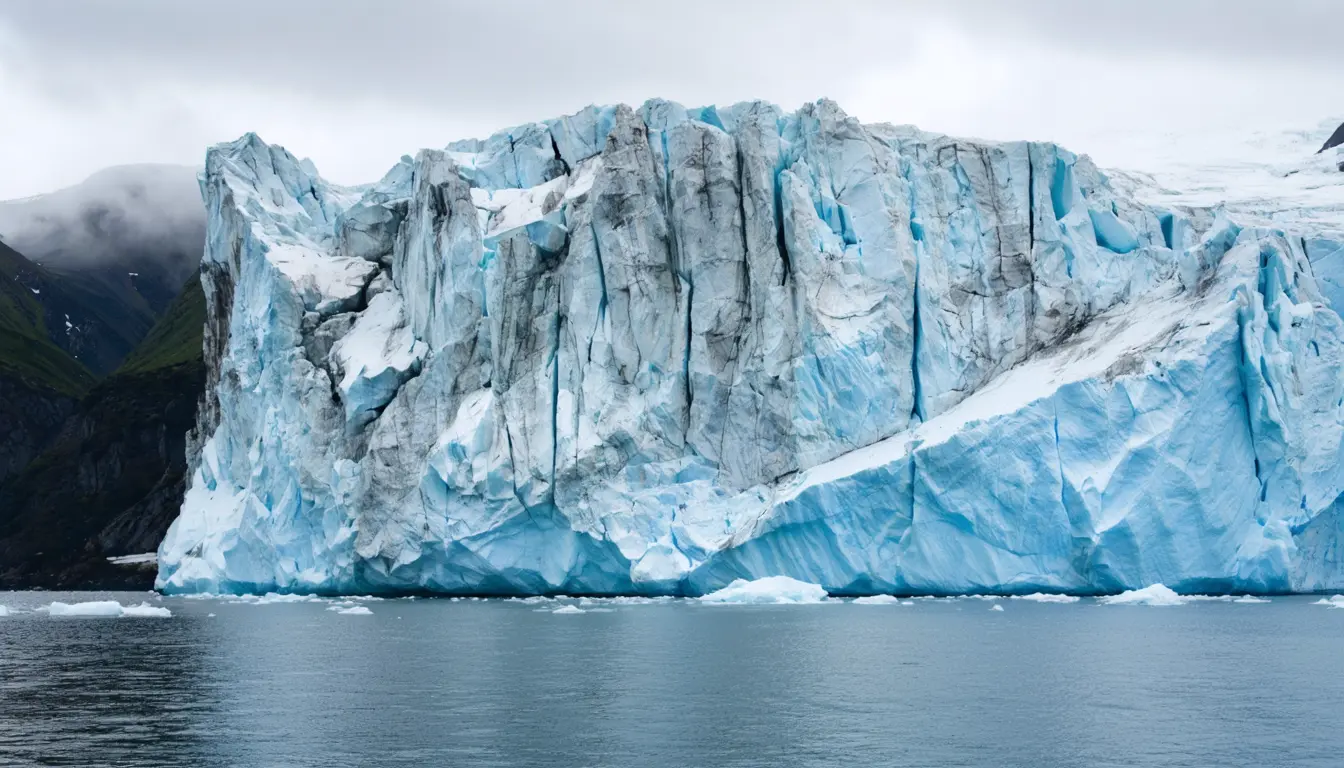
Seabed ridges help stabilise Thwaites. Its deep bed makes runaway collapse possible. Fast flow can thin cliffs. Needell: glaciers retreated faster than models predict, none unstably. IPCC: collapse could double 100-year sea-level rise. One study: possible collapse around 12,000 years ago.
- What it limits constraint Thwaites seabed ridges Underwater ridges currently help stabilise Thwaites from beneath, per Needell, claim 14
- Who's exposed exposure Thwaites glacier On reaching the deep bed, runaway collapse becomes a real possibility, claim 17
- What's now possible capability Fast ice flow Can thin a glacier's edge and reduce cliff height, appearing able to prevent a runaway effect, claim 9
- What doesn't add up contradiction Current models Per Needell, observed glaciers retreated much faster than models predict, yet none underwent unstable retreat, claim 11
- Who's exposed exposure IPCC sea-level outlook Runaway cliff collapse could potentially double sea-level rise expected over the next 100 years, claim 5
- What it sets up precedent Past record near Thwaites One study suggests runaway collapse may have happened around 12,000 years ago, claim 12
| Who | How | Kind | Claim |
|---|---|---|---|
| Thwaites seabed ridges | Underwater ridges currently help stabilise Thwaites from beneath, per Needell | constraint | 14 |
| Thwaites glacier | On reaching the deep bed, runaway collapse becomes a real possibility | exposure | 17 |
| Fast ice flow | Can thin a glacier's edge and reduce cliff height, appearing able to prevent a runaway effect | capability | 9 |
| Current models | Per Needell, observed glaciers retreated much faster than models predict, yet none underwent unstable retreat | contradiction | 11 |
| IPCC sea-level outlook | Runaway cliff collapse could potentially double sea-level rise expected over the next 100 years | exposure | 5 |
| Past record near Thwaites | One study suggests runaway collapse may have happened around 12,000 years ago | precedent | 12 |
What happened
- Runaway collapse is the worry that each cliff failure exposes a taller, potentially less stable cliff further inland.
- An IPCC report said such runaway collapse could double the sea-level rise expected over the next 100 years.
- The study ties the risk to two factors: how steeply the sea floor deepens beneath the ice and how fast the ice flows seawards.
- The idea that fast flow thins and lowers a cliff came from idealised models and had never been systematically measured in real glaciers.
Why it matters
- What it limits constraint A stop-start retreat makes one smooth rate a poor summary, so decade-scale estimates for these glaciers would swing more than a century average shows.
- What's now possible capability The doubling scenario can now be checked against two measurable quantities, bed steepness and ice-flow speed, instead of idealised models alone.
- What doesn't add up contradiction The deep bed that makes Thwaites's cliffs taller may also speed the flow that thins them, so one condition pushes toward collapse and toward stability at once.
"Up to three times" is a ceiling. New Scientist reports that the thickest glaciers may calve icebergs up to three times faster than previously predicted, and that such retreat may not be sustained over long periods [1]. New Scientist did not report how many glaciers were measured, over what period, or whether Thwaites sits at the top of that range.
Until now the runaway scenario rested on idealised mathematical models, because there was not enough empirical data to judge how likely it was [6]. Caroline Needell of the MIT-WHOI Joint Program and her colleagues used satellite data to make the first direct, large-scale observations of how the tallest cliffs behave [7]. The physical idea under test is that if ice flows fast enough, it thins at the glacier's edge and lowers the cliff, even where the ice is thicker inland [9].
"None of the glaciers we observed underwent unstable retreat, even though they did retreat much faster than our current models predict," Needell said [11]. That rules out reading fast retreat as proof of instability.
The "bursts" framing is New Scientist's, and the report hedges it with a "may" [2]. Douglas Benn at the University of St Andrews offered a picture of how it could look at Thwaites. "Over the next decades, it's going to jump from one pinning ridge to another," he said [15]. We read that as the stop-start pattern the report describes: retreat speeds up between ridges and pauses at each one.
The pauses end where the ridges do. "The bed then begins to get real deep," Benn said, and at that point "the whole structural integrity of the ice becomes unviable" [16]. New Scientist reports the glacier may reach that point within the current century [16].
The study does not show what a glacier does after its last ridge. Needell noted that most glaciers in the study are buttressed by sea-floor features [14], so the observations come mostly from glaciers still held in place from below. Her study suggests that thinning might restabilise a glacier once the bed deepens, but the question remains open [18].
In our view the open question is now whether runaway collapse happens: retreat faster than models allow has been observed [11], and runaway collapse has not. Robert Larter at the British Antarctic Survey points out that it has not yet been seen, though one study suggests it may have happened in the vicinity of Thwaites around 12,000 years ago [12]. "The problem is, nobody was around to take observations at the time," he said [13].
What to watch
- Observations of glaciers without sea-floor buttressing, where the thinning-versus-ice-loss question would be tested directly.
- The glacier counts and time periods behind the 'up to three times' figure, which New Scientist's report does not give.
- Further evidence on the possible collapse near Thwaites about 12,000 years ago.
Clarity's read
What the record supports and how the coverage leans. The claims behind it follow.
Reality
- Evidence55
- Adoption
- Insufficient
- Hype gap−10
- Incentives
- Insufficient
- Confidence45
Claim ledger
Ranked by verification strength, evidence, and original report placement.
- [1]
The world's thickest glaciers may calve icebergs up to three times faster than previously predicted, but such rapid retreat may not be sustained over long periods.
- [2]
Large bodies of ice, including Antarctica's Thwaites glacier, may collapse in bursts, with intervening periods of stability.
- [3]
The behaviour of tall ice cliffs is one of the biggest sources of uncertainty in predicting future sea level rise.
- [4]
In runaway cliff collapse, each time an ice cliff collapses it exposes a new, taller and potentially even less stable ice cliff further towards the glacier's interior.
- [5]
According to an Intergovernmental Panel on Climate Change report, loss of ice from runaway collapse of ever-taller cliffs could potentially double the amount of sea level rise expected over the next 100 years.
- [6]
There is not yet enough empirical data to know how likely runaway cliff collapse is, so previous studies relied on idealised mathematical models to envision the process.
- [7]
Caroline Needell at the MIT-Woods Hole Oceanographic Institution Joint Program and her colleagues used satellite data to provide the first direct, large-scale observations of how the tallest ice cliffs behave.
- [8]
According to the study, the risk of runaway collapse depends on two main factors: how steeply the sea floor beneath the glacial ice deepens, and how quickly the ice flows seawards.
- [9]
If the viscous flow of ice is fast enough, it will thin out the edge of a glacier and reduce cliff height; even where the glacier is thicker towards its interior, sufficiently rapid flow appears able to compensate and prevent a runaway effect.
- [10]
The idea that fast ice flow lowers cliffs has been suggested by idealised mathematical models but had never been systematically measured in real glaciers.
- [11]
Needell said: "None of the glaciers we observed underwent unstable retreat, even though they did retreat much faster than our current models predict."
- [12]
Robert Larter at the British Antarctic Survey points out that runaway cliff collapse has not yet been seen; one study suggests it may have happened in the vicinity of Thwaites around 12,000 years ago.
- [13]
Larter said: "The problem is, nobody was around to take observations at the time."
- [14]
Needell notes that most glaciers in the study are buttressed by sea-floor features; for instance, a series of underwater ridges currently helps stabilise Thwaites from beneath.
- [15]
Douglas Benn at the University of St Andrews said of Thwaites: "Over the next decades, it's going to jump from one pinning ridge to another."
- [16]
Benn said "The bed then begins to get real deep"; at that point, which New Scientist says the glacier may reach within the current century, "the whole structural integrity of the ice becomes unviable".
- [17]
When Thwaites reaches the deep bed, runaway collapse becomes a real possibility, but those conditions may also speed up the flow of ice, thinning out any looming cliffs.
- [18]
Needell says the key question is whether thinning can outcompete rapid ice loss and restabilise the glacier; her study suggests it might, but the question remains open.
Get this ledger inside ChatGPT. Ask about any of our stories and the answer brings its figure, each claim’s verdict and the sources. Free, no account.
Sources
1 independent publisher whose own reporting we read for this story.
- newscientist.comTowering glacial ice cliffs may collapse in fits and starts
1 article · October 15, 2026
Topics and entities
Follow any of these and your For You feed starts watching them — no settings page required.
Topics
- Antarctic ice lossFollow
- GlaciologyFollow
- Sea-level riseFollow
Entities
- Thwaites GlacierFollow
- Caroline NeedellFollow
- Douglas BennFollow
- Robert LarterFollow
- Intergovernmental Panel on Climate ChangeFollow
- New ScientistFollow