Product1 publisherNot yet confirmed elsewhere3 min readPublished
Microsoft's $2,600 Surface Laptop Ultra is a complicated, unproven bet on performance claims
Microsoft's Surface Laptop Ultra, its first RTX Spark laptop, runs on the Nvidia-MediaTek N1X ARM chip and starts at $2,600, Gizmodo reported. Its showcase game ran under emulation and its battery claim is untested, so for now it is a laptop to pilot before ordering in volume.
The Product Desk
What happened
- Gizmodo's reviewer had only a short session with the machine and called Microsoft's performance promise still to be determined.
- Microsoft claims the laptop keeps 99% of its GPU performance away from an outlet; Gizmodo said that would be huge if true.
- Configurations rise to $3,300 for 32GB of memory and 1TB of storage, and to close to $6,000 with 64GB or 128GB of unified memory.
- The magnetic USB-C charging port takes up to 140W, snaps on from up to an inch away, and still accepts ordinary USB-C cables.
Compiled by The Product DeskSomething wrong?How this is made
Why it matters
- constraint Nobody has measured performance on everyday business software yet, because the only emulated workload shown on this laptop is a game.
- exposure If some AI features need a cloud model, buyers take on a recurring subscription that sits outside the $2,600 hardware quote.
- decision A volume order today would rest on Microsoft's own 99% battery-performance figure, so the first purchase should be a pilot sized to test that number on real workloads.
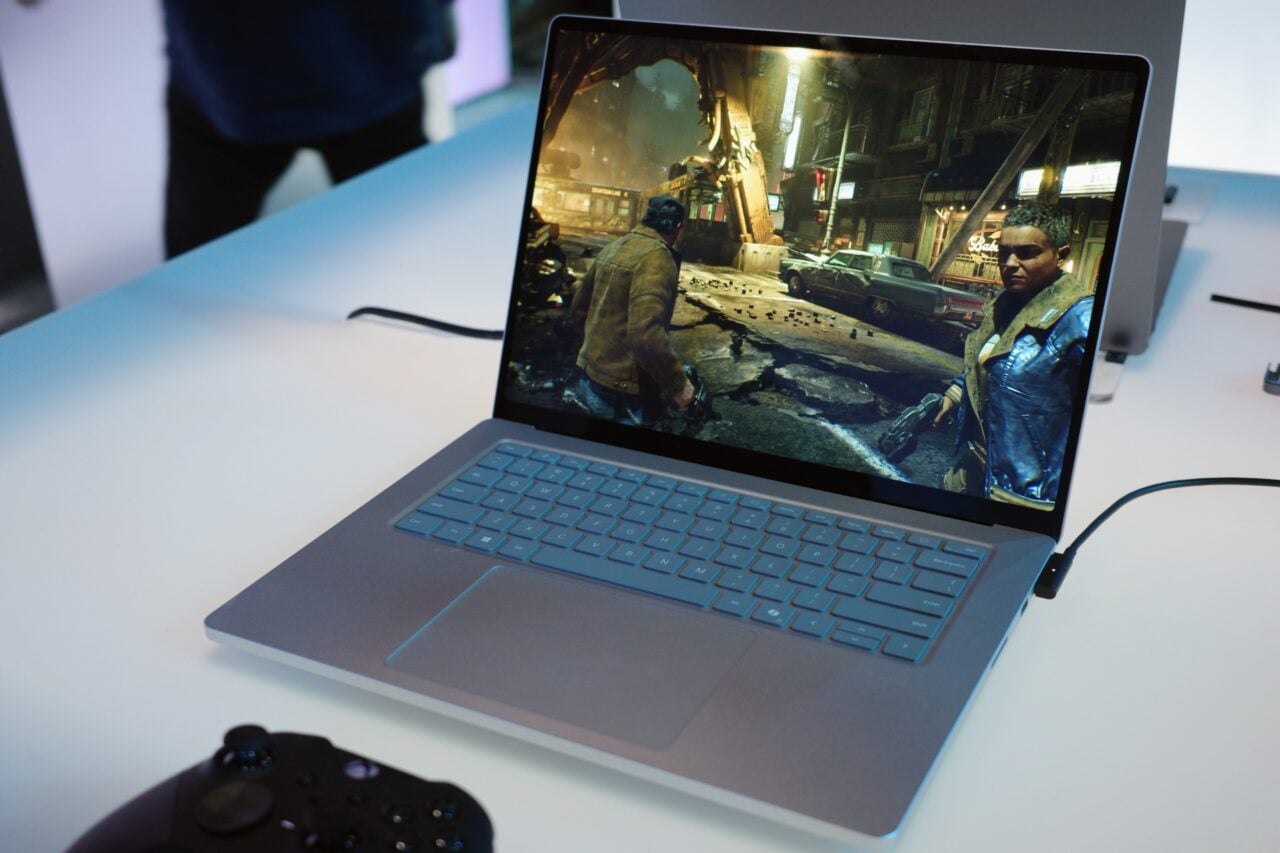
A Gizmodo reviewer sat down with the Surface Laptop Ultra and played Gears of War: E-Day at a smooth 60 frames per second on medium settings, with DLSS upscaling on [1]. Microsoft then showed the same game at 120 fps, the top refresh rate of the 15-inch mini LED panel, using frame generation [1]. The game was running through Prism, Microsoft's x86-to-ARM emulator, and Microsoft could not confirm whether an ARM-native version is coming [2].
A fleet manager should pay most attention to the emulation in that demo. Gizmodo notes that translating x86 code for ARM always costs some performance, though the reviewer was surprised by how well these laptops ran several games, both native and emulated [3]. Most work laptops spend the day on other software. I'd expect every x86 program a team depends on to go through the same translation layer until its vendor ships an ARM build [3].
Microsoft's pitch goes well beyond the demo. It bills the machine as a MacBook Pro competitor and an "everything" laptop that does not compromise on battery or GPU performance [8]. On AI, it showed a 3D modeler building background models for a starship design through an AI pipeline on a 64GB machine, and said the demos ran on-device [12]. Microsoft and Nvidia both kept implying that some tasks will still need a cloud model, and the reviewer would rather not have to consider a cloud subscription for new Copilot features [12]. Gizmodo's account does not say which tasks need the cloud.
Most buyers will argue over the first price step. It costs $700 to move from 24GB of unified memory and 512GB of storage to 32GB and 1TB [16]. The top tiers run to roughly 2.3 times the $2,600 entry price [5] [17], and Gizmodo expects AI developers to be the ones paying it [15]. Gizmodo also expects the spread of configurations to confuse some buyers [14].
A short session can judge the physical machine, and Gizmodo found the build quality more immediately compelling than the performance story [10]. The metal shell is 0.7 inches thick, weighs just under the 4.7 pounds of a 16-inch MacBook Pro, and has a full-size SD card reader [10]. The reviewer wrote: "It's just going to be a very complicated laptop." [13]
I'd buy a handful for a pilot and hold off on the volume order. Sort each role on two axes: whether its daily software runs natively on ARM Windows or through Prism, and whether it puts real work on the GPU. Native, GPU-heavy roles are the pilot group, and that includes the AI developers Gizmodo expects to buy the bigger configurations [15]. Native, GPU-light roles would be paying for graphics they leave idle. Emulated, GPU-heavy roles should wait for ARM builds, since Microsoft's own showcase game still runs emulated [2]. Emulated, GPU-light roles stay on x86. Waiting has a cost: the build and the magnetic charging port have already been shown working [10] [11], and a cautious buyer goes without them for a refresh cycle.
What to watch
- Independent battery testing of Microsoft's claim that the GPU keeps 99% of its performance away from an outlet.
- ARM-native builds of core business software, and of Gears of War: E-Day, which Microsoft could not confirm.
- Microsoft or Nvidia naming which AI tasks on the laptop require a cloud model, and what that subscription costs.
Clarity's read
What the record supports and how the coverage leans. The claims behind it follow.
Reality
- Evidence35
- Adoption
- Insufficient
- Hype gap+40
- Incentives60
- Confidence40
Claim ledger
Ranked by verification strength, evidence, and original report placement.
- [1]
Gears of War: E-Day ran at a smooth 60 fps at medium graphics settings with DLSS upscaling enabled; Microsoft also showed it at 120 fps, the max refresh of the laptop's 15-inch mini LED display, with frame generation.
- [2]
The game was running with the help of emulation, using Microsoft's Prism emulator, and Microsoft could not confirm whether it would launch an ARM-native version of E-Day anytime soon.
- [3]
Emulation from x86 to ARM microarchitectures necessarily impacts performance to some degree; the reviewer has seen these laptops run several games natively and emulated and was surprised how well they perform.
- [4]
The Surface Laptop Ultra is Microsoft's first RTX Spark device, powered by Nvidia's N1X chip, a CPU built in collaboration with MediaTek that combines an ARM-based Windows experience with CUDA GPU cores.
- [5]
Microsoft will sell a $2,600 Surface Laptop Ultra with 512GB of SSD storage and 24GB of unified memory.
- [6]
The laptop can be configured with up to 32GB of unified memory and 1TB of storage for $3,300.
- [7]
Another version, which Gizmodo describes as bumping up from an 18-core CPU to a 20-core GPU, has 64GB or 128GB of unified memory, potentially making the laptop cost close to $6,000.
- [8]
The Surface Laptop Ultra is billed as a MacBook Pro competitor, and Microsoft proposes it can be your "everything" laptop that doesn't compromise on battery or GPU performance.
- [9]
The Gizmodo reviewer had only a short time with the device and wrote that the performance promise is "still to be determined."
- [10]
Gizmodo found the build quality more immediately compelling: a solid metal shell 0.7 inches thick, weighing just under the 4.7 pounds of a 16-inch MacBook Pro, with plenty of ports including a full-size SD card reader.
- [11]
The magnetic USB-C port accepts up to 140W of charging power, plugs itself in when held up to an inch away, and still accepts any non-magnetic USB-C connection; the modular 140W brick is about the size of a child's fist.
- [12]
Microsoft showed a 3D modeler using an AI pipeline to craft background models for a starship design on a 64GB machine and promised the AI demos ran on-device, but Nvidia and Microsoft keep implying some cloud-based AI model will still be needed for some tasks; the reviewer would prefer not to consider a cloud subscription for new Copilot capabilities.
- [13]
"It's just going to be a very complicated laptop."
- [14]
Gizmodo wrote that the various configurations on offer will inevitably confuse some buyers.
- [15]
Gizmodo wrote that the people who will want to spend more on the laptop are AI developers.
- [16]
Moving from the $2,600 base configuration to the $3,300 32GB/1TB configuration costs $700 more.
- [17]
The top configurations, close to $6,000, cost roughly 2.3 times the $2,600 entry price.
- [18]
Microsoft claims the laptop maintains 99% GPU performance away from an outlet; Gizmodo wrote: "That would indeed be huge if true."
Sources
1 independent publisher whose own reporting we read for this story.
- gizmodo.comI’ll Be Honest, I’ve Always Wanted a PC Like the Microsoft Surface Laptop Ultra
1 article · October 7, 2026
Topics and entities
Follow any of these and your For You feed starts watching them — no settings page required.
Topics
- On-Device AIFollow
- Premium laptopsFollow
- Arm-based Windows PCsFollow