Invest2 publishersIndependently confirmed3 min readPublished
Ray Dalio blames debt and rising rates for an AI bubble he says is close to bursting
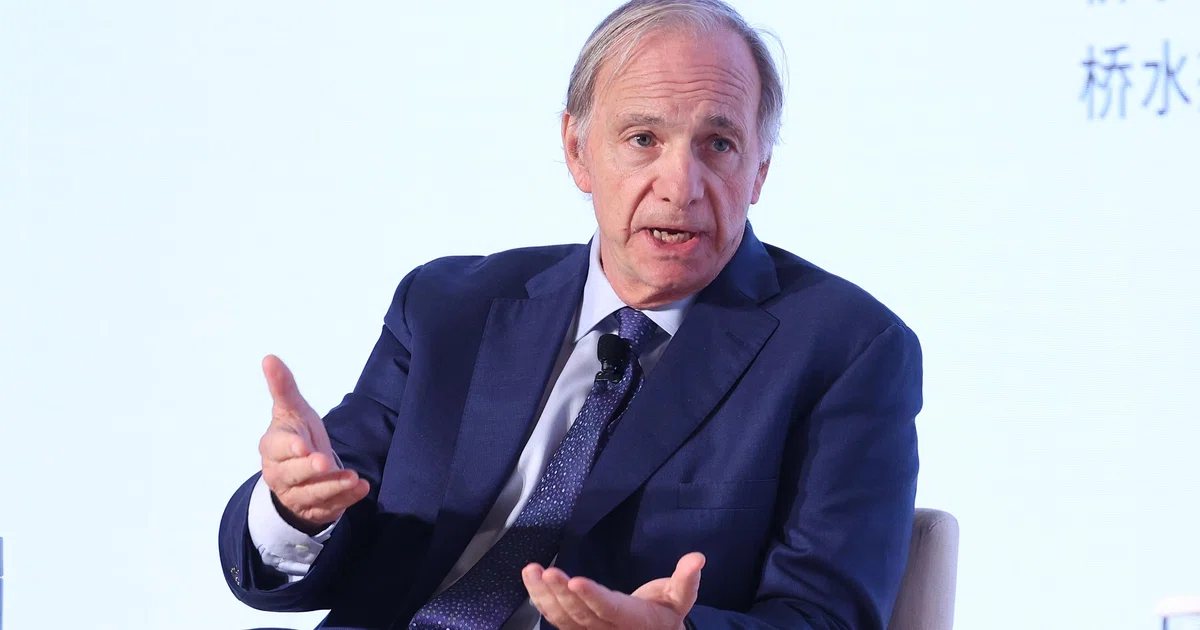
Ray Dalio called AI a "classic bubble" near bursting in Singapore, citing rising rates on AI debt that Morgan Stanley sees nearing $570 billion this year. With hyperscaler capex near all of operating cash flow, the cost of the bonds that fill the gap decides whether he is right.
The Investor · Invest desk
Drafted by a language model from the sources cited here and checked against its claim ledger before publication. How we use AISend a correction
What happened
- UBS estimates hyperscaler capital spending will consume close to 100% of operating cash flow in 2026, against a 10-year average of 40%.
- Dalio named a second trigger: wealth taxes and other measures that force owners to sell unrealized gains for cash.
- The S&P 500 and Nasdaq 100 set records this week, with Nvidia, Apple and Microsoft alone making up more than 21% of the S&P 500.
Compiled by The InvestorSomething wrong?How this is made
Why it matters
- exposure With about 60 points less of operating cash left after capex than the 10-year norm, the bond market now funds the margin of the build-out, so higher yields raise its cost directly.
- contradiction Bank of America says yields must climb considerably before the AI trade is threatened while Dalio says the break is close; neither gives a yield level, so the record cannot settle the timing.
- exposure If Dalio's forced-liquidation trigger fires, index holders end up selling three names that are over a fifth of the S&P 500, whether or not they chose AI exposure.
At UBS's 10-year average, hyperscalers spent 40% of operating cash flow on capex and kept 60 cents of every operating dollar [15]. At close to 100% this year, they keep almost none of it, and the next dollar of the build-out comes increasingly from the bond market [11][14]. Speaking at the Forbes Global CEO Conference in Singapore on Wednesday [1], Dalio described that borrowed pile as still expanding, with its cost becoming a pressure point as rates climb [2]. "We're in the part of the cycle that is before that but approaching that," Dalio said, according to Bloomberg. "I think we're close to that." [3]
The borrowing is accelerating. If the five companies issue as much in the second half as the $200 billion they sold in the first [9], the year lands near $400 billion, close to four times their 2025 total [16]. Their first half alone is about 35% of the nearly $570 billion of AI-linked debt Morgan Stanley expects worldwide this year, a forecast more than double last year's [17][10]. The comparison is loose: five issuers' investment-grade bonds set against all AI-linked debt worldwide.
The second trigger works on shareholders. "Everybody says 'I'm worth a billion dollars' but OK, try to spend that," Dalio said [7]. "In order to spend that you have to sell wealth in order to get money," he said, adding that "the bubble usually pricks at that." [8] Forced selling of that kind would land on an index where Nvidia, Apple and Microsoft are more than a fifth of the weight [4]. The Wall Street Journal, in a line Semafor quoted, put it this way: "Increasingly, the market is running on one engine" [5].
Bank of America has told clients that bond yields would need to climb considerably higher before posing a genuine threat to the AI trade [12]. If yields stall short of that level, the borrowing carries on at its current pace. They could also rise far enough that the companies trim capex before paying up. A third path skips funding altogether: Temasek's chief investment officer called an unwinding of the AI trade the biggest risk to markets in 2027, according to Semafor [13]. Semafor's account does not tie that warning to borrowing costs, or say it was made on the same panel as Dalio's.
I think the rate trigger is the one the market can check, through the volume and yield of the bonds the five issuers sell [9]. Dalio is wrong, or rather early, if those companies keep selling bonds at higher yields without cutting capex while the indexes keep setting records [4]. He is right in the version where capex stays near all of operating cash flow and the yield on the bonds filling the gap keeps rising [11].
What to watch
- Second-half bond sales by Amazon, Microsoft, Alphabet, Meta and Oracle: another $200 billion at higher yields with capex plans intact would cut against Dalio's rate trigger.
- Capex guidance at the next hyperscaler earnings, and any revision to UBS's estimate that 2026 spending takes close to 100% of operating cash flow.
- Long bond yields moving toward the 'considerably higher' level Bank of America says would threaten the AI trade.