Product1 publisherNot yet confirmed elsewhere2 min readPublished
NC State's feather-star robot swims in three dimensions on two actuators
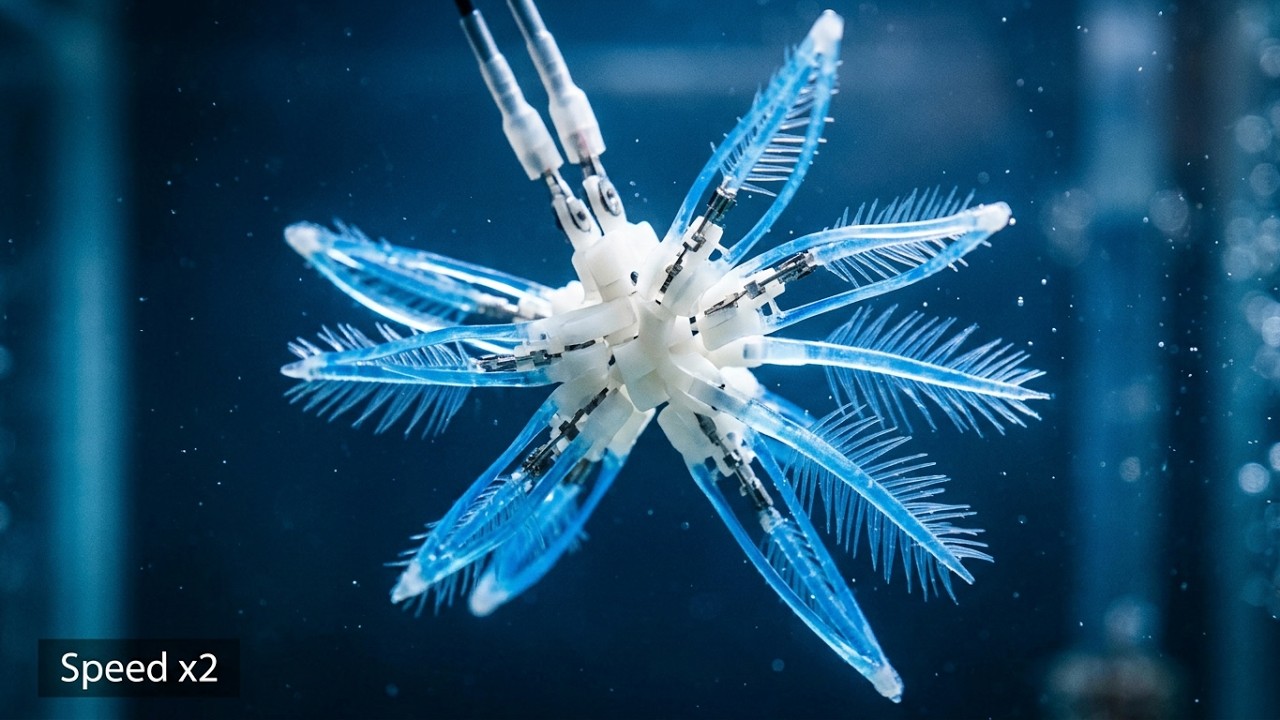
NC State researchers built a soft feather-star robot that moves in three dimensions with two actuators, against the six usually required. The elastic wings and the timing of each actuator pulse handle control work that extra motors would otherwise do.
The Product Desk
What happened
- The robot has four elastic wings around a central disk that bend when actuated and return to their original shape once the force is removed.
- Both actuators sit in the central disk and drive all four wings, snapping them down when powered and letting them spring back when switched off.
- In demonstrations, the robot explored underwater with a camera and lifted objects, both alone and in coordination with other robots.
- It builds on the team's earlier manta ray-inspired robot, which moved quickly through water but lacked comparable three-dimensional maneuverability.
Compiled by The Product DeskSomething wrong?How this is made
Why it matters
- capability Maneuverability can grow without the motor count growing, since a new kind of motion is a new firing pattern on the same two actuators.
- constraint Because the wing structure shapes the motion, the robot's repertoire is largely fixed once the wings are built.
- cost Any saving for a buyer would come from the parts that are gone: four fewer actuators to buy and keep working underwater.
To stop this robot climbing and hold it in place, an operator slows the wing beat [5]. Fast flapping lifts it through the water. The researchers call the slower, hovering version "jellyfish mode" [5]. Fire just one actuator and a single wing flutters like a tailfin, pushing the robot forward or backward [6]. Alternate the two quickly and the uneven wing strokes spin it on its axis so it can steer [7].
The team's name for the principle is "mechanical intelligence," in which a robot's structure helps decide its behavior and reduces the control input needed from computers or human operators [8]. What the robot actually does in the lab is simpler than the name suggests: a schedule of pulses goes to two actuators [4]. According to the NC State team, conventional systems with comparable three-dimensional movement typically need at least six [3].
"One exciting aspect of this work is that it demonstrates how we can create robotic devices with an incredible range of motion using a minimum number of actuators, by taking advantage of intelligent design techniques," said Jie Yin, the study's corresponding author and a professor of mechanical and aerospace engineering at NC State [9].
The evidence supports "simpler." The researchers say the design cuts the mechanical complexity this level of maneuverability normally needs [1]. Fewer parts make "cheaper" a fair expectation, but it is untested: the account gives no price or endurance figure, and it describes each mode on its own without saying whether the robot can climb and turn at the same time. The team says its next work is a fully wireless version and applications developed with researchers in other fields [13].
The researchers pitch the compact design as a platform for underwater work where maneuverability and mechanical simplicity both matter [12]. For the person who has to keep a robot like this running, the choice depends on how many motions the job needs at the same moment during its hardest minute, and on how much hardware the team will maintain.
A job that needs one motion at a time suits this design when the team wants fewer parts; when part count does not matter, either approach will do. A job that needs two motions at once depends on whether the modes can be combined, and the researchers have not shown that. Until they do, a team that wants less hardware is waiting on results, while a team willing to maintain more parts still has the conventional route of extra actuators [3].
What to watch
- The fully wireless version the team plans next, and whether the two-actuator count survives that move.
- Published figures on power draw, endurance or unit cost, which would test whether simpler hardware also means cheaper robots.
- Any demonstration of two modes running at once, such as climbing while turning.
Clarity's read
What the record supports and how the coverage leans. The claims behind it follow.
Reality
- Evidence40
- Adoption
- Insufficient
- Hype gap+15
- Incentives
- Insufficient
- Confidence45
Claim ledger
Ranked by verification strength, evidence, and original report placement.
- [1]
Researchers at North Carolina State University developed a soft underwater robot inspired by feather stars that achieves three-dimensional movement (forward and backward, up and down, rotation) using just two actuators, reducing the mechanical complexity normally required for this level of maneuverability.
- [2]
The robot uses four elastic wings arranged around a central disk. The wings are monostable: they bend under actuation but naturally return to their original position when the force is removed, letting the robot generate several types of motion without a separate actuator for each direction.
- [3]
Conventional systems capable of comparable three-dimensional movement would typically require at least six actuators.
- [4]
The robot's two actuators are housed in its central disk and control all four wings. When both actuators are activated, the wings snap downward; when switched off, the elastic wings return upward.
- [5]
Repeating the actuation cycle rapidly makes the robot flap and move upward; when the wings flap more slowly the robot can maintain position and hover, which the researchers call "jellyfish mode."
- [6]
Activating only one actuator causes a wing to flutter like a tailfin, pushing the robot forward or backward; the researchers call this "fish mode."
- [7]
Rapidly alternating between the two actuators generates asymmetric wing movements that make the robot spin around its central axis; this "rotor mode" provides directional control for steering.
- [8]
The design is based on "mechanical intelligence," in which a robot's physical structure helps determine its behavior and reduces the control input required from computers or human operators.
- [9]
"One exciting aspect of this work is that it demonstrates how we can create robotic devices with an incredible range of motion using a minimum number of actuators, by taking advantage of intelligent design techniques," said Jie Yin, corresponding author of the study and a professor of mechanical and aerospace engineering at NCSU.
- [10]
The researchers demonstrated the robot exploring underwater environments with a camera and lifting objects either individually or in coordination with other robots.
- [11]
The design builds on the team's earlier manta ray-inspired aquatic robot, which moved rapidly through water but lacked comparable three-dimensional maneuverability; instead of adding motors, the researchers sought extra movement capability through physical structure.
- [12]
The team noted the compact design could provide a platform for underwater robotic applications where maneuverability and mechanical simplicity are important.
- [13]
Future work will focus on developing a fully wireless version and exploring potential applications in collaboration with researchers from other fields.
- [14]
The design uses four fewer actuators than the typical six, one third of the usual count.
Sources
1 independent publisher whose own reporting we read for this story.
- interestingengineering.comVideo: Feather star-inspired robot moves underwater with just two actuators
1 article · October 8, 2026
Topics and entities
Follow any of these and your For You feed starts watching them — no settings page required.