E. coli uses its Uhp sensor to detect glucose-6-phosphate released by Bifidobacterium
Hosei University researchers report that E. coli detects glucose-6-phosphate released by Bifidobacterium through its Uhp sensor. They suggest the signal works only if the two species live within 40 micrometres of each other.
The Scientist · Science desk
Four claims rated. Supported: that G6P is the primary sensing molecule, and that the Uhp system responded to Bifidobacterium but not Bacteroides. Contested: that the signal works only within a 40-micrometre spatial hub. Insufficient: that prior work mainly counted which species were present.
- Supported Using a kinetic trapping method, the researchers treated Bifidobacterium-conditioned medium with a fast-acting and a slower-acting variant of G6P dehydrogenase; the fast-acting enzyme significantly decreased Uhp sensory activity compared with the slow-acting enzyme, which the report describes as strong evidence that G6P is the primary sensing molecule., claim 6
- Supported The Uhp system was activated only by metabolites released by Bifidobacterium and not by Bacteroides species, which dominate the gut microbiome., claim 5
- Contested The researchers suggest that because the G6P signal is short-lived, this communication can only happen if the two bacterial species live close to each other within a 40 micrometre 'spatial hub'., claim 13
- Insufficient evidence Previous research mainly focused on which bacteria are present and in what numbers, while the specific molecular mechanisms underlying their interaction and communication have largely remained a mystery., claim 14
| Claim | State | Claim number |
|---|---|---|
| Using a kinetic trapping method, the researchers treated Bifidobacterium-conditioned medium with a fast-acting and a slower-acting variant of G6P dehydrogenase; the fast-acting enzyme significantly decreased Uhp sensory activity compared with the slow-acting enzyme, which the report describes as strong evidence that G6P is the primary sensing molecule. | Supported | 6 |
| The Uhp system was activated only by metabolites released by Bifidobacterium and not by Bacteroides species, which dominate the gut microbiome. | Supported | 5 |
| The researchers suggest that because the G6P signal is short-lived, this communication can only happen if the two bacterial species live close to each other within a 40 micrometre 'spatial hub'. | Contested | 13 |
| Previous research mainly focused on which bacteria are present and in what numbers, while the specific molecular mechanisms underlying their interaction and communication have largely remained a mystery. | Insufficient evidence | 14 |
What happened
- Uhp responded to metabolites from Bifidobacterium but not to those from Bacteroides species, which dominate the gut microbiome.
- A fast-acting G6P dehydrogenase cut Uhp activity in Bifidobacterium-conditioned medium significantly more than a slower variant of the same enzyme did.
- Bifidobacterium released G6P consistently while metabolizing different sugars, and the team describes it as a universal signal of that genus's metabolism.
Why it matters
- capability Earlier work mostly counted which species were present. A named sensor and a named signal molecule give researchers a pair to measure or disable when they study minority species.
- constraint If the 40 micrometre range holds, the interaction depends on position as well as abundance, and a species tally alone could not show whether two bacteria are close enough to exchange the signal.
- exposure The specificity claim rests on a contrast with Bacteroides, so the idea that G6P marks Bifidobacterium in particular is untested against the many other gut species.
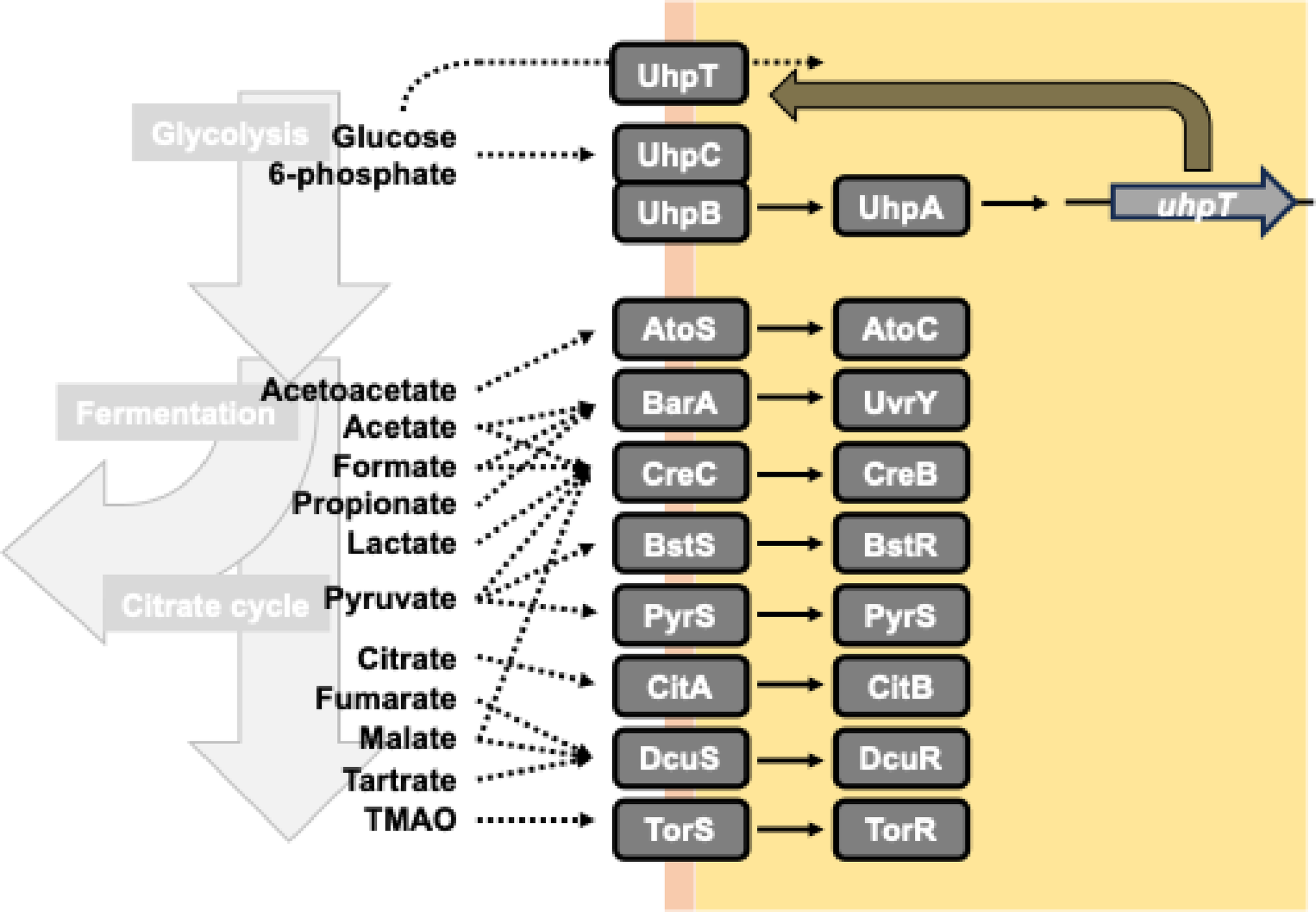
The design starts from a screen. Bifidobacterium breaks down human milk oligosaccharides and releases metabolic byproducts as it does [11]. The team tested 54 E. coli transport systems covering 61 carbon sources, and two sensory systems, Uhp and Idn, picked up that output [3]. Uhp was already a well-known two-component system for sensing and transporting hexose phosphates, G6P in particular [10]. The sensor was known. What the paper adds, according to phys.org's account, is where its signal comes from: a neighbor's metabolism, which E. coli can read and prepare for [4]. The authors call this "metabolic eavesdropping" [9].
The Bacteroides result gives the signal its specificity. Only Bifidobacterium's metabolites switched Uhp on; the Bacteroides species that dominate the gut microbiome did not [5]. From that, the authors conclude that the hexose phosphates are not universal byproducts of bacterial metabolism [12]. The comparison the account reports is against Bacteroides.
To pin the signal on G6P itself, the team used a method called kinetic trapping. It treated Bifidobacterium-conditioned medium with a fast-acting form of G6P dehydrogenase in one condition and a slower variant of the same enzyme in another [6]. The fast enzyme consumed the G6P, and Uhp activity fell significantly compared with the slow one [6]. In our reading, the slow variant is the control: the same protein sits in the medium, less G6P is removed, so a difference points at G6P and not at the enzyme's presence. Phys.org's account calls the result strong evidence that G6P is the primary sensing molecule.
Earlier work mostly asked which bacteria are present and in what numbers, and the molecular basis of their interaction stayed largely unexplained [14]. Professor Kaneyoshi Yamamoto's group chose two nondominant groups, E. coli and Bifidobacterium [1]. Yamamoto said: "In this study, we have discovered a new mechanism through which one bacterium detects the metabolic activity of the other." [8] The findings are in Scientific Reports [2].
The range claim is an inference. Bifidobacterium consistently releases G6P while metabolizing different sugars [7], and the researchers suggest that because the signal is short-lived, communication can happen only if the two species live within a 40 micrometre "spatial hub" [13]. The study does not show whether E. coli and Bifidobacterium sit that close in a real gut. The account says E. coli prepares its metabolism in response [4], but it does not describe a test in a living gut or a measured benefit to E. coli.
What to watch
- Any test of E. coli lacking Uhp alongside Bifidobacterium in a gut-like community, which would show whether the sensing changes E. coli's behavior outside conditioned medium.
- Direct measurement of how far apart E. coli and Bifidobacterium sit in gut tissue, set against the suggested 40 micrometre range.
- Whether other minority gut species respond to Bifidobacterium's G6P, given that Bacteroides did not trigger Uhp.
Clarity's read
What the record supports and how the coverage leans. The claims behind it follow.
Reality
- Evidence55
- Adoption
- Insufficient
- Hype gap+25
- Incentives40
- Confidence50
Claim ledger
Ranked by verification strength, evidence, and original report placement.
- [1]
A research team led by professor Kaneyoshi Yamamoto of Hosei University, Japan, investigated the interaction between Escherichia coli and Bifidobacterium, two nondominant bacterial groups in the human gut.
- [2]
The findings are published in Scientific Reports.
- [3]
The researchers screened 54 transport systems corresponding to 61 carbon sources used by E. coli and found it uses the Uhp and Idn sensory systems to monitor the metabolic footprints released by Bifidobacterium.
- [4]
E. coli can detect specific molecules among Bifidobacterium's metabolic products using specialized sensory systems, obtaining information about a neighboring bacterium's metabolic activity and preparing its own metabolism accordingly.
- [5]
The Uhp system was activated only by metabolites released by Bifidobacterium and not by Bacteroides species, which dominate the gut microbiome.
- [6]
Using a kinetic trapping method, the researchers treated Bifidobacterium-conditioned medium with a fast-acting and a slower-acting variant of G6P dehydrogenase; the fast-acting enzyme significantly decreased Uhp sensory activity compared with the slow-acting enzyme, which the report describes as strong evidence that G6P is the primary sensing molecule.
- [7]
Bifidobacterium consistently releases G6P while metabolizing different sugars, indicating that it is a universal signal associated with Bifidobacterium metabolism.
- [8]
"In this study, we have discovered a new mechanism through which one bacterium detects the metabolic activity of the other."
- [9]
The authors termed the phenomenon 'metabolic eavesdropping.'
- [10]
The Uhp system is a well-known two-component system dedicated to the sensing and transport of hexose phosphates, particularly glucose-6-phosphate (G6P).
- [11]
Bifidobacterium species break down complex carbohydrates such as human milk oligosaccharides and release various metabolic byproducts into their surroundings during the process.
- [12]
The report suggests that the hexose phosphates, including G6P, that trigger the Uhp system are not simply universal byproducts of bacterial metabolism but are specifically released by Bifidobacterium.
- [13]
The researchers suggest that because the G6P signal is short-lived, this communication can only happen if the two bacterial species live close to each other within a 40 micrometre 'spatial hub'.
- [14]
Previous research mainly focused on which bacteria are present and in what numbers, while the specific molecular mechanisms underlying their interaction and communication have largely remained a mystery.
Get this ledger inside ChatGPT. Ask about any of our stories and the answer brings its figure, each claim’s verdict and the sources. Free, no account.
Sources
1 independent publisher whose own reporting we read for this story.
- phys.orgHow E. coli eavesdrops on the metabolic activity of other gut bacteria
1 article · October 14, 2026
Topics and entities
Follow any of these and your For You feed starts watching them — no settings page required.
Topics
- Microbial cell signalingFollow
- Gut Microbiome and Protein FermentationFollow
- ProbioticsFollow
Entities
- Hosei UniversityFollow
- Kaneyoshi YamamotoFollow
- Escherichia coliFollow
- BifidobacteriumFollow
- Scientific ReportsFollow
- Phys.orgFollow