Invest1 publisher3 min readPublished
China's Arctic liner run cuts Ningbo-Felixstowe to 20 days. The volume is still a rounding error
Sea Legend Line's new Northern Sea Route service halves Suez transit times, but the corridor carried 23 container ships last year and runs on Russian permits.
The Investor · Invest desk
Drafted by a language model from the sources cited here and checked against its claim ledger before publication. How we use AISend a correction
What happened
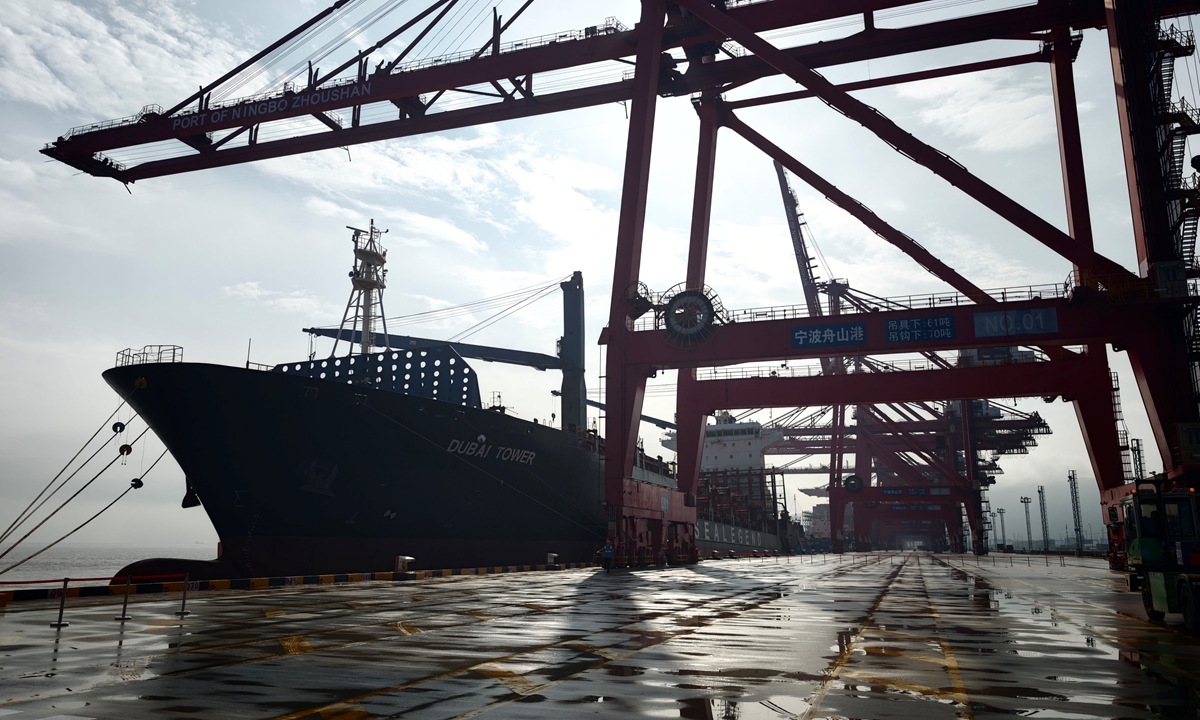
- On Saturday, Chinese container shipping company Sea Legend Line launched its first regular shipping route through the Arctic, more than 3,400 miles long along the northern coast of Russia.
- The vessel sailed from Ningbo, China, to Felixstowe in the UK, about 70 miles north of London.
- The route, dubbed the 'Ice Silk Road', takes about 20 days, half the shipping time of the route south through the Suez Canal.
- Countries scrambled for alternative trade routes after the effective closure of the Strait of Hormuz following U.S.-Israeli attacks on Iran in February.
- Continued Houthi threats to the Bab al-Mandab Strait into the Red Sea subsequently disrupted traffic through the Strait of Hormuz.
Compiled by The InvestorSomething wrong?How this is made
Why it matters
Sea Legend Line, a Chinese container operator, began its first regular Arctic service on Saturday, running more than 3,400 miles along Russia's northern coast from Ningbo to Felixstowe in about 20 days [1][2][3]. That is half the transit of the southern route through Suez, and it arrives while the Strait of Hormuz sits effectively closed after the February U.S.-Israeli attacks on Iran, with Houthi threats to Bab al-Mandab keeping the Red Sea alternative unreliable [3][4][5].
Halving 40 days to 20 is the headline [3][23]. The volume is the correction. Allianz Commercial counted 23 container ships transiting the Northern Sea Route last year, up from 15 in 2024 [8]. That is eight extra vessels, an increase of roughly 53%, and an average of one container transit every 16 days [9][10]. Against the Suez and Malacca flows those numbers do not move a freight index. What changed on Saturday is category, not capacity: a scheduled liner service implies a booking window, a lead time a planner can put in a system, and a rate someone will quote twice.
The binding constraint is calendar, not distance. The route was long inaccessible because of sea-ice volume, and warming has turned it from a warmest-months passage into one navigable for a substantial part of the year [11][12]; research from the University of Southampton indicates a 20-year slowdown in Arctic melt rates ended last year, with melting increasing again [13]. Sea Legend ran its first successful test voyage in October [14]. Chief operating officer Li Xiaobin told the Chinese financial magazine Caixin last year that the aim was to extend the season from two months to three, then four, and eventually to year-round operation [15]. Taken at face value, that trajectory still leaves eight months of the year unserved by the third season [16].
Then there is the permit. Russia's state corporation Rosatom issues Northern Sea Route authorisations through the Northern Sea Route Administration, oversees traffic and supplies the icebreaker escorts [17]. Moscow was initially sceptical of Xi Jinping's 2017 polar Silk Road framing and has conceded some ground since invading Ukraine, but it remains central to passage [18]. Fortune's framing is that heavier Arctic use could reduce China's exposure to the Strait of Malacca, through which 80% of its crude imports pass and around which the "Malacca Dilemma" blockade risk is built [19][20]. Note the asymmetry: the new service moves containers to Europe, not Gulf crude to Chinese refineries. Substituting a US-policed chokepoint for a Russian-permitted corridor relocates counterparty risk rather than retiring it.
On pricing, be careful. The disruption itself lengthened voyages and pushed up fuel and insurance, and Secretary of State Marco Rubio has floated a more permanent shift away from Hormuz [6][7]. But nothing in the record here quantifies an Arctic premium, an ice-class requirement or an escort fee, so any claim that the Ice Silk Road lowers cover is assertion. Dylan Loh of Nanyang Technological University told Al Jazeera the route is an alternative, but more time is needed to judge it on environmental, financial and reliability grounds [21]. China's first Europe-bound NSR voyage was in 2013 [22]; thirteen years produced 23 container transits.
Watch three things: whether Sea Legend gets to a three-month season next year as stated [15], whether the annual container count moves from tens into hundreds [8], and what Rosatom charges for escorts and permits when demand is not seasonal charity.