Invest1 publisher3 min readPublished
China keeps bulk soybeans off its $30 billion tariff relief list for US goods
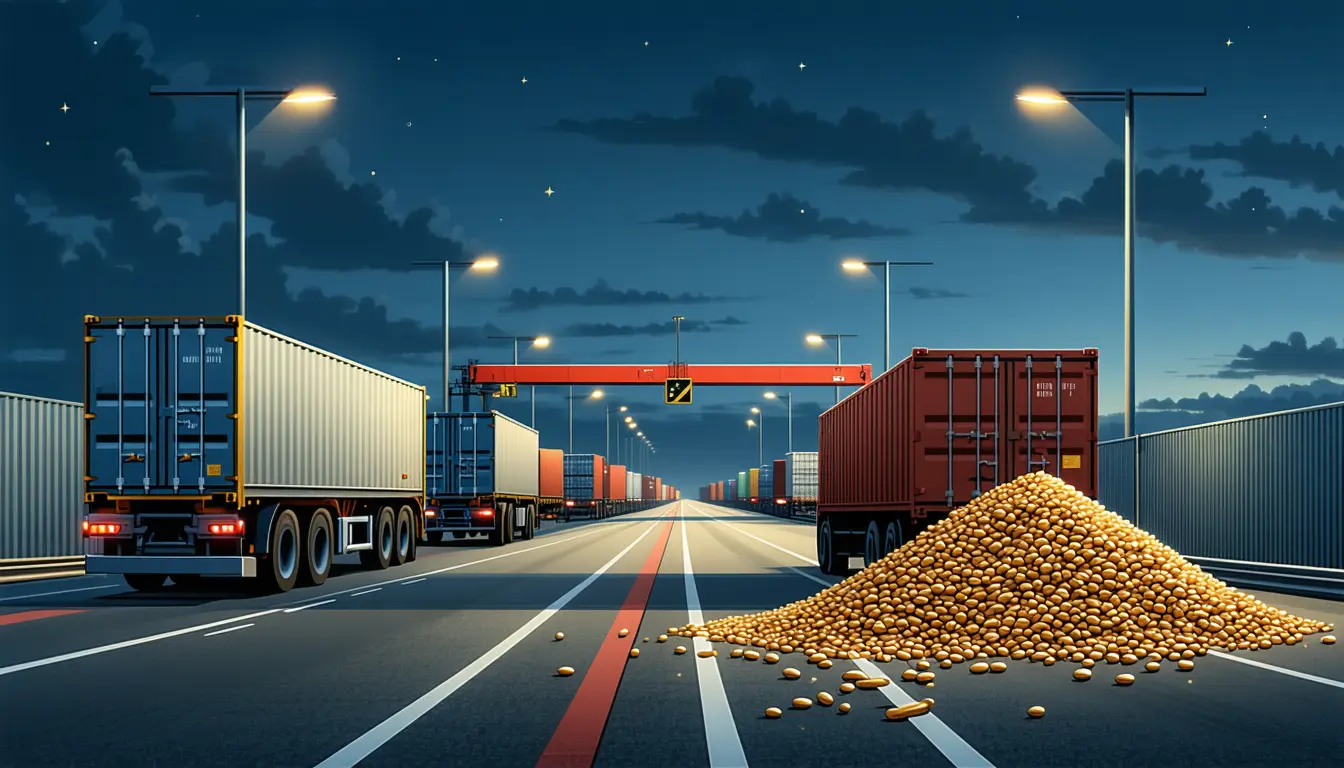
China's tariff relief list for 1,619 US products leaves out commodity soybeans, a crop the US exported $16.5 billion of last year. Holding back the crop at the center of US-China farm tensions gives Beijing a lever over Midwest farm prices to trade in a later round.
The Investor · Invest desk
What happened
- Seed soybeans, soybean flour and soybean-processing by-products all made China's list, so the exclusion falls only on the raw beans American farmers sell in bulk.
- The list is China's side of a Trump-Xi summit agreement last week to move toward lower tariffs on $30 billion of goods in each direction.
- USDA data show 71% of China's soybean imports come from Brazil, whose share has grown at US expense on cheaper prices.
Compiled by The InvestorSomething wrong?How this is made
Why it matters
- decision Washington goes into the next round having to decide what it will give Beijing to get raw soybeans onto a relief list.
- contradiction Gibbs's supplier explanation and Haley's leverage explanation disagree on whether soybean relief can be bought at all, so US negotiators have to price the next round without knowing which holds.
- exposure Iowa and Illinois, which took $2.5 billion of the $9.4 billion 2018 soybean hit, stay exposed to Chinese demand that sets prices at their local grain facilities.
Spread evenly, $30 billion over 1,619 products comes to about $18.5 million a line [2][1]. The line China left off is much bigger. The US exported $16.5 billion of soybeans last year (to all buyers, not only China), its second-largest farm export after corn, according to the USDA [4]. That one crop's exports equal 55% of China's whole relief list [2]. China buys more soybeans than any other country because it has limited arable land [5]. Before the 2018 trade war, the American Soybean Association estimated that 28% of US production was shipped there [6].
Beijing is still buying. Under the November deal it committed to at least 25 million metric tons a year in 2026, 2027 and 2028 [9]. After the May meeting, the White House said China would buy at least $17 billion of farm goods on top of that [10]. The commitment sets a minimum tonnage, and above it price decides more of the business. The USDA's attache in Beijing reported last year that Brazil's share had grown "at the expense of the United States," helped by cheaper prices. Brazil now supplies 71% of China's soybean imports [11]. Tariff relief would help American beans compete above the floor, and China withheld it [3].
Ker Gibbs, a former president of the American Chamber of Commerce in Shanghai, explains the exclusion through Brazil. "They go into pig feed, so it's not like the pigs are really gonna see a big difference between American soybeans and Brazilian soybeans," he told Fortune [13]. "They definitely want to keep Brazil warm, and so they don't want to suddenly shift everything over to the U.S.," he said [14]. "They're leaving the door half closed." [15]
Usha Haley, a Wichita State University professor who has studied Chinese trade strategy, explains it through the next negotiation. "That gives China a bargaining chip for subsequent talks, and, of course, this is about leverage," she told Fortune [16]. "They offer enough to demonstrate that they are moving on things, that they are present, but they always hold something back economically and politically for the next round." [17]
The two accounts predict different things. If Haley is right, raw soybeans reappear on a later list in exchange for something Washington gives up. If Gibbs is right, they can stay off whatever Washington offers, since adding them would pull purchases away from Brazil [14]. A third outcome is duller: the 25-million-ton floor sets US volume either way [9], and the exclusion matters only at the margin.
I give Haley's account more weight, though the record fits both. China bought 1 million tons of US soybeans ahead of the summit [12], about 4% of one year's committed minimum [3], and still held back the tariff cut. "Commercial purchasing and negotiating leverage can operate simultaneously," Haley said [18]. The pressure falls on the Midwest. Soybeans trade in export and national markets, so weaker Chinese demand can pull down the cash prices farmers get at local grain facilities [8]. Illinois and Iowa are the two largest producers [20]. After China's 25% tariff in 2018, the USDA estimated soybean farmers absorbed $9.4 billion in losses [7]. Haley said China only has to keep access to its market uncertain and expensive for farmers on thin margins. "Uncertainty also has a cost," she said [19].
The view is wrong if Chinese purchases of US beans run well above 25 million tons a year with the tariff still in place [9]. Farmers would then be losing little to the exclusion, and the bargaining chip Haley describes would be worth less in the next round [16].
What to watch
- Whether raw soybeans appear on a later Chinese tariff relief list, and what Washington concedes to get them there.
- China's 2026 purchases of US soybeans measured against the 25 million metric ton floor.
- Brazil's share of China's soybean imports, 71% by USDA's count, in the attache's next report.