Invest1 publisher3 min readPublished
Iran's rial sinks past 2.5 million per dollar before its last oil payments arrive
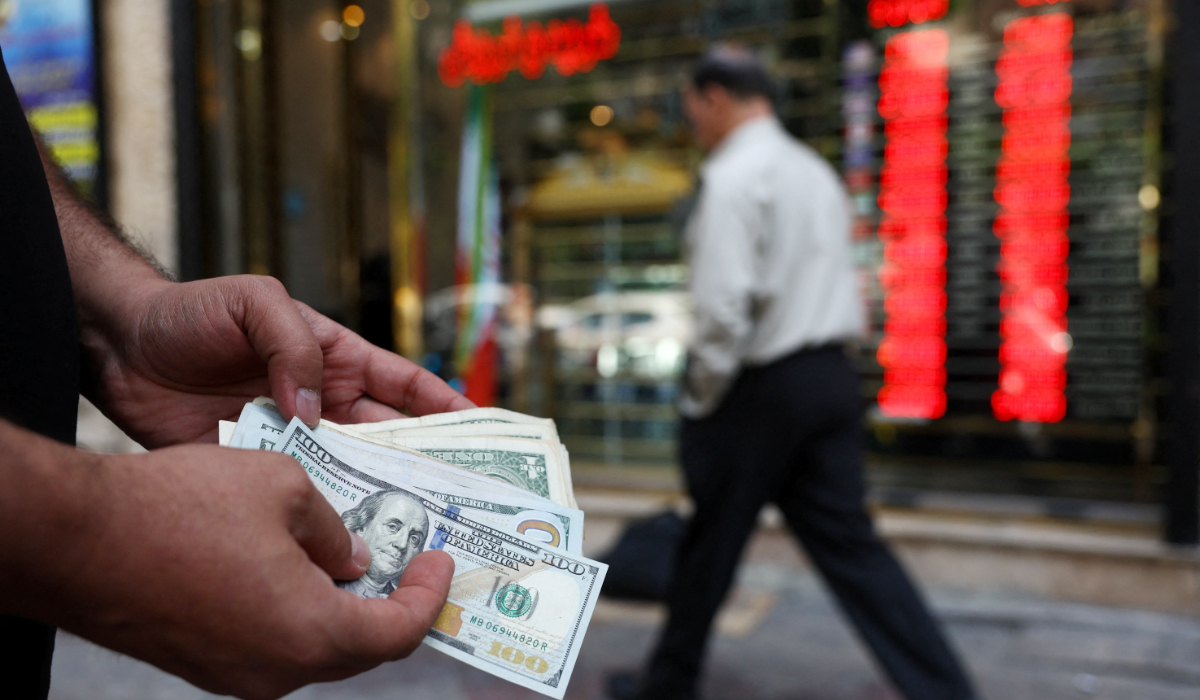
Iran's rial fell past 2.5 million to the dollar in Tehran trading after the country loaded no oil at its terminals in September, a first since 1979. The currency has lost 40% of its value this year while money for oil shipped before the blockade is still coming in.
The Investor · Invest desk
Drafted by a language model from the sources cited here and checked against its claim ledger before publication. How we use AISend a correction
What happened
- Kpler estimates the 90 million barrels Iran had in tankers when the US blockade resumed in mid-July will be used up by the middle of October.
- Payments for those last cargoes, most of which end up in China, could keep arriving until December.
- Iran's Gulf neighbours have increased their own oil shipments under US military protection while Iran's exports fell to virtually zero.
- Inflation is near 90%, GDP is expected to shrink 5.4% this year, energy is rationed and Iran cannot import fuel by sea.
- President Trump has rejected Tehran's attempts to restart negotiations and signalled he will let the economic pressure run its course.
Compiled by The InvestorSomething wrong?How this is made
Why it matters
- cost When the cargo payments stop, the state loses the income that usually covers about a third of its budget, and the Revolutionary Guards lose one of their main funding sources.
- constraint Because some of Iran's balances are stuck in China, its spendable dollars run out before its invoiced barrels do, and the December payment tail overstates the cash Tehran can use.
- precedent The currency collapse late last year brought widespread protests, so each new record low tests whether the crackdown that ended them early this year still holds.
Iran's oil money arrives on a lag. Kpler expects the 90 million barrels at sea to be used up by mid-October [7]. That works out to about a million barrels a day drawn down over the roughly 92 days since mid-July [1]. Payments could trail into December [8], and Kpler's Homayoun Falakshahi found no loadings at all in September [1]. So the last oil dollars arrive at least three months after the last loading [6].
Fortune puts the rial's fall since August 2025 at about 170% [5]. The 170% describes the dollar's move. At 920,000 rials then and more than 2.5 million now [3], a dollar costs 172% more and a rial buys 63% less [2]. Against the rate of about 1.5 million at the start of this year the rial has lost 40% [3]. Against the Sept. 2 low of 2.2 million [4], it has lost about 12% in under a month [4]. A dollar cost 35,000 rials at the start of 2018 [6], so a rial now buys about 1.4% of what it did then [5].
Part of what Iran is still owed may never be spendable. President Masoud Pezeshkian told Fox News the regime's money in China is blocked. "We can't even get our own money out of a country to which we've supplied goods, let alone using those funds to pay someone else in another corner of the world," he said [11]. The US tightened sanctions last month to make it harder to move money through front companies and other intermediaries [10].
Oil usually covers about a third of the state budget [9], and that share has to come from somewhere once the cargo payments stop. Land import routes are clogged too [12]. I think the Tehran rate is already pricing how that gap gets filled.
The Gulf side has less evidence behind it. Fortune reports that Iran's neighbours have raised their own shipments under US military protection, eroding Tehran's control over the Strait of Hormuz [2]. The report does not say how many barrels they added, so the evidence does not show that they have taken over Iran's share.
The view can break in a few places. Washington could reopen talks, though Trump has rejected Tehran's attempts to restart them [15]. Secretary of State Marco Rubio told Fox News on Monday that Iran was heading toward an economic "cataclysm" [16]. China could release the blocked funds and turn invoices into dollars before December [11]. Or the regime could hold, as it did early this year when it put down the protests that followed the previous currency collapse [14]. Supreme Leader Ayatollah Mojtaba Khamenei has expressed concern about "social cohesion" [13].
In my view the rial keeps falling through December. The barrels at sea run out on Kpler's timeline [7], and part of the money they earned is stuck in China [11]. The thesis is wrong if the Tehran rate holds near 2.5 million after the last cargo payments clear. That would mean either the cutoff was already in the price or Iran had found another source of dollars.
What to watch
- Gulf export figures through Hormuz, to see whether Iran's neighbours have replaced its barrels in full or only in part.
- Any US enforcement against the Chinese channels holding Iran's oil balances, the money Pezeshkian says is already blocked.