Science2 publishers2 min readPublished Updated
Broccoli under magenta solar panels took 25 days longer to mature in a Swedish trial
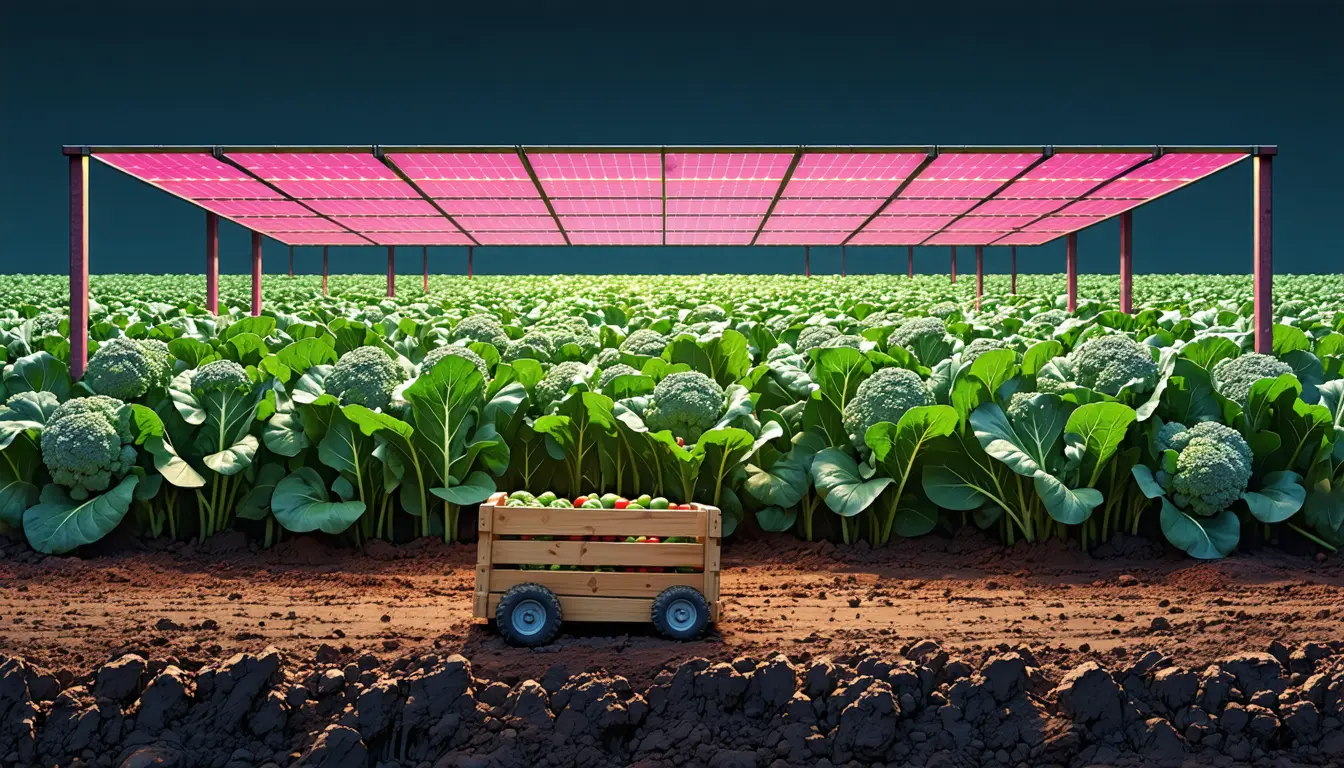
Broccoli under semitransparent magenta solar panels reached full size but took 25 days longer to mature, a Malardalen University team reports. The panels are research prototypes, and the authors say they still need testing at larger scales and over more seasons.
The Scientist · Science desk
Drafted by a language model from the sources cited here and checked against its claim ledger before publication. How we use AISend a correction
What happened
- Plants under the panels showed a 4.5-fold increase in how efficiently they used sunlight compared with broccoli grown in full sun.
- The team built two 20-by-20-metre systems of semitransparent magenta panels with different transparency levels, plus a fully sunlit comparison plot, on a farm in Sweden.
- The custom panels were designed to generate electricity while boosting the blue and red wavelengths that enhance broccoli growth.
- Through the 2024 growing season the team tracked air temperature, humidity and soil moisture alongside yield, nutrient composition and photosynthesis.
Compiled by The ScientistSomething wrong?How this is made
Why it matters
- cost The grower pays in field time. A crop that sits in the ground longer delays whatever would be planted next, and that loss has to be weighed against what the power is worth on that farm.
- decision If broccoli does as well under the denser panels in later seasons, a grower could pick the configuration that makes more electricity without taking a larger crop penalty.
- constraint By Ma Lu's own account the prototype suits community gardens or greenhouse roofs for now, so large arable fields sit outside what this evidence supports.
The comparison plot is the control: broccoli in full sun on the same Swedish farm, in the same 2024 season [4][5]. With it, the team can put differences down to the panels instead of the year's weather. It cannot show whether 2024 happened to suit shaded plants. Silvia Ma Lu of Malardalen University, one of the study's authors, raises the point herself [15]. "However, these findings are specific to our experimental conditions and should be validated across additional growing seasons and system configurations," she said [8].
The 4.5-fold efficiency gain needs the same care [2]. Suppose efficiency is counted against the light that reaches the crop. Then a plant that finishes at normal size on less sunlight will score well almost by construction. These plants did finish at normal size [3]. The panels also change the colour of the light [12], so some of the gain could come from colour and some from quantity. The team's next tests run in controlled lab settings, without interference from light that has not passed through the panels [9].
The cost to the farm shows up as time. The broccoli under each 400-square-metre system [1] took 25 days longer to mature [3]. The study's announcement does not report the panels' electricity output or how long the open-field broccoli took to mature. Without those two figures, the delay cannot yet be priced against power revenue or expressed as a share of the season. According to the announcement, scaled-up panels could in principle power irrigation, machinery, or cooling and storage, or supply the grid [14].
The finding I'd expect growers to care about most is a less prominent one. Conventional dark-blue panels are typically opaque and can shade some crops enough to cut yields [13]. The Swedish trial tested two transparency levels [4]. "One of the most interesting findings was how similarly the broccoli performed under the two solar panel systems despite their different transparency levels," Ma Lu said [6]. Panels with a greater density of photovoltaic cells produce more electricity, she noted [7]. The paper is due in Cell Reports Physical Science [1], and its title identifies the cells as cadmium telluride thin film [16].
What to watch
- A second growing season at the Swedish site, showing whether the 25-day delay and the similar results across transparency levels repeat.
- The team's lab tests of magenta, red and blue panels, the first data free of light that bypassed the panels.
- Published electricity yields for each panel system, the figure needed to set the delay against power revenue.