ScienceNot yet confirmed elsewhere1 publisher2 min readPublished
Sauces set apart on the plate make the same sturgeon dish look healthier to diners
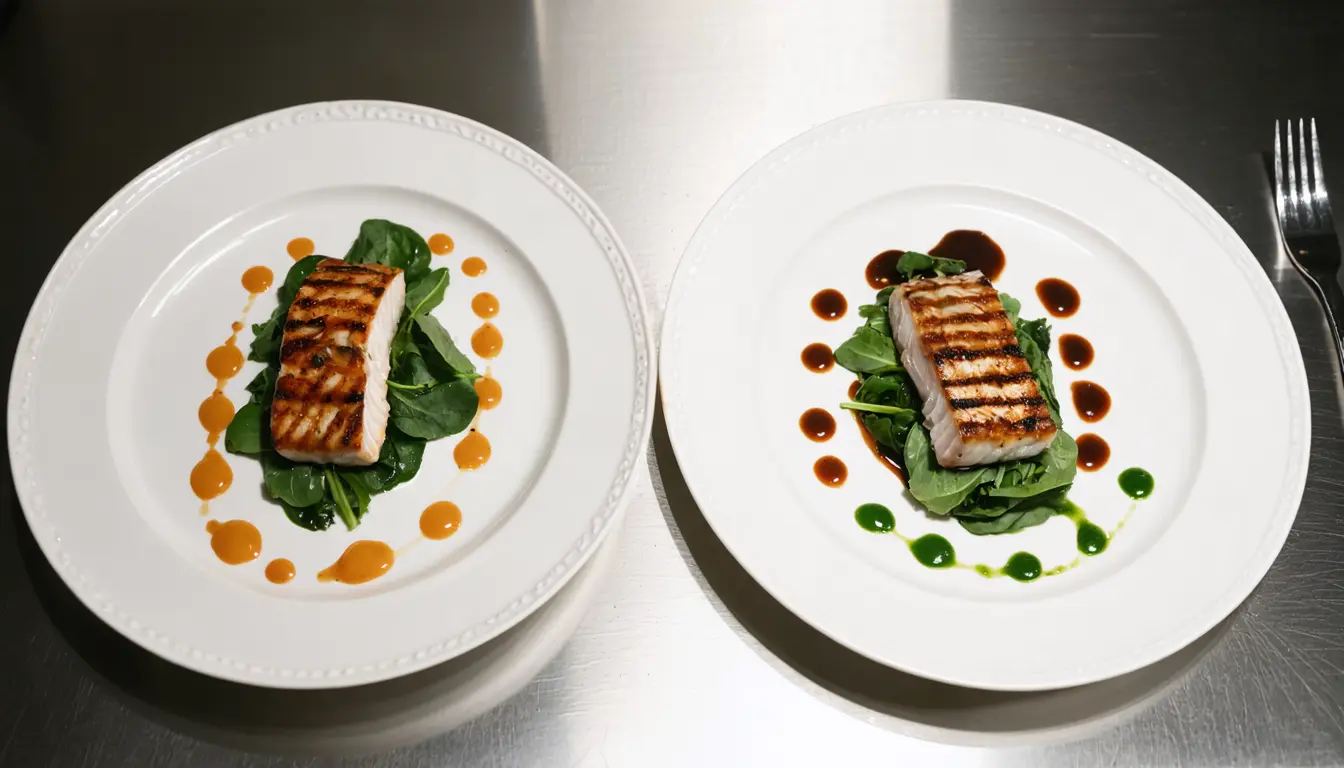
Keio University researchers found 57 diners rated the same sturgeon dish 4.65 of 7 for healthiness with sauces set apart, against 4.05 when drizzled. The food was identical on both plates, so the plating changed a first impression formed before tasting.
The Scientist · Science desk
What happened
- Every diner ate the same sturgeon dish both ways at a working Tokyo restaurant, once with sauces set apart and once with sauces drizzled across the plate.
- Expected tastiness, overall liking and willingness to pay showed no significant difference between the two plates before tasting.
- The work, led by Kosuke Motoki of Keio's Faculty of Business and Commerce with a professional chef, was published in the journal Foods.
Compiled by The ScientistSomething wrong?How this is made
Why it matters
- decision A kitchen can make a dish look healthier by moving the sauce without touching the recipe, but in this sample diners did not say they would pay more for the healthier-looking plate.
- constraint The study measured only ratings, and the one explanation with a dietary consequence, control over sauce quantity, was never tested.
- exposure Health judgements moved 0.6 points on identical food, so a menu's health impression can be set by presentation independently of what the dish contains.
The gap is 0.60 points on a seven-point scale [16], about 15 percent above the drizzled plate's score [17]. Each diner rated both plates [6], so every person was their own control. A table that happened to be more health-minded could not tilt one arm. The phys.org account did not disclose whether the order of the two plates was varied between diners. In a crossover design, plate order is the next thing to check, because a diner may judge the second plate against the first.
The statistics were handled carefully. Diners rated six things before tasting [7], and perceived healthiness was the only one to differ [18]. It held after correction for multiple comparisons [8]. After tasting, the minimal plate scored higher for overall liking and for intention to eat more. Neither difference survived the same correction, and the authors class both as preliminary [10]. With 57 diners [4], I'd treat those two results as leads for a larger study.
The same dish went out on both plates [4], so its nutrition did not change, and every outcome reported is a rating or a stated intention [7][10]. The authors offer two explanations for the healthiness gap. A less visually dense plate may suggest simplicity or naturalness, and sauces placed apart may give diners control over how much they use [11]. Neither explanation was directly measured, the account notes [11]. Only the second has a dietary consequence, and testing it would mean weighing the sauce left on the plate.
For a kitchen, the usable result is narrow. Willingness to pay was among the pre-tasting ratings that did not differ [9]. In this sample, the healthier-looking plate did not raise what diners said they would pay. "We observed that minimal plating made the same dish appear healthier, showing how small visual details can influence our first impressions of the food," said Kosuke Motoki of Keio University, who led the study [1][12].
The study tested one dish in one restaurant. The plate was sturgeon, prepared with a chef from a restaurant recognised with a Michelin Green Star [14] and served at 8go, the restaurant at Gastronomy Innovation Campus Tokyo [4]. The fish was a deliberate choice. "Sturgeon aquaculture is primarily oriented toward caviar production, while sturgeon meat is less commercially prominent," Motoki said [13]. One sturgeon plate cannot show whether the gap holds for a dish where the sauce is the main event. Earlier plating research looked at plate size, arrangement and neatness, and gave sauce presentation little attention [15].
What to watch
- Whether the full Foods paper reports varying the order in which the two plates were served, and how large any order effect was.
- A larger replication testing whether the post-tasting gains in liking and intention to eat more survive correction for multiple comparisons.
- A study that weighs the sauce left on each plate, to test whether separate placement changes how much diners actually consume.
Clarity's read
What the record supports and how the coverage leans. The claims behind it follow.
Reality
- Evidence45
- Adoption
- Insufficient
- Hype gap+5
- Incentives30
- Confidence50
Claim ledger
Ranked by verification strength, evidence, and original report placement.
- [1]
Researchers led by Dr. Kosuke Motoki of the Faculty of Business and Commerce, Keio University, examined how chef-designed sauce presentations influence consumers' evaluations of a dish.
- [2]
Collaborators included Dr. Kohei Yamaguchi and Dr. Haruka Tohara of the Institute of Science Tokyo, Dr. Shin-ichi Ishikawa of Miyagi University, and chef Tatsuya Noda of PLUM KNOT Co., Ltd.
- [3]
The findings were published in the journal Foods.
- [4]
The study involved 57 participants in a real restaurant setting at 8go, the restaurant at Gastronomy Innovation Campus Tokyo, who evaluated the same sturgeon dish presented with two different sauce arrangements.
- [5]
In the minimal plating condition, sauces were placed separately on the plate; in the drizzle condition, sauces were distributed across the plate and around the food.
- [6]
Each participant experienced both versions of the dish, allowing comparison of individual responses.
- [7]
Before tasting, participants rated expected tastiness, perceived healthiness, intention to eat, overall liking, perceived artistic presentation and willingness to pay.
- [8]
Minimal plating produced a significantly higher perceived healthiness rating than drizzle presentation, 4.65/7 compared with 4.05/7, and the difference remained significant after correction for multiple comparisons.
- [9]
No significant differences were found in the other pre-tasting measures.
- [10]
After tasting, minimal presentation received higher ratings for overall liking and intention to eat more, but these differences did not remain significant after correction for multiple comparisons and were considered preliminary.
- [11]
Possible explanations are that the minimal presentation appears less visually dense, associating it with simplicity or naturalness, and that separately placed sauces give diners more control over how much sauce they use; these mechanisms were not directly measured.
- [12]
"We observed that minimal plating made the same dish appear healthier, showing how small visual details can influence our first impressions of the food,"
- [13]
"Sturgeon aquaculture is primarily oriented toward caviar production, while sturgeon meat is less commercially prominent."
- [14]
The dish was prepared in collaboration with a professional chef from a restaurant recognized with a Michelin Green Star.
- [15]
Previous studies have examined plate size, arrangement and neatness, while relatively little attention has been given to sauce presentation.
- [16]
The perceived healthiness gap between minimal and drizzle plating was 0.60 points on the seven-point scale.
- [17]
The minimal plate's healthiness rating was about 15 percent higher than the drizzled plate's.
- [18]
Perceived healthiness was the only one of six pre-tasting measures to show a significant difference.
Sources
1 independent publisher whose own reporting we read for this story.
- phys.orgPlating matters: How sauce placement can make a dish appear healthier
1 article · October 8, 2026
Topics and entities
Follow any of these and your For You feed starts watching them — no settings page required.