Science1 publisher3 min readPublished
Cassini's salty Enceladus grains look like shards of slowly frozen ocean droplets
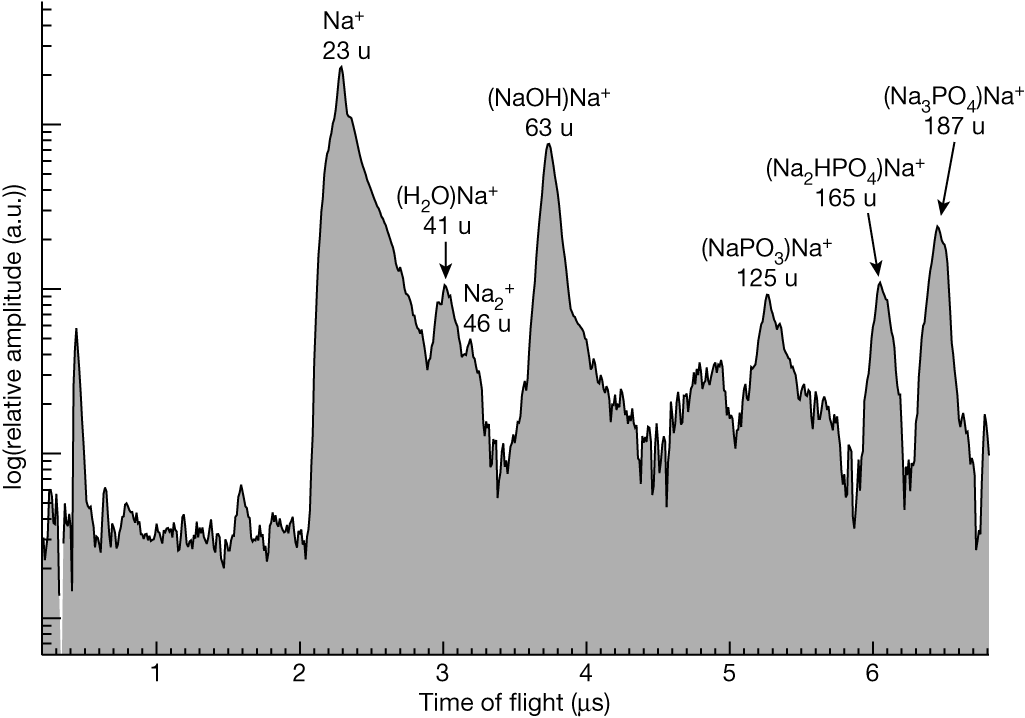
Researchers led by Frank Postberg found sharply different salt mixtures across 961 Cassini spectra of salty Enceladus grains. Tokyo freezing experiments suggest each grain is a shard of a slowly frozen droplet, so the ocean's makeup shows in how often each salt appears.
The Scientist · Science desk
Drafted by a language model from the sources cited here and checked against its claim ledger before publication. How we use AISend a correction
What happened
- Grains were enriched in different salts, including sodium chloride, carbonates, phosphates and potassium chloride, and chloride and carbonate rarely shared a sodium-rich grain.
- The team proposes that droplets freeze slowly deep in the vents, then shatter against the walls of narrower ice channels as the gas speeds up near the surface.
- Slow freezing implies droplets cross the subsurface vents more slowly than earlier work assumed, possibly along more complex fracture pathways.
Compiled by The ScientistSomething wrong?How this is made
Why it matters
- decision Anyone estimating Enceladus' ocean chemistry from plume grains has to treat each grain as a fragment and infer abundances from how often each component turns up across many grains.
- capability Sorting concentrates salts and organics into separate grains, so a compound that is dilute in the ocean could be easier for a future instrument to detect in a few enriched grains.
- constraint Vent models that assume fast freezing and a quick exit would produce uniform grains by the lab result, so they cannot easily reproduce the spread Cassini recorded.
"The Cassini data showed us that these salt-rich grains are far more chemically diverse than an average ocean composition would suggest," Postberg said [9]. The grains came from Saturn's E-ring, which Enceladus supplies, and Cassini's Cosmic Dust Analyzer measured them one at a time between 2004 and 2017 [1]. The pattern that needs explaining is a missing pairing. If each grain were a frozen drop of the average ocean, a sodium-rich grain with chloride should usually carry carbonate too. In the Cassini spectra the two rarely shared a grain [3].
The experiment at the Earth-Life Science Institute in Tokyo, part of a study published in Science Advances [11], asked whether one body of water could produce that split. Yasuhito Sekine's group froze droplets built to match the major salts expected in the ocean, varied droplet size and cooling rate, and then mapped where the elements ended up [4]. In droplets about 200 micrometers across, freezing at roughly 10 K per minute or slower pulled the salts into separate regions. Faster freezing left them much more evenly mixed [5].
That fast-freezing run is the experiment's control. Earlier work had generally assumed the spray freezes quickly and heads straight for space [7]. Under fast freezing the lab droplets came out uniform, the opposite of what Cassini saw [5]. If this explanation holds, the grains point to slow freezing during a slower passage through the vents, perhaps along winding fractures [7]. The cooling rate inside Enceladus is an inference drawn backwards from the grains.
"What surprised us was that the diversity seen by Cassini could emerge from droplets originating from essentially the same ocean water," Sekine said [6]. In the team's proposed route, droplets tens to hundreds of micrometers across freeze and sort deep in the vents. Nearer the surface, accelerating gas drives them into the walls of narrower ice channels. They shatter into fragments that carry different salt-rich regions out to the E-ring [8]. The shattering stage is a proposal; the experiments as described covered the freezing [4].
So is the plume still a sample of the ocean? Postberg's account says yes, if you count. "The abundance of each individual component in the ocean is then reflected in the number of fragments in which a particular component is found," he said [10]. A single grain is a piece of a sorted droplet. The ocean's recipe sits in the frequencies across many grains. That counting rule assumes each salt-rich region is about as likely as any other to break off and reach the E-ring. The release does not say whether that was tested.
The sorting reaches beyond salts. Salts also separate from organics, and earlier analyses found many organic species appearing apart from one another at elevated concentrations [12]. A compound that is dilute in the ocean could turn up concentrated in a handful of grains. That makes it easier to detect, and it makes one rich grain a poor measure of how much of the compound the ocean holds.
What to watch
- A test of whether shattering favours some salt-rich regions over others, since Postberg's fragment-counting rule depends on it.
- Lab or modelling work that reproduces the proposed collisions of frozen droplets with narrow ice channel walls at vent gas speeds.
- Whether proposals for future Enceladus sampling plan to count fragments across many grains when estimating ocean salt and organic ratios.