Science1 publisher2 min readPublished
Science Tokyo chemists trace a helicity-dependent photocurrent to the interior of 2D perovskites
Institute of Science Tokyo chemists used light at 90 degrees to show that a helicity-dependent photocurrent in 2D perovskites comes from the crystal bulk. Mirror-image crystals reportedly send the current the other way, so molecular handedness can set its direction.
The Scientist · Science desk
Drafted by a language model from the sources cited here and checked against its claim ledger before publication. How we use AISend a correction
What happened
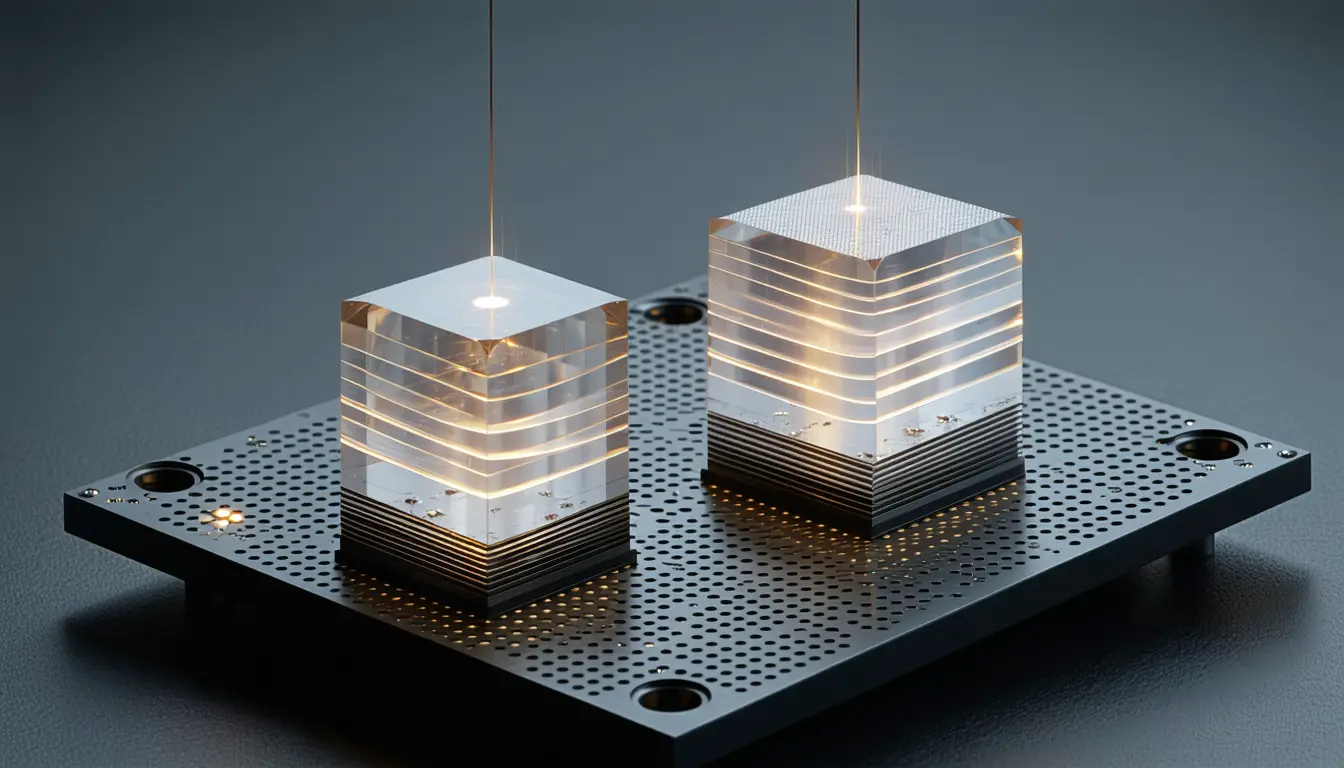
- The crystals alternate lead iodide layers, which give strong spin-orbit interaction, with 1-(p-tolyl)ethylammonium layers whose permanent dipoles make the whole crystal polar.
- With light striking head-on, electrodes perpendicular to the crystal's polarization recorded a current that reversed when the light's handedness was switched.
- Tilting the light to 45 degrees produced helicity-dependent currents along both axes.
Compiled by The ScientistSomething wrong?How this is made
Why it matters
- capability If the crystal interior sets the current, a chemist can choose its direction by choosing the handedness of the organic cation, with no magnet in the material.
- constraint A clean bulk reading depends on head-on illumination; tilted light lets surface currents add in, so any measurement or device built on this has to hold the geometry fixed.
- precedent CPGE results taken only at oblique incidence now have an obvious check to pass: normal incidence plus electrodes along the polarization axis, where the bulk should give nothing.
A current that reverses with the light's handedness is easy to record and hard to place. Kouji Taniguchi, the Institute of Science Tokyo chemist who led the work [4], said that "in conventional CPGE measurements, signals originating from crystal surfaces and interfaces are often mixed with bulk contributions, making it difficult to determine the microscopic origin of the observed photocurrent" [5]. The group's paper is in Nano Letters [3].
The experiment uses symmetry to separate the two sources. For this polar crystal, the bulk structure predicts a helicity-dependent current across the polarization axis and none along it [8]. That makes the parallel electrodes the control. If surface currents were leaking in at normal incidence, they would show up there.
A blank reading on its own could still be instrumental. The 45-degree run makes that less likely, because the same axis registered a helicity-dependent current once the light was tilted [9]. According to the report, bulk and surface states have different polarizations and spin orientations [10]. Head-on light suppresses the surface contribution through the symmetry of the measurement geometry, while the bulk can still produce a signal [10].
Polarity in these crystals comes from the organic layer, whose cations carry permanent electric dipoles [6]. The molecule is therefore the part a chemist can change. The team synthesized chiral-polar crystals as a further check on the bulk origin [11]. Phys.org's report says mirror-image crystals reverse the direction of the current [12].
The report frames the result as a strategy for regulating spin-polarized photocurrents and advancing opto-spintronic technologies [13]. The effect is attractive because light alone produces spin-polarized currents in materials that are not magnetized [14]. I think the strategy claim holds in a narrow form: in these crystals, structure sets the current's direction. The thing this doesn't tell you is whether the current is large enough to use. The report does not give photocurrent magnitudes, conversion efficiencies or measurement temperatures.
What to watch
- Photocurrent magnitudes and efficiencies in the Nano Letters paper for both mirror-image crystals, which decide whether the bulk current is usable.
- Whether other polar organic cations or other 2D perovskite families show the same perpendicular-only current under head-on light.