Pepper necrotic spot virus, once confined to Peru, is confirmed in Chilean peppers and tomatoes
Washington State and Chilean virologists confirmed pepper necrotic spot virus, until now known only from Peru, in Chile's peppers and tomatoes. Plant viruses like it have no known cure, so early detection is the main defense.
The Scientist · Science desk
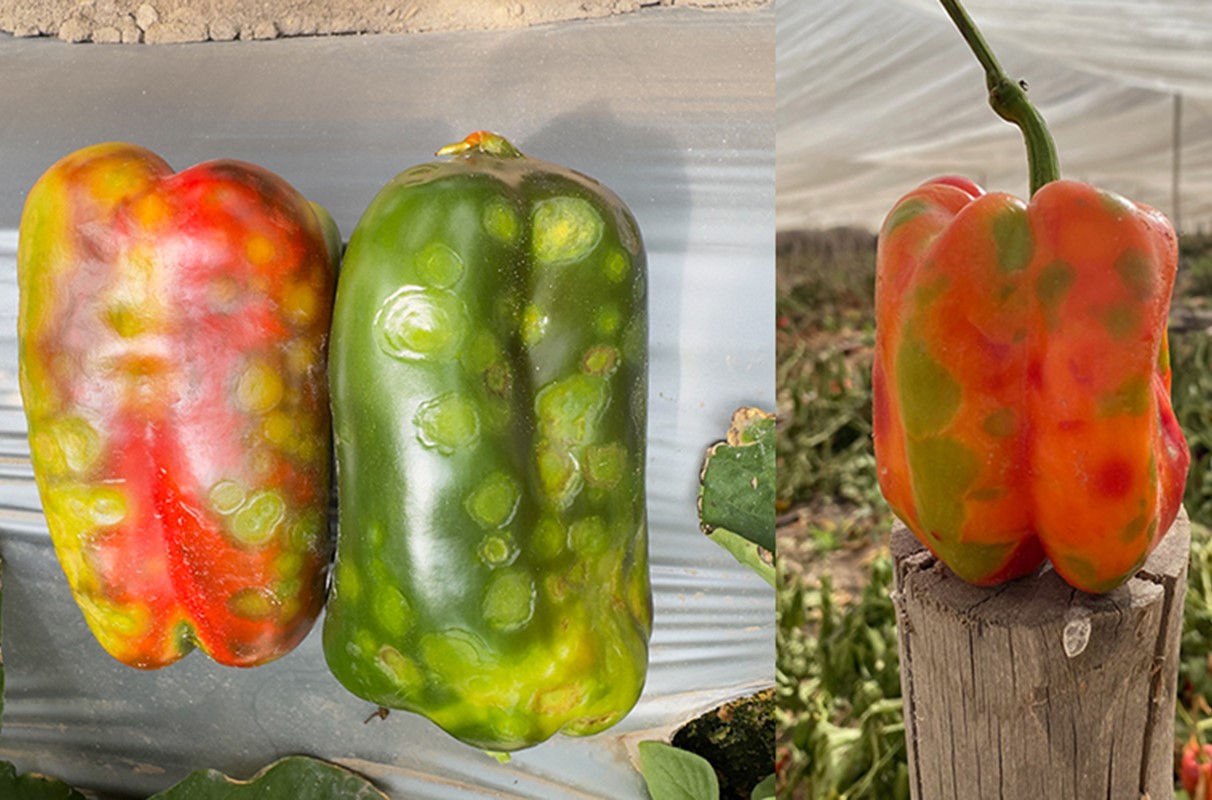
Santiago markets had tomatoes and peppers with dying-tissue rings. Arica fields showed infection signs, severe in peppers; its Azapa and Lluta valleys supply Chile's winter crop. Thrips spread the virus. No cure is known. Its family infects more than 1,000 plant species.
- exposure Santiago farmers markets Tomatoes and peppers with rings of dying tissue and bronze discoloration, claim 3
- exposure Arica fields Signs of viral infection, with symptoms particularly severe in peppers, claim 5
- exposure Azapa and Lluta valleys Arica's valleys; Chile's main out-of-season suppliers of winter tomatoes and peppers, claim 4
- capability Thrips Verified by Rosales' group to spread the virus; the tiny insects can fly for miles, claim 8
- constraint Plant virus control No known cure; best defense is early detection, managing the insect carrier and resistant varieties, claim 9
- exposure Tospoviruses The virus's family; infect more than 1,000 plant species and cause billions of dollars' worth of crop damage, claim 2
| Who | How | Kind | Claim |
|---|---|---|---|
| Santiago farmers markets | Tomatoes and peppers with rings of dying tissue and bronze discoloration | exposure | 3 |
| Arica fields | Signs of viral infection, with symptoms particularly severe in peppers | exposure | 5 |
| Azapa and Lluta valleys | Arica's valleys; Chile's main out-of-season suppliers of winter tomatoes and peppers | exposure | 4 |
| Thrips | Verified by Rosales' group to spread the virus; the tiny insects can fly for miles | capability | 8 |
| Plant virus control | No known cure; best defense is early detection, managing the insect carrier and resistant varieties | constraint | 9 |
| Tospoviruses | The virus's family; infect more than 1,000 plant species and cause billions of dollars' worth of crop damage | exposure | 2 |
What happened
- Marlene Rosales of the Pontifical Catholic University of Chile spotted tomatoes and peppers with rings of dying tissue and bronze discoloration in Santiago farmers markets.
- Her survey of Arica, near the Peruvian border, found fields showing signs of viral infection, with symptoms particularly severe in peppers.
- At Washington State, Prabu Gnanasekaran sequenced and analyzed viral RNA to confirm that the virus had moved from Peru into Chile.
- Rosales' group also verified that thrips, tiny insects that can fly for miles, spread the virus.
Why it matters
- constraint With no cure, growers are limited to catching infections early and controlling thrips. The insects can fly for miles, well past a single field.
- exposure Arica's Azapa and Lluta valleys are Chile's main winter suppliers of tomatoes and peppers, so the region where symptoms were found carries the country's off-season supply.
- decision Chilean diagnosticians and field staff now have to learn to recognize a virus not previously seen in the country, and Rosales names that training as the priority.
Sequencing settles the identity. Marlene Rosales, the Chilean virologist who found the symptoms, said she "emailed him that we were potentially looking at a new tospovirus in tomatoes and peppers" [13], and Prabu Gnanasekaran's RNA work in Hanu Pappu's lab then confirmed the virus was the one previously confined to Peru [7].
The route into Chile is a separate question. "Viruses never respect borders," said Pappu, a Washington State plant virologist. "This is just one of many plant viruses that can pass from country to country through infected plant material or migrating insects." [10] Rosales described the work this way: "This finding helped us move quickly to understand the potential pathway of this virus into Chile and its future spread within the country." [11]
The paper's title speaks of southward spread [14]. The university's account, as carried by phys.org, does not say when the virus arrived, which route it took, how many samples were tested, how many fields are affected or what yield was lost. Both routes on Pappu's list stay open, and thrips can fly for miles [8].
In our view the evidence supports only a presence claim. A trace-back from symptomatic produce finds where disease is visible; it cannot say how much of the country's crop is infected, or whether Arica is the edge of the problem or all of it.
The widely quoted damage figure needs the same care. "Billions of dollars" is attached to the tospovirus group, which infects more than 1,000 plant species [2].
What to watch
- The sample counts and survey design in the Plant Disease paper, which would show how many fields and plants the finding rests on.
- Any detection of the virus outside Arica, in central Chile or in other countries bordering Peru.
- The next May-to-September winter season, when Arica ships produce south and field symptoms could be compared against this year's.
Clarity's read
What the record supports and how the coverage leans. The claims behind it follow.
Reality
- Evidence68
- Adoption
- Insufficient
- Hype gap−10
- Incentives35
- Confidence66
Claim ledger
Ranked by verification strength, evidence, and original report placement.
- [1]
Virologists at Washington State University and the Pontifical Catholic University of Chile confirmed pepper necrotic spot virus, an insect-spread pathogen discovered in Peru but previously unknown in Chile, and published the results in Plant Disease.
- [2]
Pepper necrotic spot virus belongs to the tospoviruses, insect-borne pathogens that infect more than 1,000 plant species and cause billions of dollars' worth of damage to crops such as beans, peanuts, peppers, soybeans and tomatoes.
- [3]
Marlene Rosales, a virologist at the Pontifical Catholic University of Chile, found tomatoes and peppers with rings of dying tissue, bronze discoloration and other deformations in farmers markets in Santiago, which led her to investigate their supply chain.
- [4]
Rosales surveyed growing areas in the northern province of Arica near the Peruvian border; Arica's Azapa and Lluta valleys are Chile's main out-of-season suppliers of winter tomatoes and peppers.
- [5]
In Arica, Rosales found fields showing signs of viral infection, with symptoms particularly severe in peppers.
- [6]
Doctoral student Fernanda Rodriguez tested samples in Rosales' lab to reveal a viral presence; Rosales then asked Pappu, who has worked on tospoviruses for over 30 years, to help confirm the virus was new.
- [7]
Prabu Gnanasekaran, a research associate in Pappu's lab, sequenced and analyzed viral RNA to confirm that the virus previously confined to Peru had now moved into Chile.
- [8]
Rosales' research group generated new information on the virus's biological properties and verified it is spread by thrips, tiny insect pests that can fly for miles.
- [9]
Plant viruses like pepper necrotic spot virus have no known cure, so the best defense is to identify incursions as early as possible, manage the insect carrier and develop varieties that resist infection.
- [10]
"Viruses never respect borders," said Hanu Pappu of Washington State University. "This is just one of many plant viruses that can pass from country to country through infected plant material or migrating insects."
- [11]
"This finding helped us move quickly to understand the potential pathway of this virus into Chile and its future spread within the country," Rosales said.
- [12]
Rosales said: "Training first responders to identify this new virus now becomes a priority."
- [13]
Rosales said: "I emailed him that we were potentially looking at a new tospovirus in tomatoes and peppers, and almost instantly got a response asking for details."
- [14]
The paper is Eduardo Silva Gorayeb et al., "Southward Spread of Pepper Necrotic Spot Orthotospovirus into Chile: Identification and Characterization," Plant Disease (2026), DOI 10.1094/pdis-12-25-2427-re.
Get this ledger inside ChatGPT. Ask about any of our stories and the answer brings its figure, each claim’s verdict and the sources. Free, no account.
Sources
1 independent publisher whose own reporting we read for this story.
- phys.orgBorder-hopping virus identified in Chilean pepper and tomato crops
1 article · October 14, 2026
Topics and entities
Follow any of these and your For You feed starts watching them — no settings page required.
Topics
- Crop disease surveillanceFollow
- Chilean agricultureFollow
- Plant pathologyFollow