ScienceNot yet confirmed elsewhere1 publisher2 min readPublished
An Oregon State electrode of zinc phosphate and carbon black reads eugenol in real foods
Oregon State researchers built a zinc phosphate and carbon black sensor that recovered 96.4% to 99.9% of eugenol from five foods. It targets chromatography testing, which is accurate but slow, costly and dependent on specialized staff.
The Scientist · Science desk
What happened
- The composite is precipitated in a water-based solution from components the report describes as relatively abundant and inexpensive.
- Zinc phosphate's mesoporous framework captures eugenol and concentrates it at the electrode surface, while the conductive carbon black carries electrons away quickly.
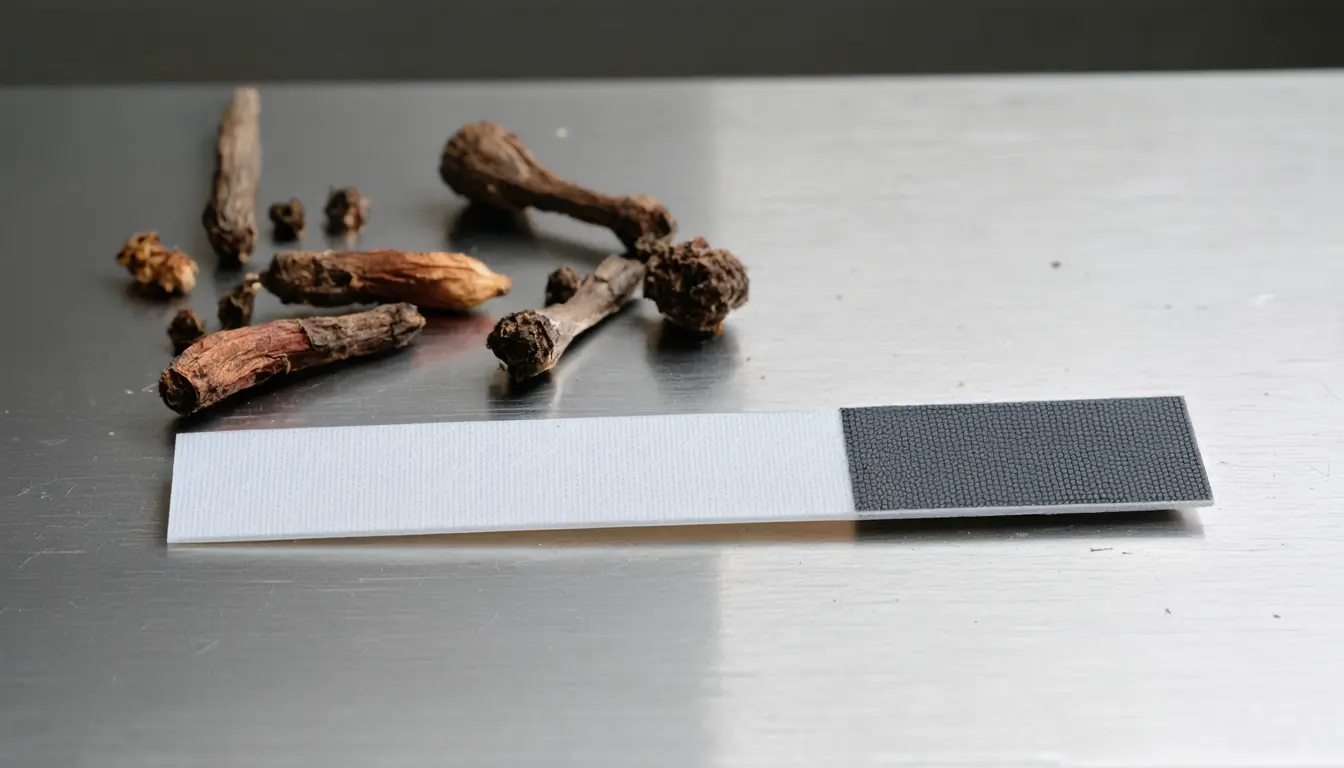
- The test foods were cinnamon, peach, coffee beans, strawberry and canned tuna.
- Postdoctoral researcher Gopika Meenakumari Gopakumar led the study, which is published in Materials Today Chemistry.
Why it matters
- cost Cheap ingredients lower the cost of making the sensor. Savings on labor depend on whether non-specialists can run the readout, which is a separate question.
- decision A lab weighing a switch would want to run the sensor against its own chromatography results on its own products. Five foods in one study is a reason to run that comparison.
- capability The authors say the platform could be adapted to other phenolic compounds for food safety and pharmaceutical analysis. If that works, one electrode design could cover a family of compounds, but only eugenol is reported here.
Recovery is the only performance figure in the report on the study, and it is a good one. The range, 96.4% to 99.9% [6], spans 3.5 percentage points [9] across samples as different as peach and canned tuna [6].
The headline over the report says the sensor could make food quality testing faster and less expensive [8]. The thing this doesn't tell you is how much faster or cheaper. The report does not include a run time, a per-test cost, a detection limit or a side-by-side with chromatography on the same samples.
Gopakumar, who led the study [2], said: "Demonstrating accurate performance in complex foods shows the technology is likely not far away from practical application" [12]. Accuracy in complex foods is the right first test, and five foods is a respectable start [10]. It is also the authors' own demonstration, and it covers one compound [1].
The scalability case rests on the recipe. The scientists say the low cost of the components and the ease of synthesis suggest high potential for scalability [11]. Many nanomaterial sensors need precious metals, complex fabrication or both [7], so on paper the recipe is an advantage.
Oregon State's Mas Subramanian described what the group wants to learn next from the work. "We want to design materials for a particular function, but we also want to see whether that function translates into a useful result in the real world," Subramanian said [13].
What to watch
- A head-to-head comparison with gas or high-performance liquid chromatography on identical samples, with detection limits and run times.
- A demonstration on a second phenolic compound, which would test the adaptation claim.
- Synthesis beyond a lab batch, since the scalability case so far rests on the ingredients and the precipitation recipe.
Clarity's read
What the record supports and how the coverage leans. The claims behind it follow.
Reality
- Evidence45
- Adoption
- Insufficient
- Hype gap+25
- Incentives
- Insufficient
- Confidence55
Claim ledger
Ranked by verification strength, evidence, and original report placement.
- [1]
Researchers at the Oregon State University College of Science developed an electrochemical sensor for rapidly and accurately detecting eugenol, a naturally occurring compound widely used in the food, beverage and fragrance industries.
- [2]
The study was led by postdoctoral researcher Gopika Meenakumari Gopakumar, and the findings are published in Materials Today Chemistry.
- [3]
Current techniques for measuring eugenol and other phenolic compounds rely on gas chromatography or high-performance liquid chromatography; the testing is accurate but requires specialized personnel, making it expensive and time-consuming.
- [4]
The nanocomposite sensor is based on zinc phosphate and carbon black, which are relatively abundant and inexpensive, and the composite is produced in a water-based solution via precipitation.
- [5]
The sensor captures eugenol in its mesoporous phosphate framework, concentrating it at the electrode surface, and uses conductive carbon black to quickly carry away electrons.
- [6]
The researchers report that the sensor recovered 96.4% to 99.9% of eugenol from real food samples: cinnamon, peach, coffee beans, strawberry and canned tuna.
- [7]
Many nanomaterial-based sensors require precious metals, complex fabrication methods or both.
- [8]
The headline over the phys.org report reads: New electrochemical sensor could make food quality testing faster and less expensive.
- [9]
The recovery range spans 3.5 percentage points.
- [10]
The recovery tests covered five foods.
- [11]
The scientists say the comparatively low cost of components and ease of synthesis suggest the technology has high potential for scalability.
- [12]
"Demonstrating accurate performance in complex foods shows the technology is likely not far away from practical application,"
ReportedInsufficientSource: Gopika Meenakumari Gopakumar, postdoctoral researcher at Oregon State University, study leadView cited source - [13]
"We want to design materials for a particular function, but we also want to see whether that function translates into a useful result in the real world,"
ReportedInsufficientSource: Mas Subramanian, university distinguished professor and Milton Harris Chair in Materials Chemistry, Oregon State UniversityView cited source - [14]
The researchers say the platform could be adapted to detect other phenolic compounds for food safety and pharmaceutical analysis.
Sources
1 independent publisher whose own reporting we read for this story.
- phys.orgNew electrochemical sensor could make food quality testing faster and less expensive
1 article · October 13, 2026
Topics and entities
Follow any of these and your For You feed starts watching them — no settings page required.