ScienceNot yet confirmed elsewhere1 publisher2 min readPublished
Sixteen new mayfly genomes put mayflies and dragonflies in one insect lineage
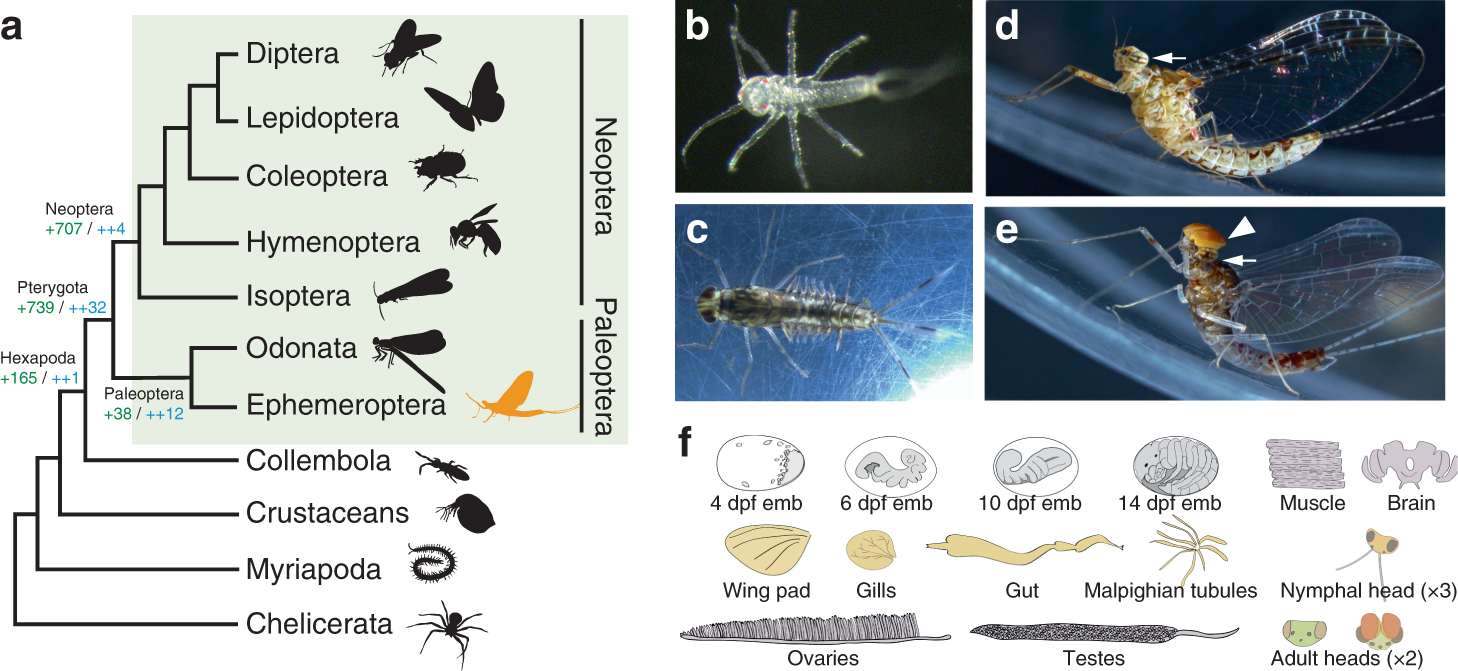
Chinese researchers who sequenced 16 new mayfly genomes report that mayflies and dragonflies form one group, Palaeoptera, sister to wing-folding insects. Their fossil-calibrated clock puts crown-group winged insects in the Early Devonian.
The Scientist · Science desk
Key figures card. Lead: approximately 40% of gene trees were affected by incomplete lineage sorting and gene tree estimation error. Below: data from more than 100 insect species were integrated, and the molecular clock was calibrated with 13 fossil reference points.
| Figure | Value | Note | Claim |
|---|---|---|---|
| Gene trees affected by sorting and estimation error | 40% approx. | 4 | |
| Species in data, over | 100 insect species | 2 | |
| Fossil points in clock | 13 reference points | 8 |
What happened
- The work, published Oct. 12, came from Cai Chenyang's team at the Nanjing Institute of Geology and Palaeontology and Zhou Changfa's team at Nanjing Normal University.
- The dataset also integrated genomic and transcriptomic data from more than 100 insect species, which the authors say fills gaps in earlier taxon and gene sampling.
- A molecular clock calibrated with 13 fossil reference points dates crown-group Palaeoptera to the Late Devonian.
- In the authors' reconstruction, mayflies and dragonflies developed rigid wing-base complexes suited to gliding or high-speed predatory flight.
Why it matters
- constraint If the grouping holds, rigid wings cannot be treated as the ancestral condition in comparative work, because the authors place both wing types as new traits.
- decision Anyone reusing the Devonian dates in another analysis should check the 13 fossil calibrations first, since the dates are only as firm as those placements.
- precedent The authors blame earlier failures on gene-tree conflict and thin sampling, so we'd expect other rapid early splits to be retested with denser sampling and simulation checks.
The authors report that incomplete lineage sorting and gene tree estimation error affected about 40% of gene trees during the rapid early radiation of winged insects [4]. They say that discordance pushed different analytical frameworks toward competing answers and explains why earlier phylogenomic studies did not fully resolve the basal relationships [5].
The team ran concatenation and multispecies coalescent methods, several evolutionary models, topological tests, site-level signal dissection and simulations on two amino-acid supermatrices [3]. If the conflict were steering the answer, methods that handle it differently should have split. According to the authors, they did not: the approaches consistently support a monophyletic Palaeoptera, with mayflies and dragonflies as sister groups [6].
Insects have more than 1 million described living species [7], but what matters is how many mayfly and dragonfly lineages are among the 100-plus species in the dataset [2]. All 16 new genomes are from Chinese mayflies [2]. The phys.org account does not break the species down by lineage, and it reports the dates as epochs without intervals [8].
The authors say the folding mechanism, enabled by rotation of the independent third axillary sclerite, gave Neoptera the morphological and ecological basis for its radiation after the Carboniferous [10]. The reconstruction does not show that folding caused that radiation.
We think the grouping is well supported by this dataset, on the condition that the mayfly and dragonfly sampling holds up in other datasets. The authors conclude that rigid and foldable wings are both new traits acquired independently from ancestral winged insects, and they say that largely resolves the Palaeoptera Problem [9].
What to watch
- The full paper's dating tables: numeric ages and intervals around the Early and Late Devonian estimates.
- Independent datasets with more mayfly and dragonfly lineages, to see whether they recover the same grouping.
- Responses from groups whose earlier analyses reached competing conclusions on the three winged-insect lineages.
Clarity's read
What the record supports and how the coverage leans. The claims behind it follow.
Reality
- Evidence62
- Adoption
- Insufficient
- Hype gap+10
- Incentives
- Insufficient
- Confidence55
Claim ledger
Ranked by verification strength, evidence, and original report placement.
- [1]
The study, published in Proceedings of the National Academy of Sciences on Oct. 12, was conducted by Cai Chenyang's team from the Nanjing Institute of Geology and Palaeontology (Chinese Academy of Sciences) and professor Zhou Changfa's team from Nanjing Normal University.
- [2]
The researchers sequenced 16 new genomes from Chinese mayflies and integrated genomic and transcriptomic data from more than 100 insect species.
- [3]
The researchers built two large amino-acid supermatrices from universal single-copy orthologous nuclear genes, then examined phylogenetic signal using concatenation and multispecies coalescent methods, multiple evolutionary models, topological tests, site-level signal dissection and simulation analyses.
- [4]
During the rapid early radiation of winged insects, incomplete lineage sorting and gene tree estimation error affected approximately 40% of gene trees, creating topological discordance between gene trees and the species tree.
- [5]
The authors say this discordance caused competing conclusions across different analytical frameworks and explains why earlier phylogenomic studies failed to fully resolve the relationships of basal winged insects.
- [6]
Results from the diverse phylogenomic approaches consistently support the monophyly of Palaeoptera, and the genomic data strongly indicate that Ephemeroptera and Odonata are sister groups, together forming Palaeoptera, the sister clade of Neoptera.
- [7]
Insects are the most species-rich group of animals on Earth, with more than 1 million formally described living species.
- [8]
Molecular-clock analyses calibrated with 13 fossil reference points indicate that crown-group Pterygota originated in the Early Devonian and crown-group Palaeoptera arose in the Late Devonian.
- [9]
The authors suggest the nonfoldable wings of Palaeoptera and the foldable wings of Neoptera are both novel traits independently acquired from ancestral winged insects, thereby largely resolving the Palaeoptera Problem.
- [10]
The authors say insect wings evolved only once, and that the neopteran wing-folding mechanism, enabled by rotation of the independent third axillary sclerite to tuck hindwings over the abdomen, provided morphological and ecological foundations for the radiation of Neoptera after the Carboniferous.
- [11]
Both mayflies and dragonflies evolved highly specialized rigid wing-base complexes adapted for gliding or high-speed predatory flight.
Sources
1 independent publisher whose own reporting we read for this story.
- phys.orgWinged insect evolution: New evidence sheds light on century-old debate
1 article · October 13, 2026
Topics and entities
Follow any of these and your For You feed starts watching them — no settings page required.
Topics
- Insect phylogenomicsFollow
- PaleontologyFollow
- Evolutionary BiologyFollow