Dropping one humerus estimate leaves Omo I shorter and heavier than the old reconstruction
Anthropologists Osbjorn Pearson and John Fleagle estimate Omo I at about 1.65 m and 71 kg after dropping one doubtful humerus length. Their reanalysis rests on one skeleton and the lower of two stature estimates, so it tests ideas about early Homo sapiens bodies without settling them.
The Scientist · Science desk
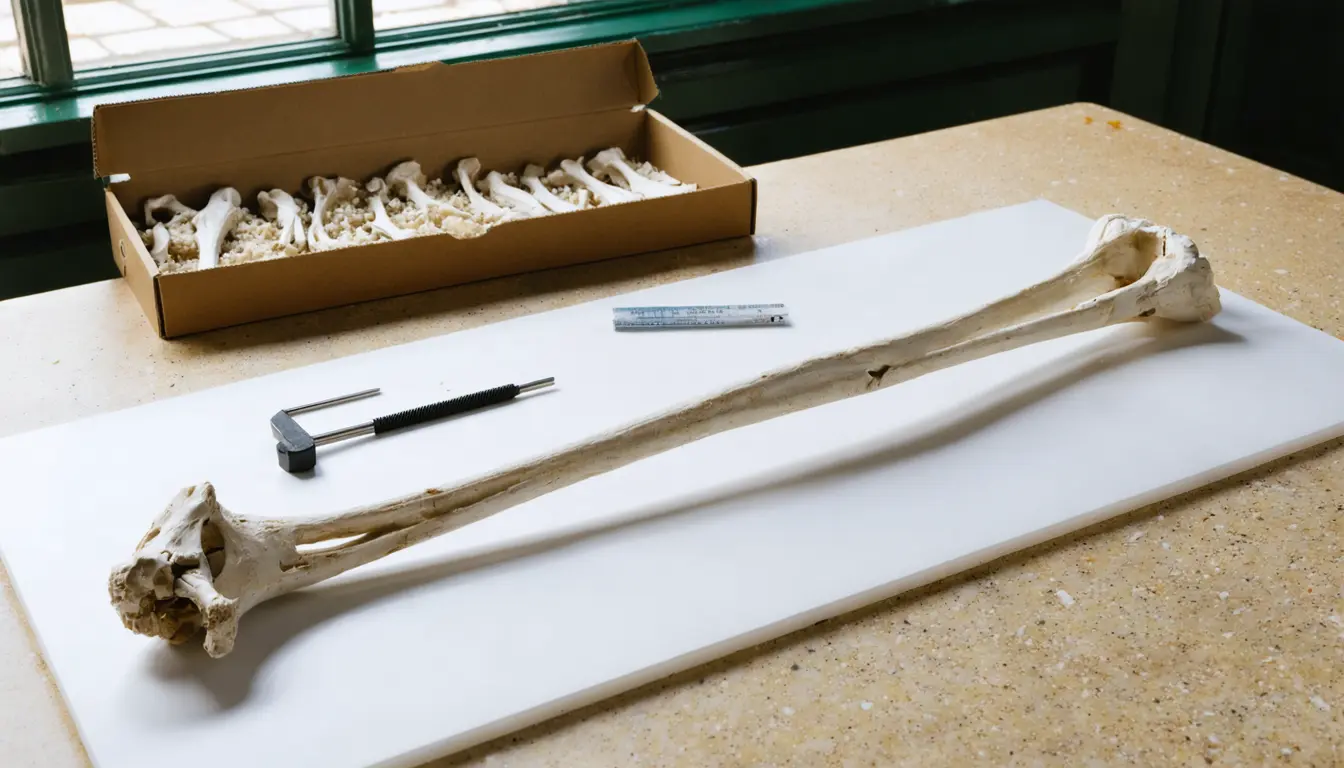
Revised stature if the humerus estimate is unreliable: about 1.65 m. 2008 foot-bone range: 1.62 to 1.73 m. 2008 humerus-based range: 1.78 to 1.82 m.
| Figure | Value | Note | Claim |
|---|---|---|---|
| Stature if humerus estimate is unreliable, about | 1.65 m | 9 | |
| 2008 foot-bone range, at least | 1.62 m | up to 1.73 m | 15 |
| 2008 humerus-based range, at least | 1.78 m | up to 1.82 m | 13 |
What happened
- Omo I lived more than 230,000 years ago, and for decades measurements of her skeleton led researchers to picture a relatively tall, slender woman.
- A 2008 study by Pearson and colleagues had produced two stature estimates that disagreed: 1.62 to 1.73 m from a foot bone and 1.78 to 1.82 m from the left humerus.
- On comparing the measurements, the authors found no clear size difference between her upper and lower body, and uncertain or abraded measurements seemed to explain the discrepancy.
- The length of her clavicles and the size of her pelvis also point to a sturdier build than earlier work assumed.
- Humans from Skhul and Qafzeh, who lived around 100,000 years after Omo I, tended to be taller and more slender.
Why it matters
- constraint The sturdier reconstruction is only as good as the lower stature estimate, so anyone citing it for early Homo sapiens should carry that condition with it.
- decision Anyone using Omo I as a reference for early Homo sapiens stature now has to choose between the humerus-based figures, 13 to 17 cm above the revised one, and the foot-based range.
- capability The idea that body mass fell relative to height after Omo I gives new fossils from the period a specific prediction to confirm or fail.
The two 2008 estimates did not overlap. The top of the foot-bone range sits 5 cm below the bottom of the humerus range [14], and the new figure of about 1.65 m falls inside the foot-bone range [15]. According to Discover Magazine's account of the paper, Pearson and Fleagle conclude that the humerus length estimate is the one to exclude [8].
Their method was a second look at old numbers. They went back through measurements of numerous bones and compared them with those of more recent humans [3]. Pearson had a specific worry: some dimensions had to be estimated from incomplete fragments [5]. "I also worried that abrasion of the original skeleton had made some of the measurements unreliable," he said [6]. A real difference in proportion between her upper and lower body would have been the other explanation for the 2008 gap, and the comparison did not support it [7].
We think the exclusion is defensible on the grounds the authors give, fragmentary and abraded bone. It remains a judgement call about a single input.
Pearson was direct about what the revision means for her build. "The new result means that Omo I would have been substantially heavier for her height than we thought. This would make her more like Neanderthals and other Middle Pleistocene humans from Eurasia," he said [11][19].
He also tied it to the wider argument about modern anatomy. "This would add to a growing body of data that refutes the hypothesis that all of the 'anatomically modern' traits emerged as a package. They seemed to have evolved gradually and perhaps in a mosaic fashion," Pearson said [18].
The thing this doesn't tell you is how firm the mass figure is. The Discover report gives about 71 kg [9] without the size of the comparison sample or an error range. A single skeleton set against later groups also cannot separate change over time from differences between populations.
What to watch
- Whether other anthropologists re-measure the Omo I humerus or recompute her stature with and without it.
- New African Middle Pleistocene fossils with preserved limb and pelvis bones, which could test the body-mass reduction hypothesis.
- The paper's own tables: the comparison sample size and the error range on the 71 kg estimate.
Clarity's read
What the record supports and how the coverage leans. The claims behind it follow.
Reality
- Evidence45
- Adoption
- Insufficient
- Hype gap+10
- Incentives
- Insufficient
- Confidence50
Claim ledger
Ranked by verification strength, evidence, and original report placement.
- [1]
Omo I lived more than 230,000 years ago, and her skull already displayed features characteristic of Homo sapiens, including a high, rounded cranial vault and a chin.
- [2]
For decades, measurements of Omo I's skeletal remains led researchers to picture her as a relatively tall, slender woman.
- [3]
Osbjorn Pearson of the University of New Mexico and John Fleagle of Stony Brook University reexamined measurements of numerous bones from the Omo I skeleton and compared them with those of more recent humans, in an analysis published in the Journal of the Royal Anthropological Institute.
- [4]
A 2008 study by Pearson and colleagues produced two different stature estimates for Omo I: 1.62 to 1.73 m based on a foot bone, and 1.78 to 1.82 m based on the left humerus.
- [5]
Pearson suspected some measurements might be unreliable because some dimensions had to be estimated from incomplete fragments, and wear on the fossil may have affected certain measurements.
- [6]
"I also worried that abrasion of the original skeleton had made some of the measurements unreliable," Pearson said.
- [7]
When the researchers compared the measurements, they found no clear size difference between the upper and lower body parts; uncertain measurements, either estimates or ones affected by abrasion, seemed to explain the discrepancy.
- [8]
The authors concluded that the humerus length estimate should be excluded from the analysis.
- [9]
If the humerus estimate is unreliable, Omo I would have stood about 5 feet 5 inches (1.65 m) tall and weighed about 157 pounds (71 kg), a robust build for her height.
- [10]
The length of Omo I's clavicles and the size of her pelvis also suggest a more robust build than previously assumed.
- [11]
"The new result means that Omo I would have been substantially heavier for her height than we thought," Pearson said.
- [12]
The robust-build reconstruction of Omo I depends on the lower estimate of her stature being correct.
- [13]
The 2008 humerus-based stature range (1.78 to 1.82 m) sits 0.13 to 0.17 m above the revised figure of about 1.65 m.
- [14]
The top of the 2008 foot-bone range (1.73 m) is 0.05 m (5 cm) below the bottom of the humerus range (1.78 m), so the two ranges do not overlap.
- [15]
The revised stature of about 1.65 m lies inside the 2008 foot-bone range of 1.62 to 1.73 m.
- [16]
Ancient humans from Skhul and Qafzeh, who lived around 100,000 years later than Omo I, tended to be taller and more slender.
- [17]
The researchers suggest a substantial reduction in body mass relative to height may have occurred between Omo I and the Skhul and Qafzeh people, although more fossils are needed to test that hypothesis.
- [18]
"This would add to a growing body of data that refutes the hypothesis that all of the 'anatomically modern' traits emerged as a package. They seemed to have evolved gradually and perhaps in a mosaic fashion," Pearson said.
- [19]
Pearson said of the new result: "This would make her more like Neanderthals and other Middle Pleistocene humans from Eurasia," naming as examples the people from Sima de los Huesos in Spain.
Get this ledger inside ChatGPT. Ask about any of our stories and the answer brings its figure, each claim’s verdict and the sources. Free, no account.
Sources
1 independent publisher whose own reporting we read for this story.
Topics and entities
Follow any of these and your For You feed starts watching them — no settings page required.