Capuchin meat-eating rises when fruit falls, and the fed group hunted about half as much
Bearded capuchins turn predator when fruit thins, and the clearest evidence comes from a second group that was fed daily for an unrelated project and hunted roughly half as often.
The Scientist · Science desk
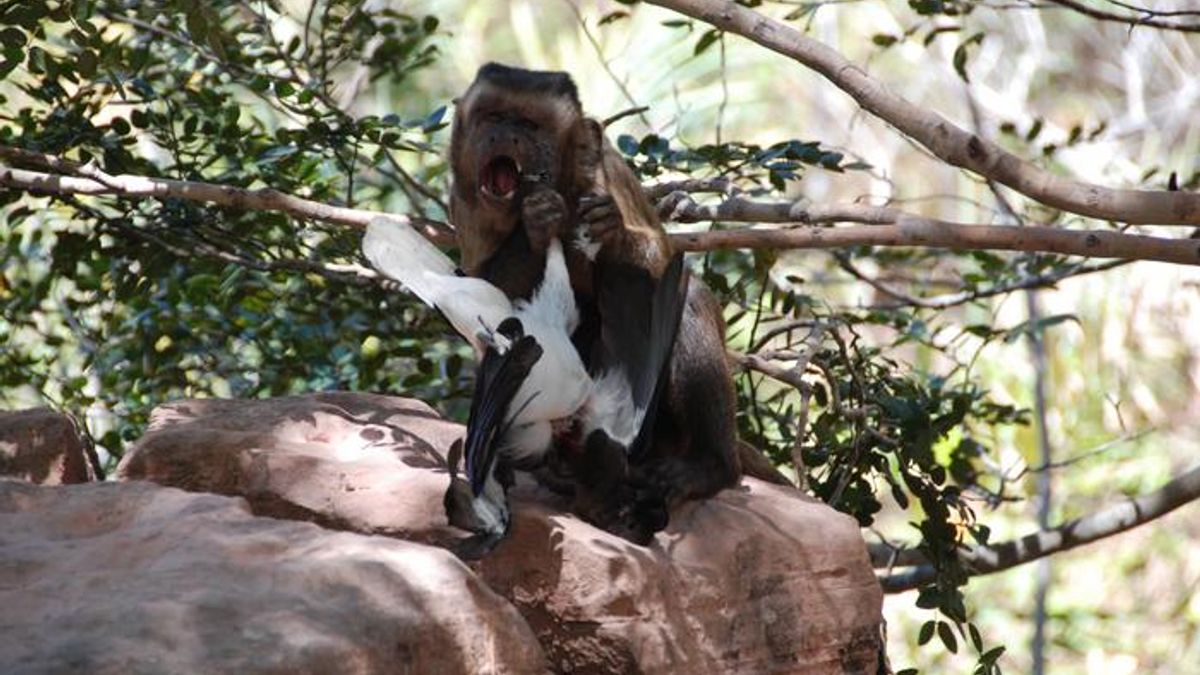
What happened
- Susana Carvalho, Noemi Spagnoletti and colleagues report in PLOS One on small vertebrate eating by wild bearded capuchins.
- Across 5,093 hours of following two groups in Brazil, the team recorded 446 occasions when the monkeys ate a vertebrate.
- Hunting went up when plant foods were less accessible.
- The monkeys usually ate brain and internal organs before muscle, and sometimes abandoned the remainder of the carcass.
Why it matters
- constraint Prey abundance was never quantified, so the seasonal result cannot separate hunger from opportunity, and any read-across to hominins inherits that gap.
- capability Organ-first feeding that leaves most of the carcass gives archaeologists a behavioural yardstick for judging whether small-animal bone damage reflects fallback foraging rather than organised hunting.
- contradiction Science News presents 281 as the count of vertebrate meals, while the other two reports treat it as the identified fraction of 446, so a reader computing rates from coverage can be off by more...
The number carrying the most weight here is a by-product of someone else's project. One of the two groups at Fazenda Boa Vista was handed nuts, corn and water every day as part of an unrelated study, while the second had to find all of its own food [13]. The unsubsidised group ate vertebrates about 1.9 times as often [14], which means a guaranteed daily ration cut meat eating to roughly 53 percent of the unfed rate [21]. That comparison does work a seasonal correlation cannot. A bowl of corn does not change how many lizards live in the sandstone, so the gap between the two groups points at the calorie floor rather than at prey supply.
Coverage is thinner than the totals suggest. The 446 vertebrate meals came out of 5,093 hours of following [7], about one for every 11.4 hours of watching [15]. Carvalho describes 45 months of data [23], roughly 113 observation hours a month split between two groups [26], inside a window running from May 2006 to December 2010 [24], so something like ten months of that span went unwatched [27]. (Science News dates the start to June 2006 [25].) Spagnoletti says what surprised her most was how thoroughly vertebrate predation was woven into the monkeys' daily lives [17], and roughly a meat meal per full day in the field is consistent with that.
Prey identity rests on a subsample. It was noted in 281 of the 446 events [3][12], with lizards at 43 percent and rodents at 28 percent of those [4]; the remaining 37 percent were never pinned down [12]. Males hunted more than females and were the only ones seen eating snakes, usually after removing the head [10]. The study also carries the first records of this species eating opossums, iguanas, bird eggs and nestlings [11].
The organ-first habit has two explanations on offer, and neither was tested. Brain and viscera are fat-rich, according to earlier work, and getting at them first may pre-empt another monkey taking the carcass, an idea the authors did not examine [28]. Muscle was tougher and slower to pull apart and chew [9]. The monkeys generally hunted and fed alone, though joint hunts and meat transfers were seen [16], which sits awkwardly with a rival-driven reading of the sequence. Spagnoletti's account in Science News is nutritional: when hunting is worth the extra investment, the fat in brains and guts is the quick way to bank it [31].
Capuchins are distant relatives, and that is what makes the comparison worth anything. Carvalho lists the convergences: proportionally large brains, meat in the diet, tools carried while walking on the hind legs, and a willingness to eat snakes that chimpanzees do not share [18]. Margaret Bryer, who was not involved, notes that chimpanzees take the headlines while a range of other primates eat vertebrates too [20]. Humans remain the only living primate that regularly hunts animals larger than itself [19], so the Cerrado shows the low rung: a plant eater short of fruit, eating the fattiest parts of a gecko and leaving the rest [8]. Sites about two million years old already hold signs that hominins ate small animals, and the team wants capuchin feeding marks compared against those bones [29]. Carvalho calls small prey a steppingstone to larger game and says the record needs reanalysing [30].
What to watch
- A follow-up that measures prey abundance directly, which is the missing half of the fruit-scarcity claim.
- Whether the fed-versus-unfed contrast reappears at other sites where one primate group is provisioned and another is not.
- Whether anyone publishes capuchin feeding damage on small bones in a form archaeologists can match against assemblages.
Clarity's read
What the record supports and how the coverage leans. The claims behind it follow.
Reality
- Evidence68
- Adoption
- Insufficient
- Hype gap+15
- Incentives
- Insufficient
- Confidence65
Perspective Coverage
3 publishers- Builder
- Builder 53%
- Operator
- Operator 37%
- Investor
- Investor 10%
Claim ledger
Ranked by verification strength, evidence, and original report placement.
- [1]
The monkeys also ate more animals when less fruit was available, though more prey may have been around at certain times of year.
- [2]
Diets varied with environmental conditions, with an increase in hunting when plant foods were less accessible.
- [3]
Researchers made notes about what was being eaten in 281 of the feeding cases; most involved lizards or rodents, and the monkeys also ate birds, snakes, marsupials, bats and an iguana.
- [4]
Documented prey was mostly lizards (43 percent) and rodents (28 percent).
- [5]
Science News reports that the team recorded 281 instances of the capuchins eating small vertebrates, nearly half lizards and over a quarter rodents.
- [6]
A study in PLOS One by Susana Carvalho (Gorongosa National Park, Mozambique), Noemi Spagnoletti (Sapienza University of Rome) and colleagues examines small vertebrate consumption by capuchin monkeys (Sapajus libidinosus) and its bearing on the human predatory pattern.
- [7]
Over 5,093 hours of observation the team recorded 446 occasions on which the monkeys ate vertebrates.
- [8]
The monkeys often started with the brain and internal organs before moving on to muscle, and sometimes left the rest behind.
- [9]
Muscle was tougher and took longer to pull apart and chew.
- [10]
Males hunted more often than females and were the only monkeys seen eating snakes, usually after removing the head.
- [11]
These were the first records of bearded capuchins eating opossums, iguanas, bird eggs or nestlings.
- [12]
Prey was identified in 63 percent of the 446 recorded vertebrate feeding events, leaving 37 percent unidentified.
- [13]
One of the two groups was given nuts, corn and water each day as part of another project, while the other had to find all of its own food.
- [14]
The group that found all its own food ate vertebrates about 1.9 times as often as the group fed each day.
- [15]
The 446 vertebrate feeding events across 5,093 observation hours work out to about one event per 11.4 hours of observation.
- [16]
The monkeys generally hunted and ate alone, but researchers also saw them hunt together and pass meat to one another.
- [17]
Spagnoletti said what surprised her most was the extent to which vertebrate predation was integrated into the capuchins' daily lives, since her main interest at the outset was tool use.
- [18]
Carvalho notes that bearded capuchins have proportionally large brains, eat meat, use tools that they transport by walking on their hind legs, and, unlike chimpanzees, will eat snakes.
- [19]
Humans are the only living primates that regularly hunt animals larger than themselves.
- [20]
Margaret Bryer, a biological anthropologist at the University of Wisconsin-Madison who was not involved in the research, says chimpanzees get the most headlines for hunting vertebrates but a diverse set of nonhuman primates, including capuchins, eat them too.
- [21]
Daily provisioning corresponds to a vertebrate-eating rate of about 53 percent of the unprovisioned group's rate.
- [22]
The team observed two groups of bearded capuchins at Fazenda Boa Vista, Brazil, between 2006 and 2010.
- [23]
Carvalho describes the dataset as 45 months of data.
- [24]
Researchers followed the two groups from May 2006 to December 2010.
- [25]
Science News reports that the analysed observational data were collected between June 2006 and December 2010.
- [26]
5,093 observation hours spread over 45 months is about 113 hours of observation per month across both groups.
- [27]
A May 2006 to December 2010 window spans about 55 months, so 45 months of data leaves roughly 10 months of the period without observation.
- [28]
Brains and organs are rich in fat and other nutrients according to earlier research, and by eating those parts first a monkey may have reached the fattier tissues before another monkey could take the carcass; the researchers did not test that idea.
- [29]
Fossil sites about 2 million years old contain signs that hominins ate small animals, and the team hopes future studies will compare the marks capuchins leave behind with those on ancient bones.
- [30]
Carvalho says hunting small prey could have been an important source of nutrition for human ancestors during food scarcity and a steppingstone to larger prey, and that the fossil record now needs reanalysing for evidence of small vertebrate predation.
- [31]
Spagnoletti says eating vertebrates may be worth the extra hunting investment in times of scarcity, and the rich fats and nutrients in brains and viscera might be a quick way to consume those dietary needs.
Get this ledger inside ChatGPT. Ask about any of our stories and the answer brings its figure, each claim’s verdict and the sources. Free, no account.
Sources
3 independent publishers whose own reporting we read for this story.
- discovermagazine.comCapuchin Monkeys Hunt Small Vertebrates When Fruit Runs Low, Eating Brains and Organs First
1 article · August 26, 2026
- phys.orgWhen fruits and veggies are scarce, monkeys hunt for meat
1 article · August 26, 2026
- sciencenews.orgMonkeys hunt small animals when fruit is scarce
1 article · August 26, 2026
Topics and entities
Follow any of these and your For You feed starts watching them — no settings page required.
Topics
- Human EvolutionFollow
- Primate behaviourFollow