InvestNot yet confirmed elsewhere1 publisher2 min readPublished
Nvidia backs a pluggable optics format while promoting the co-packaged alternative
Four companies, Nvidia and Cisco among them, have introduced a new pluggable optics form factor for AI data centers, cryptobriefing.com reported. Nvidia also sells the co-packaged alternative, and the evidence that supplier lists will change is thin.
The Investor · Invest desk
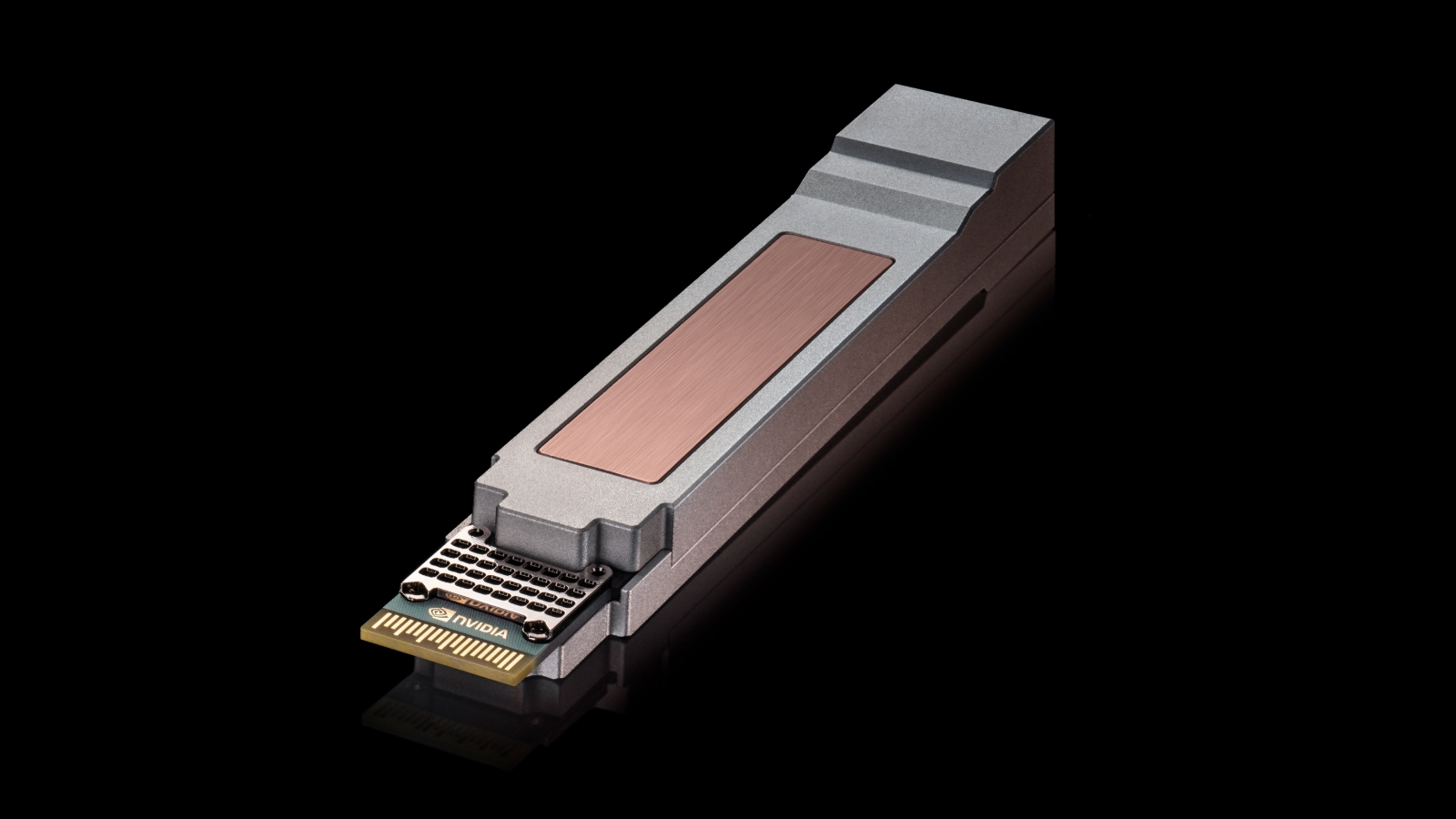
Cisco's 800G LPO cuts optical module power consumption by approximately 50%. CPO cuts electrical signal loss to roughly 4 dB, from roughly 22 dB. Shipments of 800G-and-faster transceivers are projected to exceed 24 million units in 2025.
| Figure | Value | Note | Claim |
|---|---|---|---|
| Cisco 800G LPO power cut, optical modules, approximately | 50% | 4 | |
| CPO electrical signal loss, roughly | 4 dB | down from roughly 22 dB | 8 |
| Transceiver shipments, over | 24 million units | 800G-and-faster, projected for 2025 | 15 |
What happened
- Cisco's 800G linear pluggable optics cut module power by about 50% and total switch power by around 30%, according to the report.
- Nvidia announced its co-packaged optics switches, Spectrum-X Photonics and Quantum-X Photonics, at its GTC conference on March 18, 2025.
- TE Connectivity and Amphenol showed components for both co-packaged and linear pluggable architectures at OFC 2026.
- Shipments of 800G-and-faster transceivers were projected to exceed 24 million units in 2025, driven by AI cluster buildouts.
Why it matters
- constraint Per the report, co-packaged optics suits the highest-radix core switches best. Pluggables keep the layers where operators want to swap a failed module without touching the switch.
- decision Operators choosing optics layer by layer trade a swappable module for an engine that is a bigger repair job, with Nvidia's own claims as the main case for the engine.
- exposure Whoever sells the signal-processing electronics inside today's modules loses content wherever linear pluggable optics replace them, since LPO strips out some of that electronics.
- contradiction Nvidia promotes co-packaged optics as more power-efficient than pluggables while backing a pluggable format, and both positions hold only if pluggables keep the layers co-packaged optics does not reach.
Two power claims in cryptobriefing.com's report bear on cost, and they start from different places. If Cisco's 50% module saving and 30% switch saving share a baseline [4], modules make up 30 over 50, or 60%, of the power in that comparison [12]. Nvidia's 3.5 times better power efficiency for co-packaged optics, measured against traditional pluggable transceivers [7], works out to about 71% less power for the same traffic, if efficiency means traffic per watt [13]. The 71% and the 50% come from different vendors with different comparison points, so they cannot be set side by side.
Nvidia's other figures need a second look. The report lists signal loss falling from roughly 22 dB to roughly 4 dB [8], a drop of 18 dB, and an 18 dB change is a power ratio of about 63 [14]. The report also lists, as a separate benefit, 63 times better signal integrity [7]. By our calculation those look like one measurement stated in two units.
We think the new format is a hedge, and Nvidia is the clearest case: it sells co-packaged switches [1] and backs a pluggable format [3]. The report's view is that this wins it the sale whichever architecture a customer picks for a given layer [17]. The counter-thesis is timing. Spectrum-X Photonics is not expected until the second half of 2026 [2], so the pluggable backing may only cover the gap before co-packaged parts ship.
The supplier claim is where the evidence is thinnest. The report says a component's format determines which companies can make it, which can purchase it and how fast it can be replaced [16], and then does not name the form factor, give its specifications, identify a governing body or set an availability date [11].
Three outcomes fit. A published specification open to any maker would let suppliers beyond the four in, and the supplier thesis would hold. A format shipped only inside Nvidia and Cisco switch ecosystems leaves the buyer and supplier lists where they are. If co-packaged optics takes the core and the new format settles at the edge, the effect is confined to layers where pluggables already sell.
We think the second or third is likelier until an open specification appears. A module maker outside the four shipping to a published specification would prove us wrong.
What to watch
- Publication of the form factor's name, specification and governing body, and whether module makers outside the four can build to it.
- Shipment of Spectrum-X Photonics, expected in the second half of 2026, and which network layers customers assign to it.
- Independent power measurements comparing linear pluggable modules with co-packaged engines at the same port speed.
Clarity's read
What the record supports and how the coverage leans. The claims behind it follow.
Reality
- Evidence30
- Adoption
- Insufficient
- Hype gap+35
- Incentives55
- Confidence45
Claim ledger
Ranked by verification strength, evidence, and original report placement.
- [1]
On March 18, 2025, at its GTC conference, Nvidia announced Spectrum-X Photonics and Quantum-X Photonics switches using co-packaged optics (CPO).
ReportedSupportedSource: cryptobriefing.com report2 sources— create a free account to open themView cited source - [2]
Spectrum-X Photonics is expected in the second half of 2026; Quantum-X Photonics switches are expected between late 2025 and early 2026.
ReportedSupportedSource: cryptobriefing.com report2 sources— create a free account to open themView cited source - [3]
Nvidia, Cisco, TE Connectivity and Amphenol have introduced a new pluggable optics form factor built for AI data centers.
- [4]
Cisco's 800G Linear Pluggable Optics (LPO) solutions cut power consumption by approximately 50% for the optical modules and around 30% overall for the switch.
- [5]
LPO strips out some of the signal-processing electronics that normally sit inside each optical module.
- [6]
TE Connectivity and Amphenol showed components for co-packaged and linear pluggable architectures at OFC 2026.
- [7]
Nvidia says its co-packaged optics design delivers 3.5 times better power efficiency, 63 times better signal integrity and ten times better resiliency than traditional pluggable transceivers.
- [8]
CPO cuts electrical signal loss from roughly 22 dB to roughly 4 dB.
- [9]
CPO is best suited to the highest-radix switches at the core of a network; pluggables let operators mix vendors, replace a failed module without touching the switch, and upgrade in pieces.
- [10]
With co-packaged optics, a fault in the optical engine is a much bigger repair job than pulling out a module and plugging in a new one.
- [11]
The cryptobriefing.com report does not name the new form factor, give its specifications, identify a governing body or set an availability date.
- [12]
If the 50% module saving and 30% switch saving share a baseline, optical modules account for about 60% of the power in that comparison.
- [13]
Nvidia's 3.5 times power-efficiency claim implies about 71% less power for the same traffic, if efficiency means traffic per watt.
- [14]
A signal-loss reduction from 22 dB to 4 dB is 18 dB, which as a power ratio is about 63, matching the separately listed 63 times signal-integrity figure.
- [15]
Shipments of 800G-and-faster transceivers are projected to exceed 24 million units in 2025, driven by AI cluster buildouts.
- [16]
The report states that in data centers the format of a component decides who can build it, who can buy it, and how quickly it can be swapped out.
ReportedInsufficientSource: cryptobriefing.com report (publisher's statement, no named speaker)View cited source - [17]
The report's assessment: playing on both the CPO and pluggable sides means Nvidia wins regardless of which architecture a customer picks for a given layer, and TE Connectivity and Amphenol are positioned as suppliers to the whole market because both CPO and advanced pluggables need dense connectors.
Sources
1 independent publisher whose own reporting we read for this story.
- cryptobriefing.comNvidia, Cisco and partners introduce new pluggable optics format for AI data centers
1 article · October 12, 2026
Topics and entities
Follow any of these and your For You feed starts watching them — no settings page required.
Topics
- Pluggable opticsFollow
- AI Data Center NetworkingFollow
- Co-Packaged OpticsFollow