BuildNot yet confirmed elsewhere1 publisher2 min readPublished
Upscale's Token Fabric manages two switch silicon families from one SONiC-based OS
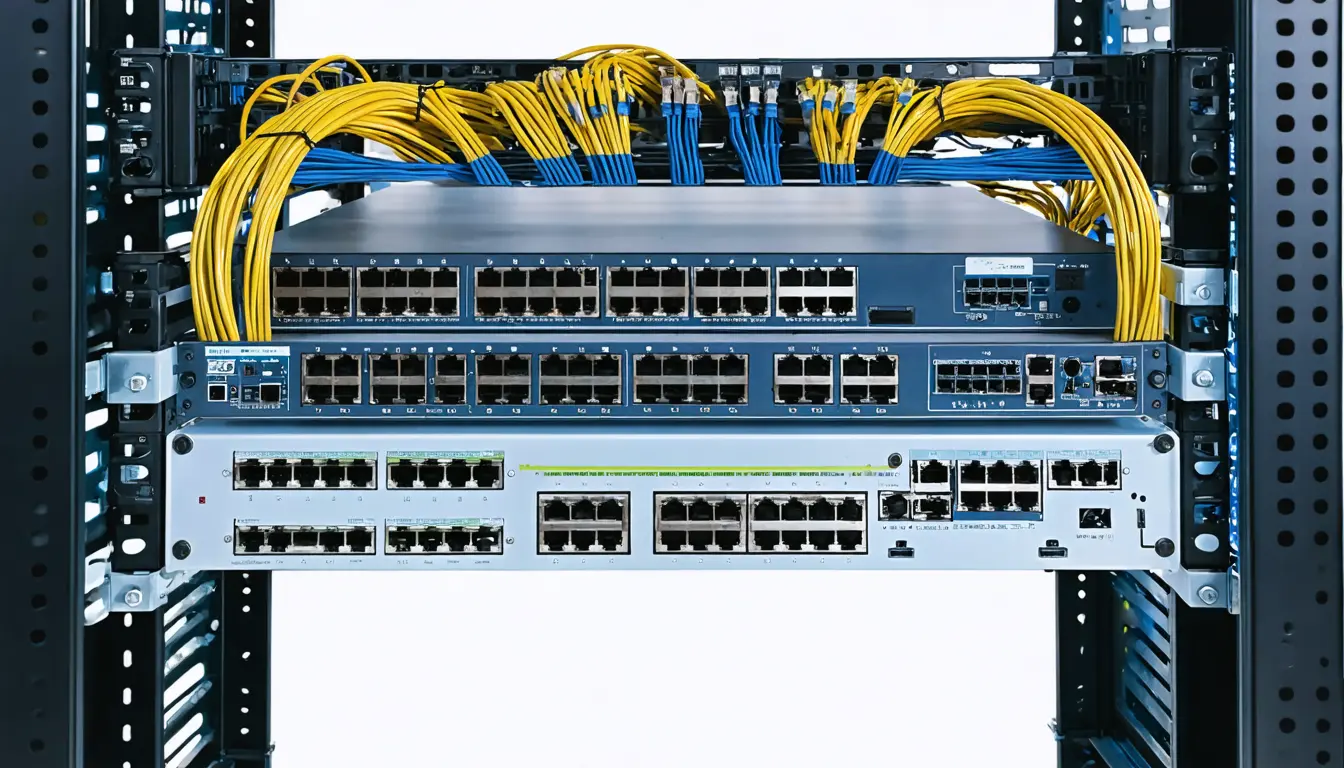
Upscale's Token Fabric puts its SkyFabriX scale-up silicon and Nvidia Spectrum-X scale-out switches under one network OS, due in early 2027. For planners, the open question is whether one management layer holds across two suppliers' chips and two traffic regimes.
The Engineer · Build desk
What happened
- Early-access and joint-validation programs for Token Fabric are already running, so the system can be tested before it ships.
- SkyFabriX switches 115.2 terabits per second today, and Upscale plans to take that capacity to multiple petabits.
- A separate layer, SkyCMD, handles orchestration and observability through one management plane covering both scale-up and scale-out.
- Customers can buy only the silicon, only the software, or the full stack, with enterprise teams and smaller cloud providers as the stated targets.
- Nvidia joined Upscale's June funding round as a strategic investor and is also the supplier of the Spectrum-X silicon in the scale-out half.
Why it matters
- constraint Qualification stays a two-vendor job, because one OS on top leaves the scale-up and scale-out data planes, and their separate protocols, unmerged underneath.
- exposure Full-stack buyers rely on Nvidia twice: for the scale-out silicon, and as a shareholder in the company writing the OS that drives it.
- decision With SkyOS built on SONiC, a team already running SONiC can weigh the software-only option first and put off the decision on SkyFabriX silicon.
In Token Fabric, "one software layer" means one network operating system. According to the dev.to account of the launch, SkyOS runs on both fabrics, is based on the open-source SONiC platform, and is tuned for AI protocols [6]. The data planes under it stay distinct. Inside the rack, scale-up traffic uses Ethernet for Scale-Up Networking alongside standard IP. Between racks, scale-out traffic uses standard Ethernet with RoCE to carry remote direct memory access [9]. Each half runs on a different company's silicon [2].
So the hard engineering sits in the OS. It has to drive Upscale's own scale-up chip and Nvidia's scale-out chip and present both the same way. The account says SkyOS abstracts the underlying hardware [11]. It also lists Upscale's SONiC contributions and its extensions to the Switch Abstraction Interface [10]. Those SAI extensions are the first thing I would ask to see in an evaluation. I'd expect any difference in how SkyOS treats the two chips to show up there.
The protocol choices are conservative, and I think that is correct. Upscale says it is extending existing protocols, and that the approach eases integration into existing data centers [8]. SkyFabriX is designed to accommodate evolving standards such as Ultra Accelerator Link [3]. Upscale also works with the Ultra Ethernet Consortium and the UALink groups [12].
The 115.2 Tbps switch capacity and the 400G, 800G and 1.6T scale-out speeds are vendor specs for parts [4][19]. A part spec predicts cluster behaviour only if a planner also knows how big the scale-up domains are and how traffic behaves when it crosses from one fabric to the other. The trays come in custom and standard rack form factors and pool GPUs and other accelerators into large scale-up domains [5]. The account does not give domain sizes, latency, job-completion times or prices.
Upscale is based in Santa Clara and came out of stealth in September 2025 with a $100 million seed round [14]. In June it raised $190 million and outlined SkyHammer, its custom scale-up switch chip, which SkyFabriX is built on [15]. Those two rounds total $290 million [21]. The account puts total capital at about $500 million [17]. That leaves roughly $210 million outside the rounds it names [22]. The company has more than 300 employees [17]. As the account paraphrases him, chief executive Barun Kar argues that compute is ramping quickly while networking has lagged [18].
Upscale's starting premise is that a single AI job spans both fabrics [1]. The test I would run before 2027 is that job, with scale-up and scale-out behaviour read from the same SkyCMD view [7].
What to watch
- Publication of Upscale's Switch Abstraction Interface extensions, showing how SkyOS maps onto SkyFabriX and Spectrum-X.
- Named joint-validation customers or job-level latency results released before general availability in early 2027.
- Whether UALink support on SkyFabriX moves from design intent to a shipped feature.
Clarity's read
What the record supports and how the coverage leans. The claims behind it follow.
Reality
- Evidence30
- Adoption8
- Hype gap+30
- Incentives60
- Confidence30
Claim ledger
Ranked by verification strength, evidence, and original report placement.
- [1]
Scale-up networking connects accelerators inside a rack, scale-out networking connects racks across the data center, and a single AI job spans both.
ReportedSupportedSource: dev.to account of the Token Fabric launch2 sources— create a free account to open themView cited source - [2]
Upscale introduced Token Fabric, which combines its proprietary SkyFabriX scale-up silicon with scale-out systems built on Nvidia Spectrum-X Ethernet, with a common software layer managing operations across both.
- [3]
SkyFabriX supports Ethernet for Scale-Up Networking and standard IP, and its design is intended to accommodate evolving standards like Ultra Accelerator Link.
- [4]
SkyFabriX switch capacity currently reaches 115.2 terabits per second, with plans to reach multiple petabits.
- [5]
Token Fabric's scale-up switch trays come in custom and standard rack form factors and pool GPUs and other accelerators into large scale-up domains.
- [6]
SkyOS is the network operating system for both fabrics, based on the open-source SONiC platform and optimized for AI-related protocols.
- [7]
SkyCMD provides orchestration and observability, with a single management plane across scale-up and scale-out environments.
- [8]
Upscale says it is extending existing protocols rather than replacing them, an approach meant to ease integration into existing data center environments.
- [9]
Scale-up traffic uses Ethernet for Scale-Up Networking alongside standard IP; scale-out traffic uses standard Ethernet with RoCE, carrying remote direct memory access over Ethernet.
- [10]
Upscale contributes to SONiC and has extended the Switch Abstraction Interface.
- [11]
SkyOS abstracts the underlying hardware to provide a consistent layer across the two fabrics.
- [12]
Upscale works with the Ultra Ethernet Consortium and UALink groups on industry standards.
- [13]
General availability of Token Fabric is planned for early 2027; early-access and joint-validation programs are currently running.
- [14]
Santa Clara-based Upscale emerged from stealth in September 2025 with a $100 million seed round.
- [15]
In June Upscale raised an additional $190 million while outlining plans for SkyHammer, its custom scale-up switch chip; SkyFabriX is built on the SkyHammer architecture.
- [16]
Nvidia joined Upscale's June funding round as a strategic investor and is the supplier of the Spectrum-X silicon.
- [17]
Upscale has raised approximately $500 million in total and has more than 300 employees.
- [18]
CEO Barun Kar explained that compute capabilities are ramping up rapidly while networking infrastructure has lagged behind (paraphrase in source, no direct quotation).
- [19]
Scale-out systems built on Nvidia Spectrum-X operate at 400G, 800G and up to 1.6T and integrate with accelerator clusters through SkyOS.
- [20]
Customers can adopt only the silicon, only the software, or the full stack; Upscale targets enterprise teams and smaller cloud providers that lack large internal engineering resources.
- [21]
Upscale's two named rounds total $290 million.
- [22]
About $210 million of Upscale's roughly $500 million total sits outside the two named rounds.
Sources
1 independent publisher whose own reporting we read for this story.
- dev.toUnified AI Networking Architecture Bridges Data Center Gaps
1 article · October 9, 2026
Topics and entities
Follow any of these and your For You feed starts watching them — no settings page required.
Topics
- AI Data Center NetworkingFollow
- Network operating systemsFollow