Science1 publisher2 min readPublished
Benzene rings in the organic layer take a stiff perovskite film to 0.04 watts per metre-kelvin
NC State's Jun Liu says the azobenzene lead iodine film is 700 to 10,000 times stiffer than silicone and five times the insulator. The lowest-conductivity claim in the announcement applies to dense, nonporous materials only.
The Scientist · Science desk
What happened
- An NC State group measured a thermal conductivity of about 0.04 watts per metre-kelvin at room temperature in an azobenzene ethyl ammonium lead iodine thin film.
- Liu said the production method scales up fairly easily and that the material can be applied as a coating at fairly large scales.
- The paper, "Extremely Low Thermal Conductivity in Rigid Layered Hybrid Perovskites" by Ziqi Wang and colleagues, publishes on Sept. 18 in Science Advances.
Compiled by The ScientistSomething wrong?How this is made
Why it matters
- capability A dense insulator that can be printed as a coating lets a designer put the insulating layer on the part that is already carrying the weight, instead of adding a separate insulating component behind it.
- contradiction The phys.org headline says the insulator outperforms any material found in nature, while the account itself limits the low-conductivity claim to dense, nonporous materials, so porous insulators are never ranked against this film.
- constraint Lead is a constituent of the compound the group measured. That puts Sun's cookware example in front of food-contact regulators before any thermal specification is argued.
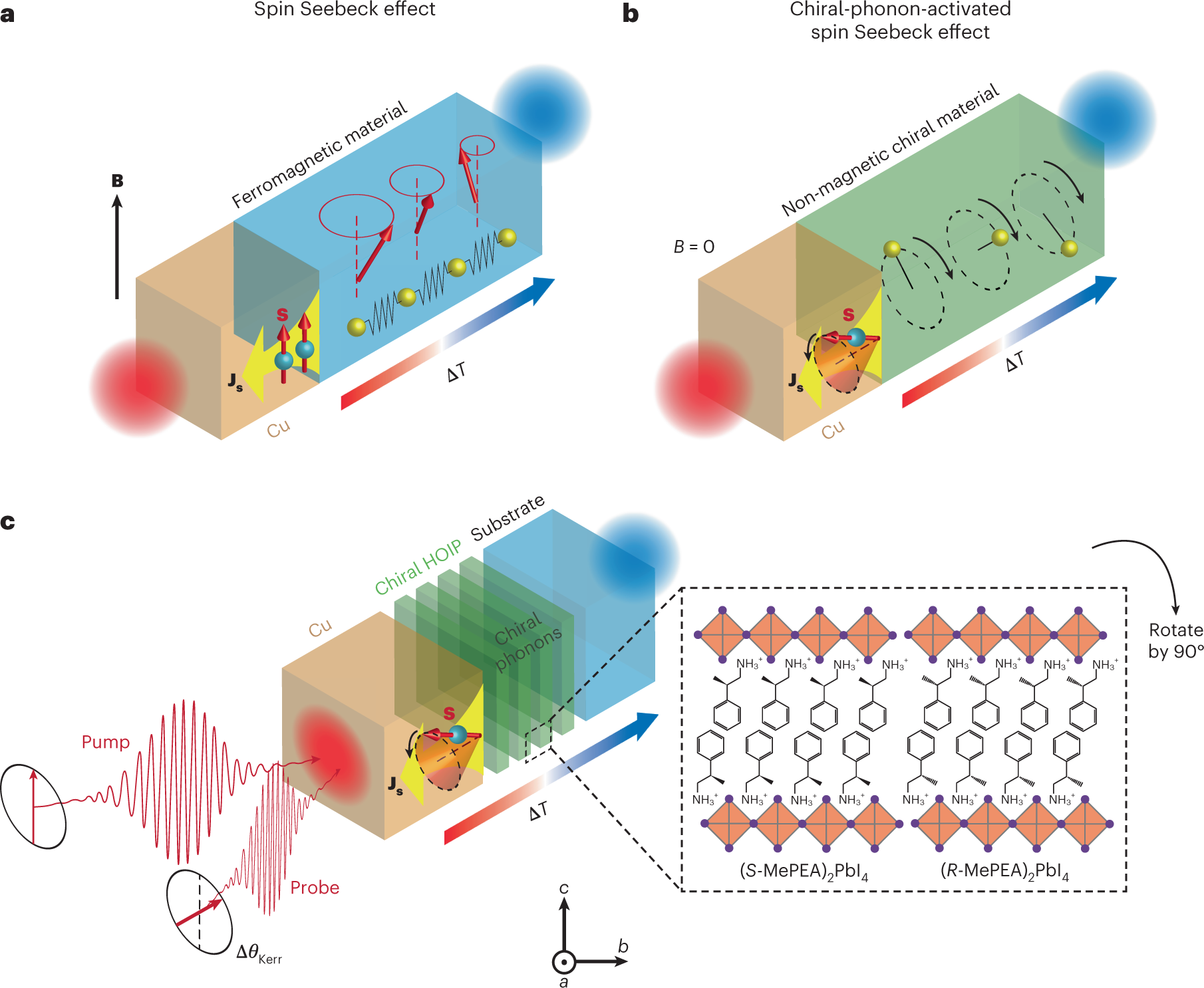
Sun put the tradeoff the group went after in one sentence. "Because, in general, stiff materials are good at conducting heat, and materials that are not stiff are good at insulating against heat," he said [5]. Their handle on it was the organic half of the crystal. These films are two-dimensional hybrid organic-inorganic perovskites, thin-film semiconductors built from alternating organic and inorganic layers in a highly ordered crystalline structure [10]. Swapping some of the carbon-carbon chains in the organic layers for a tailored combination of benzene rings lets the team control stiffness and thermal conductivity together [11]. Liu said the group had shown odd stiffness-conductivity behaviour in this class before, and that "for this work, we engaged in more advanced molecular engineering to intentionally create an extreme combination of those properties" [8].
At room temperature the film measured about 0.04 W m-1 K-1 [13]. Silicone, the comparison the release reaches for because it insulates oven mitts, is 0.2 [14]. The factor of five is those two numbers divided [17]. "So, if we want to compare this material to silicone, the material we made is 700-10,000 times stiffer than silicone and five times better at insulating against heat," Liu said [15].
The stiffness half of that sentence spans a factor of about 14 end to end [18]. I would take the conductivity value as the firm number here and read the paper for the modulus. Direction matters too. A stack of alternating organic and inorganic layers conducts heat across the layers and along them as two different quantities, and the announcement reports a single figure [20].
Sun named the applications he has in mind: "Stiff materials that are good thermal insulators would have substantial utility in a variety of applications, from cookware to electronic devices to space travel" [4]. None of the three was tested. And a 0.04 W m-1 K-1 layer keeps heat out of one region; it will not carry heat away from a hot one [24].
On manufacturing, Liu said: "You can produce it at fairly large scales, apply it as a coating, and so on" [16]. The release does not report the largest area the group has printed [22]. The paper, "Extremely Low Thermal Conductivity in Rigid Layered Hybrid Perovskites," by Ziqi Wang and colleagues, publishes Sept. 18 in Science Advances [9].
What to watch
- Whether the Sept. 18 Science Advances paper reports cross-plane and in-plane conductivity separately and gives a modulus in gigapascals.
- Whether the 0.04 W/m/K figure and the stiffness hold at cookware and spacecraft temperatures rather than only at room temperature.
- Whether the same benzene-ring substitution reaches comparable numbers in a lead-free perovskite.