Product1 publisher2 min readPublished
MIT powers a half-millimetre swimming robot with a single layer of living muscle
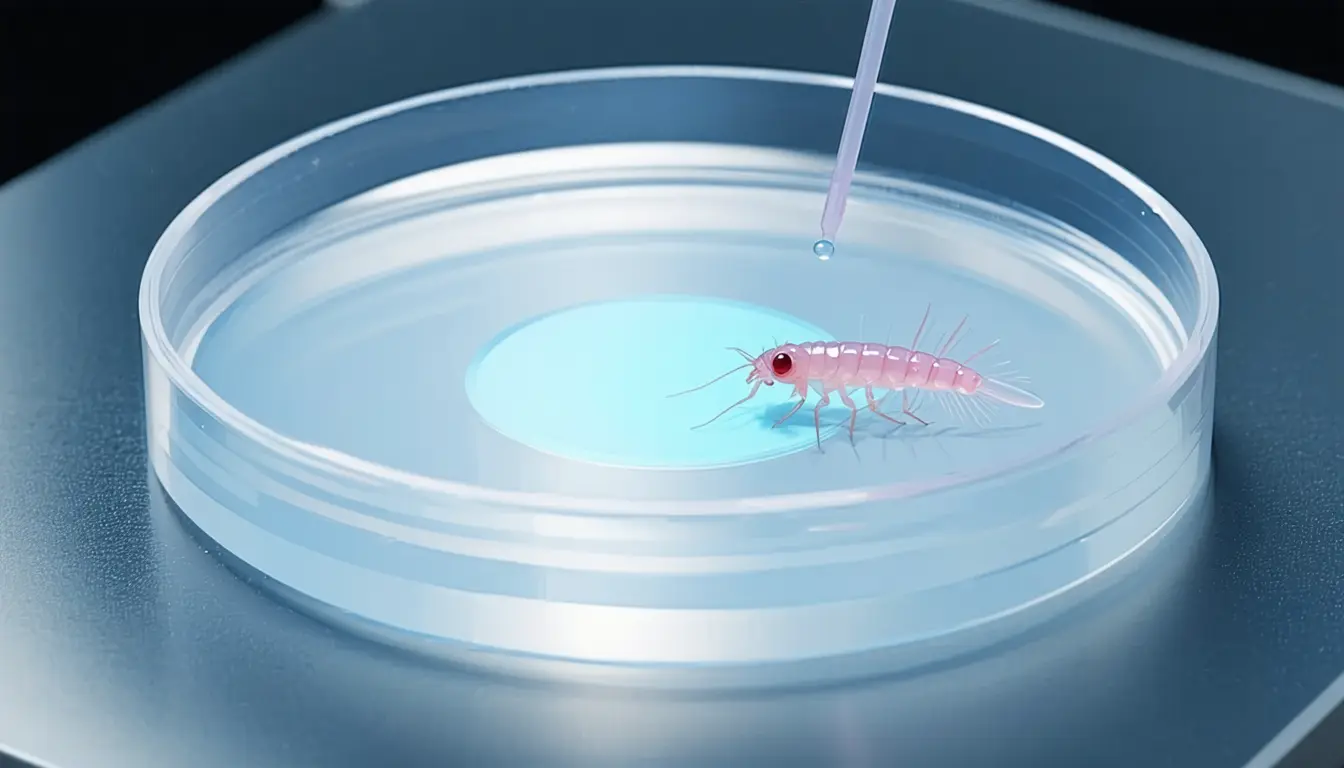
MIT engineers built a half-millimetre gel robot that swims up to four body lengths a minute on one layer of light-triggered muscle. The team expects the design to need less living tissue than bulkier robots, but it has not published a cell count, and a person still steers it with a hand-moved light.
The Product Desk · Product desk
What happened
- The muscle cells are genetically engineered to contract under light, so lighting one fin makes that fin flap and push the robot through the water.
- Aiming light at either fin and changing the timing of the illumination lets researchers set the robot's direction and speed.
- Ritu Raman's group previously built an iris-inspired muscle disk whose movement was limited to about 100 micrometers.
- For the swimmer, stiffer GelMA replaced the ultrasoft fibrin gel of that earlier design and gave better cell alignment and stronger contractions.
- The researchers call it the first demonstration of a very thin, two-dimensional muscle-powered robot capable of locomotion.
Compiled by The Product DeskSomething wrong?How this is made
Why it matters
- exposure Anyone quoting a tissue reduction from this robot in a grant or product pitch is quoting a team estimate that a later cell count could shrink.
- constraint Field work in fragile aquatic settings needs steering without a person holding a light over the water, and this work has not shown that yet.
- decision Teams trying to get more force from lab-grown muscle now have reason to spend design time on gel stiffness and groove shape before growing more cells.
In MIT's tests, a person did the steering. The team put the robot in a large petri dish with a maze inside and moved a light source above it by hand. The robot followed the light through the maze [5]. At top speed it covers one body length about every 15 seconds [1]. The account does not give the robot's length, so that speed cannot be converted into millimetres per second.
The pitch is about how much material the robot needs. According to the report, conventional biohybrid robots often rely on bulky three-dimensional structures made from millions of lab-grown muscle cells [12]. The MIT team believes its thinner design could reduce the biological material required and perhaps improve movement efficiency [13]. What the team actually built is two fins, each covered by a cell layer thinner than a human hair [16]. With that geometry, a saving is plausible. The report does not include a cell count for the new robot, so the size of the saving is still the team's estimate.
Most of the engineering went into what the cells sit on. The researchers found that the supporting material mattered as much as the cells themselves [18]. Square-bottomed grooves aligned the cells better than curved ones, and the better-aligned cells fused into fibres that contracted in a more coordinated way [10]. A film about half a millimetre thick gave the cells enough support while staying flexible and light enough to move with them [17]. Before assembly, the team strengthened the tissue with repeated light stimulation [11].
For now, the result is for labs building biohybrid actuators. They get a substrate recipe they can test against their own force measurements. Raman has suggested uses such as exploring fragile or unpredictable environments, including aquatic ecosystems [14]. The team calls the robot an early research demonstration with limited speed. Its stated next goal is a body design that swims faster [15].
Two questions put any biohybrid claim on a 2x2. The first asks who closes the control loop: a person moving a light, or the machine. The second asks whether the tissue saving has been counted or only argued. This robot sits in the square where a person steers and the saving is argued. That is normal for an early lab demonstration. Whichever result from this group first moves the robot along either axis will be the first one that an operator outside a lab could plan around.
What to watch
- Results from the team's effort to optimise the body design for speed, and whether it still runs on a single cell layer.
- A published cell count or force measurement that lets the tissue saving be compared with three-dimensional biohybrid designs.
- A version that steers through the maze without a person moving the light source by hand.