Science1 publisherNot yet confirmed elsewhere3 min readPublished
Elastic helices twisted until they snap propel a 3.4-ounce frog-like robot
Michigan and UCLA researchers built a 3.4-ounce robot that hops about three body lengths a second by twisting elastic helices until they snap. The team says timing the snap spares the motor from high output, though the published account has no energy figures to test it.
The Scientist · Science desk
What happened
- A rotating motor twists the bent rods until they snap, then unwinds the twist and loads each rod again for the next hop.
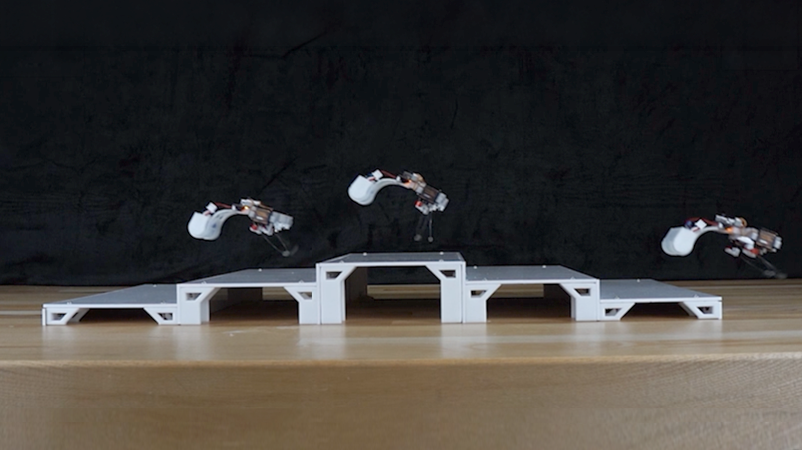
- The frog-like prototype hopped on wood, glass, leather, sand and grass, climbed and descended steps, and swam when fitted with paddles.
- Firing only one of its two rods let the robot turn, and a person used a remote control to steer it through a small obstacle course.
Compiled by The ScientistSomething wrong?How this is made
Why it matters
- capability If Jawed's geometric design rules hold at smaller sizes, millimetre-scale robots could get strong bursts of motion from small motor movements, though so far only a palm-sized device has been tested.
- constraint Steering depended on a human with a remote control and swimming on bolt-on paddles, so the demonstration does not show autonomous travel across land and water.
- decision Picking a snap actuator over a larger direct-drive motor depends on energy-per-hop and motor-size numbers, which the team would need to publish to support Huang's claim.
If you rotate the ends of a bent rod, it will eventually release its tension by changing shape. It can get there by more than one route [4]. Some combinations of bending and twisting let the rod relax gradually. Others make it snap from one shape to another, and only the snap gives a strong push [4]. The paper, published Sept. 18 in Science Advances [1], calls the problem "instability pathway selection" [10]. The experiment searches the geometry for shapes that reliably take the fast route. The team ran computer models and used a robotic arm to deform rods again and again, and both pointed to a helix wound like a coiled spring as the shape that released the most energy [5].
In this design the motor does the slow job. It twists the rod until it snaps, then unwinds the twist and loads the rod again [6]. The rod handles the fast part. "By programming when an elastic structure stores and rapidly releases energy, we can give small robots access to powerful, repeatable motions without continuously demanding high output from the motor," said Xiaonan (Sean) Huang, an assistant professor of robotics at the University of Michigan and a co-first author, in a statement [13][7].
Huang went further. "The broader opportunity is to let the mechanics of the robot do some of the work that would otherwise require larger motors or more complicated control," he said [12]. The argument is plausible, because storing energy in an elastic part and releasing it quickly is exactly what the device does. The thing this doesn't tell you is how much motor it saved. The Live Science report on the study does not give the motor's power, the energy per hop, the robot's body length, or a comparison with a hopper driven directly by its motor. Without the body length, the speed of about three body lengths per second [3] cannot be converted into centimetres per second.
The terrain tests show how widely the robot works. The prototype, which weighs about 96 grams [11] and has two snapping rods at the rear, hopped on wood and glass and on soft, slippery leather. Outdoors it hopped on sand and grass, and it also climbed and descended steps [8]. Two of its abilities needed help. It swam only with paddle attachments [8]. It turned by firing one rod, and a person steered it by remote control through a small obstacle course [9].
The scaling claim is the one I would most like to see tested. "Because the design rules depend on the rod's shape and how its ends are moved, they work across different sizes and scales," said Khalid Jawed, an associate professor at UCLA's School of Engineering and a co-first author, whose lab ran the simulations and robot-arm experiments [14][7]. "This opens a promising path toward miniaturized robots just a few millimeters in size that turn small motor movements into powerful bursts of motion," he said [15]. The reasoning comes from geometry, so it should carry across sizes. The robot the team actually built and tested is palm-sized [2].
What to watch
- Energy-per-hop or motor-power figures from the Science Advances paper, set against a hopper driven directly by its motor.
- A millimetre-scale build of the snapping helix that tests Jawed's claim that the design rules hold across sizes.
- Cycle-life data on how many snaps an elastic helix survives before its release weakens.