Science2 publishers2 min readPublished
NC State's knitted Plant Armor cover lifted tunnel strawberry yields as much as 3.56-fold
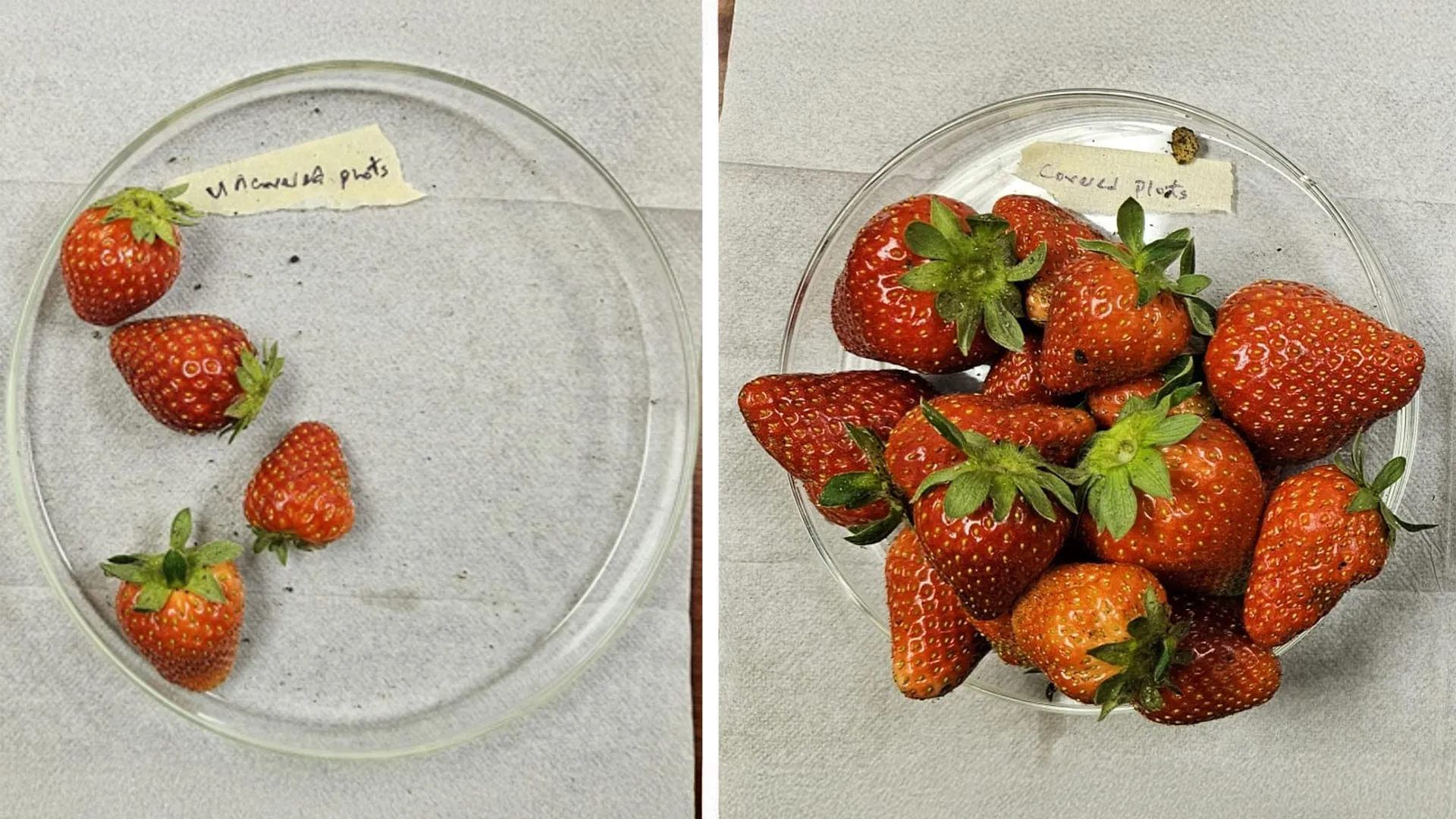
NC State researchers report a knitted fabric cover raised strawberry yields as much as 3.56 times over uncovered plants in tunnel trials. The lead author credits steady warming for earlier fruiting, and the pesticide savings the team describes are so far a projection.
The Scientist · Science desk
What happened
- The knitted, three-dimensional fabric is laid directly over the plants to keep insects off while letting sunlight, rain and air through.
- The cover did not reduce light or relative humidity, and the covered plants showed no harm to their health.
- Plant Armor grew out of military textile research on mosquito-resistant uniforms and more comfortable body armor.
- NC State patented the Gen 2 fabric used in the trials in February 2023 and has licensed it for commercial development.
Compiled by The ScientistSomething wrong?How this is made
Why it matters
- constraint A grower who already sprays or uses another cover gets no figure from these trials for what Plant Armor adds over current practice, because the only comparison was bare plants.
- contradiction The product is sold on insect protection, but its lead author explains the extra fruit through accumulated heat, so the gain could be smaller where warmth is not what limits fruiting.
- decision With the fabric already licensed, growers may be asked to buy it on the strength of one university's tunnel trials, before the pesticide and water savings have been measured.
"As much as 3.56 times" is the best result in the trials, and the comparison is with strawberry plants grown with no cover at all [2]. In that best case, covered plants gave 256% more fruit than bare ones [1]. The university's release does not give the average gain across the three growing seasons [5] or a price for the fabric.
The comparator matters more than the multiple. A cover changes at least two things at once. The knit keeps insects off the plants [1], and it also warmed them steadily through all three seasons [5]. Gabriel Olawuyi, a graduate research assistant at NC State and the paper's lead author [14], said that warmth brought the covered plants to fruiting sooner [5]. A bare plot differs on both counts. As described, the trial cannot split the extra fruit between insect exclusion and heat.
Olawuyi's own explanation leans on heat. "Plants require a certain amount of accumulated heat, calculated as 'growing degree-days,' to progress through developmental stages including fruiting. Our plant cover has proven to enhance these," he said [6].
The best moment in the study is a prediction the team got wrong. "We expected that Plant Armor's seemingly opaque fabric would lead to an increase in vegetative biomass at the expense of fruiting -- because reduced sunlight would trigger a 'shade-avoidance' response, making the plant divert energy toward stem and leaf growth rather than fruit production," Olawuyi said [4]. Then the measurements came in. "However, we found the fabric did not impede access to light at all, and fruit production increased significantly," he said [15].
The pesticide case comes from the design. Olawuyi said that because the fabric physically stops insects from feeding, it could reduce the conventional pesticides fields need [7]. The researchers say it may also cut water use [8]. The results the release reports are yield, light, humidity, plant health and warmth [2][3][5]. I think the light result is the firm finding. The 3.56 multiple is a best case against the weakest comparator available.
Co-author R. Michael Roe, William Neal Reynolds Distinguished Professor at NC State [16], said the work led to "a product which could triple the output of strawberry farms here in North Carolina" [10]. The trials behind that statement were run in tunnels [2]. The North Carolina Agricultural Foundation and the USDA's National Institute of Food and Agriculture funded the work [12], and the paper appears in the journal Agriculture [13].
What to watch
- Trials that set Plant Armor beside sprayed plots or conventional row covers, which would separate insect exclusion from the warming effect.
- Pest counts or pesticide application records from farms using the fabric, the first data that could test the pesticide-reduction claim.
- A price per acre for the licensed product and any results outside tunnels.