Motorboat playback cuts the share of young reef fish that escape a simulated strike by a third
A 78-day playback experiment on Great Barrier Reef spiny chromis separates the window that stunted growth from the one that broke escape responses, which is what makes vessel traffic a lever managers can pull.
The Scientist · Science desk
What happened
- The work comes from the University of Exeter, the University of Bristol and James Cook University, and is published in the journal Environmental Pollution.
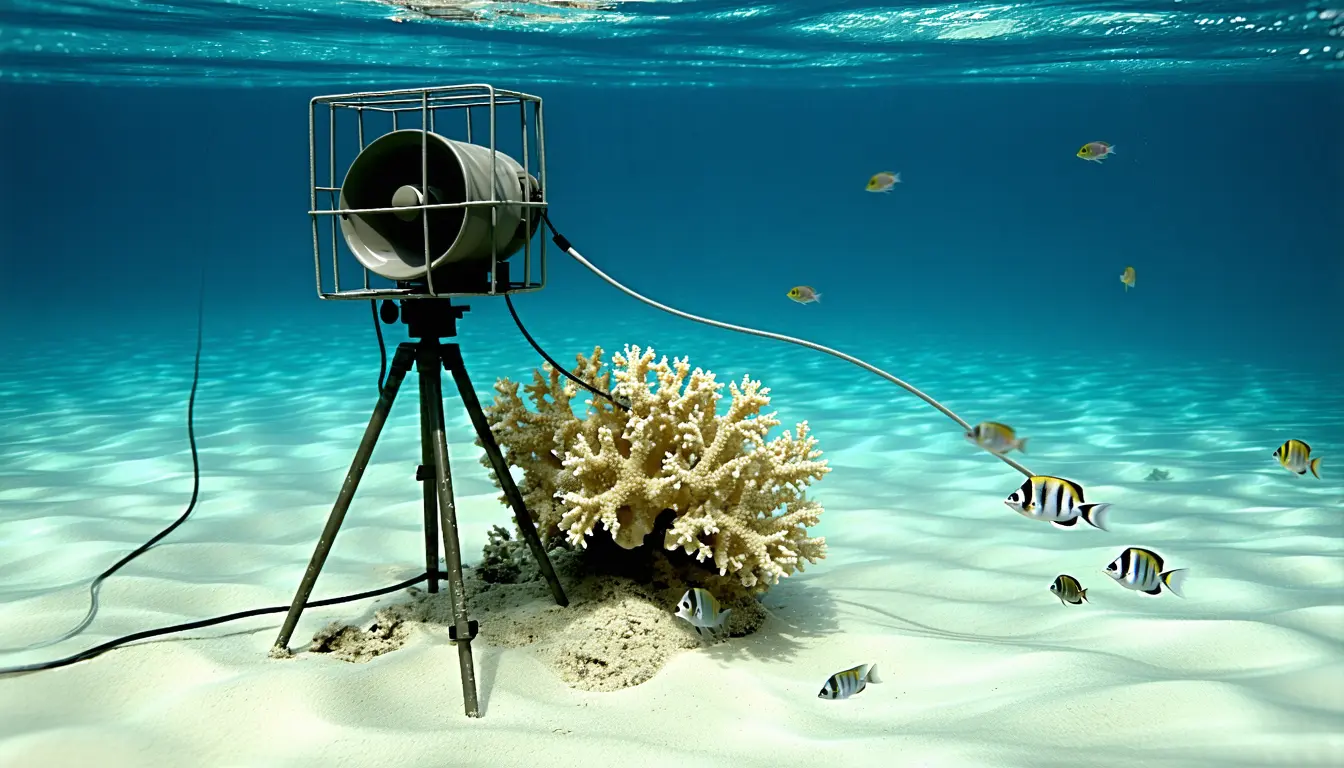
- Spiny chromis from the Great Barrier Reef were split into four tank groups hearing either motorboat noise or natural reef sound as embryos and again after hatching, in every combination.
- Fish that heard boat noise after hatching averaged 7% shorter than those that heard reef sound at the same stage.
- Among fish exposed to boat noise at both stages, 68% reacted at all to a weight dropped on the water, and 40% of those that reacted swam toward the simulated threat.
- Among fish that heard natural reef sound during at least one developmental stage, about 80% reacted, and about 20% of those turned the wrong way.
Why it matters
- capability Because the noise was assigned by experimenters rather than found in the field, reef managers are looking at a stressor whose dose can be lowered locally within a single breeding season, which is not true of warming.
- decision A closure timed only to the spawning weeks would leave the post-hatching weeks uncovered, and that is the exposure window the growth deficit tracked.
- constraint Without received levels or distances, the result supports the case for limits near reefs but cannot supply the decibel threshold or buffer width that an enforceable rule needs.
The two effects did not arrive through the same developmental window, and that is the part with management consequences. The 7% length deficit tracked exposure after hatching [5]. The escape failures were reported for the group that heard motorboats at both stages [9], and the comparison figure pools every fish that heard reef sound during at least one stage [8], so the summary does not separate the two single-exposure groups.
Multiply the two escape numbers to get the share of fish that both reacted and reacted away from the threat. For the reef-sound groups: about 80% responded, about 20% of those went the wrong way, leaving roughly 64% clean escapes. For fish raised under boat noise throughout: 68% responded, 40% of those went the wrong way, leaving about 41% [10]. The gap is around 23 percentage points, a bit more than a third fewer clean escapes [11]. The reported percentages are not two separate problems; they compound on the same animals.
Two design choices do real work. Exposure was assigned by the experimenters across four playback combinations for up to 78 days [3][4], so this is a manipulation rather than a correlation between busy anchorages and small fish. And nothing was played for 24 hours before or during the predator test [6], which rules out the simplest reading: that engine noise masks the cue at the moment of the strike. Whatever changed outlasted the speaker, which is why the paper is framed around carryover [17].
What the write-up does not tell you is how loud and how close. No received sound levels or vessel distances are given [14], and the group percentages arrive without sample sizes [13]. The threat itself was a weight dropped on the water surface, scored against the C-shape-then-burst reaction a spiny chromis normally makes [7]; no survival or mortality outcome is reported [15]. Body length is also a partial measure of size. If shape were unchanged, a fish 7% shorter would carry about 20% less volume [18], but the summary reports length, not mass.
On mechanism, Exeter's Sophie Nedelec offers candidates rather than conclusions. Earlier work found motorboat noise disturbs parental care, including the fanning that oxygenates eggs, which is linked to egg survival [19]. If embryonic exposure sensitises the fish, she suggests, they may react more strongly as juveniles, with stress or disrupted feeding accumulating into poor risk assessment and smaller bodies [20]. Her reading of the result is that early-life noise can disrupt escape behaviour even when the escape happens in quiet water [12], and that limiting motorboat traffic close to reefs during the breeding season may reduce the effect [21].
That recommendation is cheap and, on this evidence, defensible, with one condition attached: the study establishes a hazard from an assigned dose, not the distance at which a real outboard delivers it.
What to watch
- Field trials using real vessel passes with measured received levels at set distances from a spawning reef.
- Whether survival or recruitment, rather than escape kinematics in a tank, moves under the same exposure.
- Per-group sample sizes, and separate results for the two single-stage groups, in the full paper.
Clarity's read
What the record supports and how the coverage leans. The claims behind it follow.
Reality
- Evidence52
- Adoption
- Insufficient
- Hype gap+20
- Incentives45
- Confidence50
Claim ledger
Ranked by verification strength, evidence, and original report placement.
- [1]
Scientists played either motorboat noise or natural reef sounds to spiny chromis, a coral reef fish species from the Great Barrier Reef, both as embryos and soon after hatching.
- [2]
The study was carried out by the University of Exeter, the University of Bristol and James Cook University, and is published in the journal Environmental Pollution.
- [3]
The fish were divided into four groups and exposed to either motorboat noise or reef sound playback in tanks during the embryo and post-hatching stages, or one of each (boat noise as embryos then reef sound as juveniles, or the reverse).
- [4]
Sound exposure was carried out for up to 78 days.
- [5]
Fish exposed to boat noise after hatching were 7% shorter on average than those exposed to reef sounds.
- [6]
No sounds were played to the fish for 24 hours before the predator test or during the test itself, so the results reflect longer-term effects rather than a momentary distraction.
- [7]
Predator response was tested by dropping a weight onto the water's surface; a spiny chromis normally twists into a C shape and then bursts away from danger.
- [8]
In the groups of fish exposed to natural reef sounds for at least one stage of development, about 80% reacted to the simulated predator, and about 20% of those made the mistake of swimming toward it.
- [9]
Among fish exposed to motorboat noise as both embryos and juveniles, only 68% responded to the simulated predator, and 40% of those swam toward it.
- [10]
Combining response rate with direction, about 64% of fish in the reef-sound groups both reacted and moved away from the threat, against about 41% of fish exposed to boat noise at both stages.
- [11]
The clean-escape gap is about 23 percentage points, equivalent to roughly 36% fewer clean escapes in the continuously boat-noise group.
- [12]
Nedelec said the results show exposure to motorboat noise during early development can affect growth and disrupt the escape response of juveniles, even when the escape occurs in relatively quiet conditions.
- [13]
The published summary reports the predator-response percentages without stating how many fish were in each group.
- [14]
The summary reports no received sound levels for the playback and no distances from vessels to which those levels would correspond.
- [15]
The summary reports growth and escape-response outcomes only; no survival or mortality outcome is given.
- [16]
The comparison figure of about 80% responding is reported for the groups exposed to natural reef sound for at least one stage of development, pooling more than one treatment group.
- [17]
The paper is L. Velasquez Jimenez et al, 'Motorboat noise playback during development limits reef fish growth and impairs predator responses with carryover effects', Environmental Pollution (2026), DOI 10.1016/j.envpol.2026.128975.
- [18]
Holding body shape constant, a fish 7% shorter would have about 20% less volume.
- [19]
Dr Sophie Nedelec of Exeter said previous research shows motorboat noise affects parental care behaviour, including oxygenating eggs by fanning during the embryonic phase, which is linked with egg survival.
- [20]
Nedelec said that if exposure as embryos sensitises the fish to noise they may respond more strongly as juveniles, and that noise could cause stress or affect feeding, creating cumulative effects leading to poor assessment of risk and decision-making and smaller body size.
- [21]
Nedelec said limiting motorboat traffic close to reefs during the breeding season may reduce these effects and protect reef fish, helping preserve coral reefs.
Get this ledger inside ChatGPT. Ask about any of our stories and the answer brings its figure, each claim’s verdict and the sources. Free, no account.
Sources
1 independent publisher whose own reporting we read for this story.
- phys.orgMotorboat noise stunts growth and impairs predator escape in reef fish, study shows
1 article · August 28, 2026
Topics and entities
Follow any of these and your For You feed starts watching them — no settings page required.
Topics
Entities
- Spiny chromisFollow
- University of ExeterFollow
- University of BristolFollow
- James Cook UniversityFollow
- Sophie NedelecFollow
- L. Velasquez JimenezFollow
- Environmental PollutionFollow
- Great Barrier ReefFollow