Science2 publishersIndependently confirmed2 min readPublished Updated
Modeling the tortoises surveyors missed puts Aldabra's population near 180,000
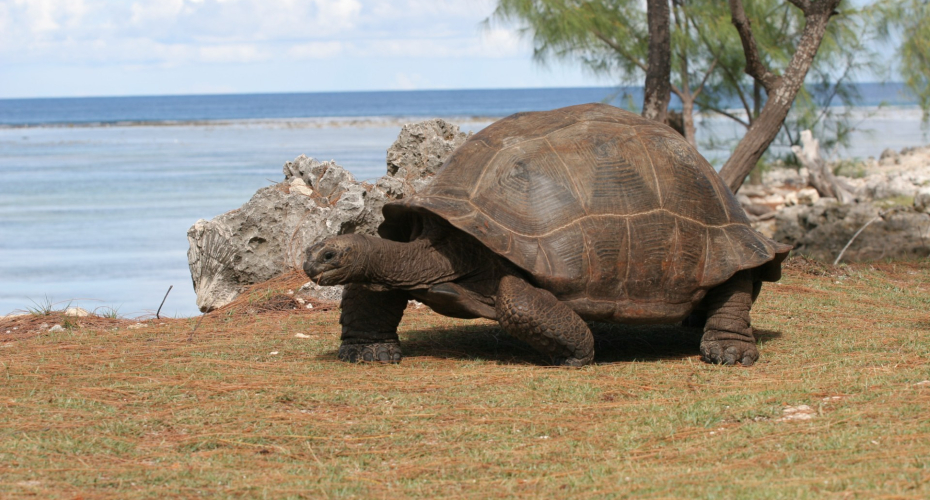
Seychelles Islands Foundation and University of Exeter researchers put Aldabra's giant tortoises at about 180,000 in the first rigorous atoll-wide count. Older surveys missed tortoises hidden in scrub, the authors say, so part of the rise from the 1990s figure of 100,000 comes from the change of method.
The Scientist · Science desk
What happened
- The estimate draws on five years of tortoise counts that Seychelles Islands Foundation staff collected on the atoll between 2018 and 2022.
- The best estimate is almost 183,000 adult and subadult tortoises, and the population was relatively stable across those five years.
- Heavy exploitation in the 19th century had cut Aldabra's tortoises to fewer than 1,000 animals.
- Feral goats, which had devastated the atoll's vegetation, were eradicated in 2012.
- The authors expect longer, more frequent droughts to cut tortoises' shade and food, while rising seas threaten low-lying parts of the atoll.
Compiled by The ScientistSomething wrong?How this is made
Why it matters
- constraint Future trend claims for Aldabra's tortoises have to be measured against this model-corrected figure. Comparing them with the 1990s number mixes a change of method with a change in the animals.
- constraint A headcount of adults and subadults cannot show directly whether eggs and hatchlings survive. Those are the stages feral cats and black rats still prey on.
- decision The authors name eradicating the remaining cats and rats as the step that could remove the last barriers to growth and help the population withstand future climate pressures.
The new best estimate is about 1.83 times the widely cited figure of 100,000 from the late 1990s [19][3]. The authors ask readers not to treat that as an 83 percent rise. Earlier surveys did not account for tortoises that were present but unseen in dense scrub or shade, and the researchers caution that the new figure does not mean the population has nearly doubled since 1999 [7]. In their view the older figures were probably underestimates, and the population has still genuinely grown [9]. The published account does not say how much of the gap comes from each cause.
The two numbers come from different ways of counting. The team used Bayesian hierarchical distance sampling, which corrects for animals the surveyors missed and for visibility that differs from one habitat to another [8]. "Aldabra's giant tortoise monitoring program is one of the longest-running in the region, but the atoll's dense vegetation makes counting tortoises genuinely difficult in places," said Nancy Bunbury, a co-author [13]. Tortoises were densest on the grassland known as "tortoise turf," then on open exposed surfaces and open mixed scrub [10]. They were hardest to detect in dense scrub, mangrove and Pemphis, where the modeling helps correct for reduced visibility [10].
I think the design suits the question. A tally of only the animals seen would come out lowest in exactly the habitats where tortoises are hardest to see, and those are the habitats the correction targets [8][10]. "By modeling what we didn't see, as well as what we did, we've produced the most reliable baseline yet for this iconic Seychelles species, establishing a benchmark we can use to track the population for decades to come," Bunbury said [14]. The figure is strong as a baseline. The stability finding behind it covers only the survey period [4].
The recovery shows up over the longer record. Against the 19th-century low, today's estimate is more than 180 times larger [20][1]. Aldabra became a strict nature reserve in 1981 and a UNESCO site in 1982, and the study's account credits that protection with aiding the recovery [6]. The new survey shows where the population stands now. The case that protection drove the recovery rests on that longer history [6].
Frauke Fleischer-Dogley, chief executive of the Seychelles Islands Foundation, gave the credit to the field staff. "The monitoring data in this study were collected by SIF staff living and working on the atoll, year after year," she said [15]. Aldabra is one of only two places where giant tortoises live in the wild. The other population, in the Galapagos, is much smaller [18].
What to watch
- A repeat atoll-wide survey using the same Bayesian distance-sampling method, which would give the first like-for-like trend against this baseline.
- Progress on the planned eradication of feral cats and black rats, and any measured change in hatchling survival afterwards.
- Drought frequency on Aldabra and whether the shade and forage on tortoise turf hold up.
Clarity's read
What the record supports and how the coverage leans. The claims behind it follow.
Reality
- Evidence65
- Adoption
- Insufficient
- Hype gap+15
- Incentives35
- Confidence62
Claim ledger
Ranked by verification strength, evidence, and original report placement.
- [1]
The Aldabra giant tortoise population on Aldabra Atoll stands at approximately 180,000 individuals, the highest figure ever recorded for the species, following a survey led by the Seychelles Islands Foundation (SIF) and the University of Exeter.
- [2]
The team analyzed five years of tortoise counts collected by SIF research staff between 2018 and 2022.
- [3]
The study is the first rigorous, atoll-wide estimate of the population and the first update since the widely cited figure of 100,000 tortoises from the late 1990s; it was published in Ecology and Evolution.
- [4]
The population was relatively stable during the study period, with a best estimate of almost 183,000 adult and subadult tortoises.
- [5]
Heavy exploitation in the 19th century reduced Aldabra's tortoises to fewer than 1,000 individuals.
- [6]
The tortoises' recovery was aided by protection since Aldabra became a strict nature reserve in 1981 and a UNESCO site in 1982.
- [7]
The researchers caution that the new headline figure does not mean the population has nearly doubled since 1999; earlier surveys did not account for tortoises that were present but not seen, hidden in dense scrub or shade.
- [8]
The study used Bayesian hierarchical distance sampling, which corrects for missed animals and for differences in visibility across Aldabra's habitats.
- [9]
Because earlier methods likely missed tortoises, the study suggests previous figures were probably underestimates, while still pointing to a population that has genuinely grown and now appears healthy and stable.
- [10]
Tortoises occur at the highest densities in Aldabra's grasslands, or 'tortoise turf,' followed by open exposed surfaces and open mixed scrub; they were harder to detect in dense scrub, mangrove and Pemphis habitats, where the new modeling helps correct for reduced visibility.
- [11]
Aldabra's climate is changing, with longer and more frequent droughts predicted to reduce the shade and food available to tortoises, while rising sea levels threaten low-lying parts of the atoll.
- [12]
Feral goats, which devastated the atoll's vegetation, were successfully eradicated in 2012.
- [13]
"Aldabra's giant tortoise monitoring program is one of the longest-running in the region, but the atoll's dense vegetation makes counting tortoises genuinely difficult in places."
ReportedSupportedSource: Dr. Nancy Bunbury, study co-author2 sources— create a free account to open themView cited source - [14]
"By modeling what we didn't see, as well as what we did, we've produced the most reliable baseline yet for this iconic Seychelles species, establishing a benchmark we can use to track the population for decades to come."
ReportedSupportedSource: Dr. Nancy Bunbury, study co-author2 sources— create a free account to open themView cited source - [15]
"The monitoring data in this study were collected by SIF staff living and working on the atoll, year after year."
ReportedSupportedSource: Dr. Frauke Fleischer-Dogley, CEO of SIF2 sources— create a free account to open themView cited source - [16]
Feral cats and black rats still prey on tortoise eggs and hatchlings on Aldabra.
- [17]
The planned eradication of the remaining invasive mammals could lift the last barriers to further growth of the population and help it withstand future climate pressures, the authors say.
ReportedSupportedSource: study authors2 sources— create a free account to open themView cited source - [18]
Aldabra Atoll is one of only two places in the world where giant tortoises can be found in the wild, with a much smaller population resident in the Galapagos.
- [19]
The best estimate of almost 183,000 is about 1.83 times the late-1990s figure of 100,000, which a naive reading would treat as an 83 percent rise.
- [20]
About 180,000 tortoises today against fewer than 1,000 at the 19th-century low is more than a 180-fold increase.
Sources
2 independent publishers whose own reporting we read for this story.
- dexerto.comResearchers find 180,000 giant tortoises living on island
1 article · October 8, 2026
- phys.orgGiant tortoises outnumber people in Seychelles, with nearly 183,000 on Aldabra
1 article · October 7, 2026
Topics and entities
Follow any of these and your For You feed starts watching them — no settings page required.
Topics
Entities
- Aldabra giant tortoiseFollow
- Frauke Fleischer-DogleyFollow
- Aldabra AtollFollow
- University of ExeterFollow
- Ecology and EvolutionFollow
- Seychelles Islands FoundationFollow
- Nancy BunburyFollow
- Dave HudsonFollow