ScienceNot yet confirmed elsewhere1 publisher3 min readPublished
Singapore lutetium clock measures the second about four times more accurately than any before it
National University of Singapore physicists report in Nature a lutetium clock that measures a second about four times more accurately than any before it. It still fills a laboratory, so field uses such as monitoring magma underground wait on a transportable version.
The Scientist · Science desk
What happened
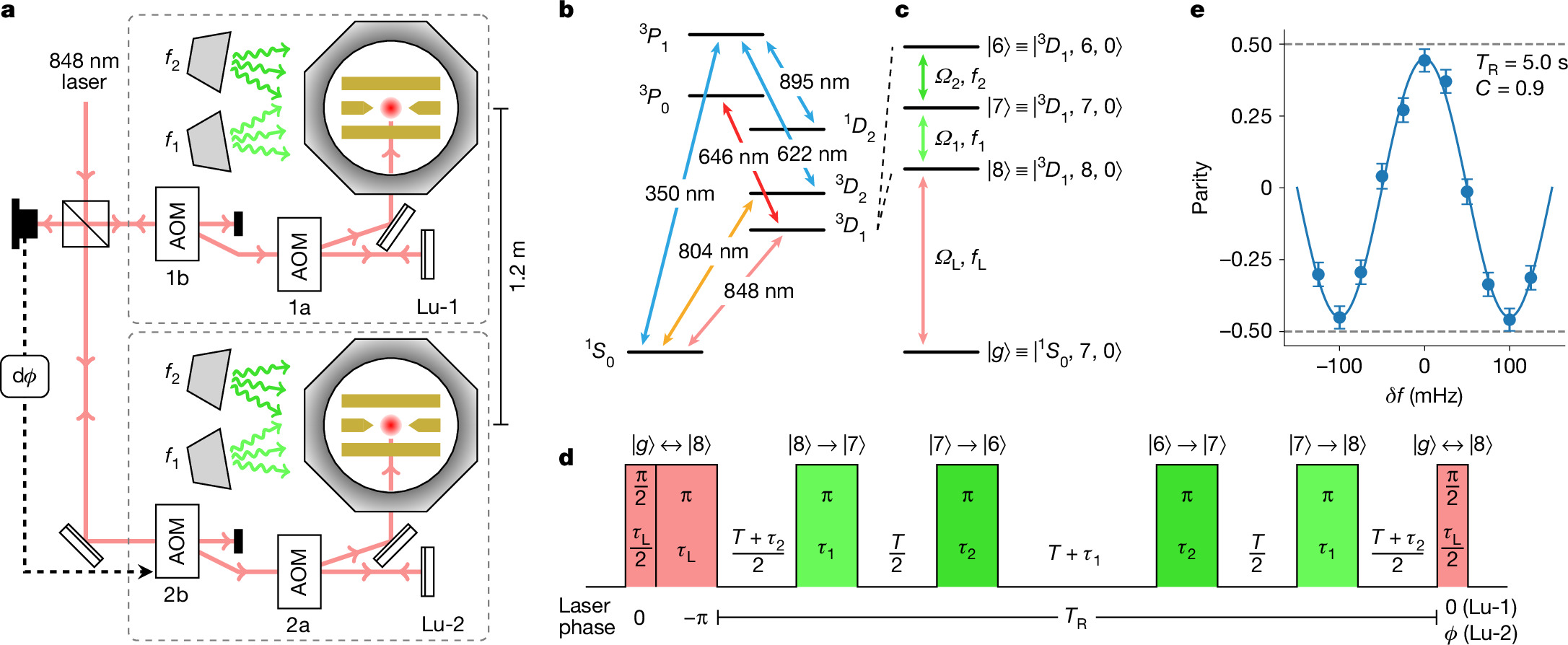
- To test the result, the team built a second lutetium clock and compared the pair, correcting for general relativity because the two sat in slightly different places.
- Across 200 hours of measurements spread over 12 days, the difference between the two clocks was effectively zero.
- The group has worked on lutetium for a decade and is so far the only team to realize the element's timekeeping potential, according to ScienceAlert.
Why it matters
- constraint Because both clocks share one design, their agreement shows the design reproduces, but a bias common to both would cancel out and stay hidden until a different kind of clock is compared.
- constraint With only one group able to build lutetium clocks so far, the fourfold figure waits on independent replication before other labs can rely on it.
- capability Room-temperature operation on off-the-shelf lasers gives the team a plausible route to a transportable clock for field jobs such as monitoring magma underground.
The headline figure is an uncertainty of under a ten-billion-billionth of a second on each second the clock measures [2]. ScienceAlert restates it as a clock that would be out by less than a second after 300 billion years of running, a span it puts at roughly ten billion-billion seconds [3]. The conversion checks out. At about 31.6 million seconds a year, 300 billion years comes to about 9.5 billion-billion seconds [18]. "I am confident that what we have now is the most accurate clock in the world," physicist Murray Barrett said [4]. He went further: "In the future, I just don't see how this clock can be beat." [5]
That confidence rests on a comparison. The team built a second lutetium clock, corrected for general relativity because the two did not sit in exactly the same place, and measured one against the other [8]. "It basically tells you that the only way to test the accuracy of a standard is to compare clocks and demonstrate reproducibility," physicist Kyle Arnold said [10]. The 200 hours of measurement fell inside a 12-day window, about 69 percent of the 288 hours available [9] [17].
The thing this doesn't tell you is whether both clocks share an error. Two units of one design, built by one group, would carry a common offset into both, and it would cancel when one reading is subtracted from the other [19]. I think the near-zero difference is solid evidence that the design reproduces, and that the fourfold accuracy claim will be on firmer ground once a clock of another kind sits on the other side of the comparison. The account does not say whether either clock was checked against one built on a different element, or whether lutetium is being weighed for any future definition of the second. The group has worked on lutetium for a decade and, according to ScienceAlert, is so far the only team to realize its timekeeping potential [12].
Cesium has been the traditional reference element for atomic clocks, and newer clocks built on elements such as strontium oscillate faster, packing more ticks into each second [11]. Lutetium's advantage is its insensitivity: its atomic structure is well shielded from heat, magnetism and motion, all of which disturb the electron transitions a clock counts [6]. "The lutetium clock would be stable even if you went from the hottest place recorded on Earth in Death Valley to the coldest place in the Antarctic plateau," Barrett said [7].
An accuracy record does not measure the first obstacle to field use. The clock currently takes up an entire lab, and the team wants it small enough to move, so it can be tested in more locations and put to work on jobs such as monitoring magma underground [14]. Clocks this precise also feed physics such as measuring how gravity changes across Earth [16]. Lutetium helps with the shrinking: the clock works at room temperature on off-the-shelf lasers, with no bulky cooling system [13]. "The next step is to take the lab-scale clock and miniaturize it into a transportable system," physicist Michael Lee said [15].
What to watch
- A comparison of the lutetium clock against an optical clock built on a different element, such as strontium, which would expose any error the two lutetium units share.
- A second research group building its own lutetium clock and reproducing the uncertainty figure.
- The transportable version Michael Lee describes, and whether it holds its accuracy once it leaves the lab.
Clarity's read
What the record supports and how the coverage leans. The claims behind it follow.
Reality
- Evidence45
- Adoption4
- Hype gap+25
- Incentives
- Insufficient
- Confidence50
Claim ledger
Ranked by verification strength, evidence, and original report placement.
- [1]
Researchers from the National University of Singapore built an atomic clock based on lutetium and published the work in Nature.
- [2]
The lutetium clock measures a second with an uncertainty level of under a ten-billion-billionth of a second, around four times better than anything previously recorded.
- [3]
The clock should be out by less than a second if left running for 300 billion years, which is roughly ten billion-billion seconds.
- [4]
"I am confident that what we have now is the most accurate clock in the world," said physicist Murray Barrett.
- [5]
"In the future, I just don't see how this clock can be beat," said Murray Barrett.
- [6]
Lutetium's atomic structure makes it well protected against heat, magnetism and motion, which would disturb the electron energy-state shifts a clock relies on.
- [7]
"The lutetium clock would be stable even if you went from the hottest place recorded on Earth in Death Valley to the coldest place in the Antarctic plateau," said Murray Barrett.
- [8]
To verify the clock's accuracy, the researchers built a second lutetium clock and compared the two, adjusting for general relativity because the clocks were not in exactly the same place.
- [9]
Across 200 hours of measurements, taking 12 days in total, the differences between the two clocks were so small they were effectively zero.
- [10]
"It basically tells you that the only way to test the accuracy of a standard is to compare clocks and demonstrate reproducibility," said physicist Kyle Arnold.
- [11]
Atomic clocks have traditionally used cesium as their reference element; other elements including strontium have been tested, and these oscillate faster than cesium, meaning more ticks per second.
- [12]
The researchers have been exploring lutetium for a decade and are so far the only team to realize its time-keeping potential.
- [13]
The lutetium clock uses off-the-shelf lasers that do not take up much space and works at room temperature without bulky cooling systems.
- [14]
The clock currently takes up an entire lab; the team wants to reduce its size so it can be moved, tested for accuracy in more locations, and used for practical applications such as underground magma monitoring.
- [15]
"The next step is to take the lab-scale clock and miniaturize it into a transportable system," said physicist Michael Lee.
- [16]
Super-precise atomic clocks are used for fundamental physics investigations such as measuring how gravity changes across Earth.
- [17]
The 200 hours of measurement covered about 69 percent of the 288 hours in the 12-day comparison window.
- [18]
300 billion years is about 9.5 billion-billion seconds, consistent with the roughly ten billion-billion seconds the report cites.
- [19]
A comparison between two clocks of the same design cannot reveal an offset both share, because a common error cancels in their difference.
Sources
1 independent publisher whose own reporting we read for this story.
- sciencealert.com'The Most Accurate Clock in The World': Atomic Clock Just Set a New World Record
1 article · October 8, 2026
Topics and entities
Follow any of these and your For You feed starts watching them — no settings page required.
Topics
- MetrologyFollow
- Atomic clocksFollow